

This is 63: Laura Dickerman Responds to The Oldster Magazine Questionnaire
"I suppose it’s too late to be my generation’s slayer? I am looking forward to my caftan era."

From the time I was 10, I’ve been obsessed with what it means to grow older. I’m curious about what it means to others, of all ages, and so I invite them to take “The Oldster Magazine Questionnaire.”
Sometimes you’ll find responses from writers, musicians, and artists you’ve heard of—like Ellen Burstyn, Kate Pierson, Neko Case, Rosie O’Donnell, Ava Duvernay, Jerry Saltz, Lucy Sante, magazine legend Tom Junod, Ricki Lake, Hilma Wolitzer, Elizabeth Gilbert, Judith Viorst, Cheryl Strayed, Deesha Philyaw, Chloe Caldwell, etc.—but more often it will be people (of all ages) you haven’t heard of, Humans of New York-style. (Check out all the Oldster interviews…)
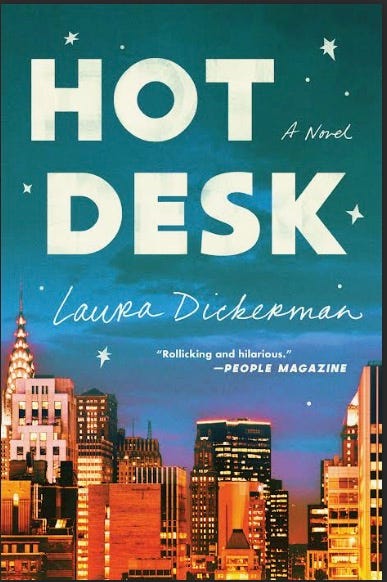
Here, Laura Dickerman, debut author of the novel Hot Desk, responds. -Sari Botton
PS If you’re enjoying the work I do here at Oldster, please consider supporting it by becoming a paid subscriber. 🙏
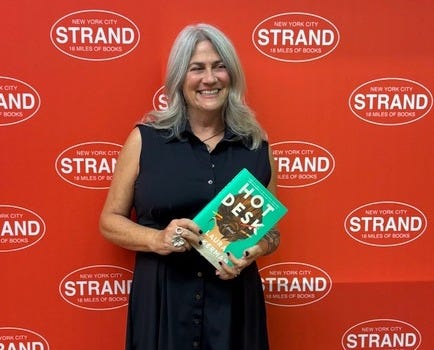
Laura Dickerman has been a high-school English teacher, a book club leader, a tutor, and the recipient of an NEH grant. She is bossy in two book clubs, opinionated about even things she knows very little about, believes you can put down a bad book, and passionately supports re-reading Middlemarch every five years. She lives in Atlanta with her husband. They have two grown daughters. Her debut novel, Hot Desk, was published by Gallery, an imprint of Simon & Schuster, on Sept 2, 2025. The paperback, released yesterday, August 4, 2026, will look delightful in a beach bag. Find her on Instagram, and her reviews on Book Clique.
—
How old are you?
63.
Is there another age you associate with yourself in your mind? If so, what is it? And why, do you think?
I’m really bad at math. I often forget what year we’re in and how old I am. If I’m ever being treated for a concussion or tested for dementia, there is zero chance I will be able to count backwards by seven. My baseline, I’m announcing now, is that I could never do that even with my wits about me.
So I don’t think about age in numbers, but in stages. That said, 63 is the new 37. 37 not so much for what was happening in my life but because 37 just sounds how I see myself: old enough to be confident and young enough to be (relatively) healthy, at a stage where I have experience behind me and potential ahead of me.
There is a strong through line from when I was a girl to now. I think I’ve only gotten “more so” as I’ve gotten older. I always had a clear sense of myself as a writer, a reader, a friend, a teacher, a sexual and romantic partner, a mother. Getting married at 37, having children at 39 and 41, and becoming a published author in my 60s might seem late—I mean, in the 1980s, everyone thought that a single woman at 40 was more likely to get struck by lightning than to get married—but the older I get, the more experience I have, the more fully myself I am.
Do you feel old for your age? Young for your age? Just right? Are you in step with your peers?
One thing I try not to do is to compare myself to others. I say “try” because of course that is impossible—there are ancient ladies in yoga classes contorting themselves into pretzels and women older than I am publishing critically-acclaimed best sellers. But unless I stumble upon a recent photo of Helen Mirren or Jane Fonda or attempt that diabolical challenge of lowering myself to the floor and heaving myself back up without support (WHAT? LOL. NO.), I usually feel young for my age.
What do you like about being your age?
I feel very powerful—I am reclaiming “crone” as a symbol of post-menopausal strength—chin hairs and all. Women all around me give less of a fuck about what others (mostly men) think of them, and more about how to be a good friend. Among the best of us, there is uproarious laughter, unconditional support, shared outrage at encroaching fascism, and unfettered expression.
What is difficult about being your age?
Getting serious about doing the things I know I’m supposed to do for my health. I know I should cultivate a meditation practice; I should balance on one foot while brushing my teeth; I should go to bed earlier and eat less dessert; I should keep up with Duolingo so that owl won’t keep popping up on my phone to say, “What’s Spanish for quitter?”
Also, as much as my age is the “friends’ kids’ weddings” stage, it’s also the “friends’ cancers coming back” stage and the “parents’ last chapter” stage. I have always been keenly aware that grief is an unavoidable part of life. I know how suddenly tragedy strikes. I had to make a conscious decision to balance these two opposing realities: inevitable loss heightens your experience of happiness; at the same time, imagining that loss impedes joy.
I remember we were in our old fifth-floor walkup rental on the Upper West Side, and my husband was holding our three-month old, Lucy. My heart was exploding with happiness: I was 39 and had recently married the exact right person for me; after six miscarriages, I had a healthy baby. But I caught myself thinking that everything could turn in an instant. At that moment, I decided to be present and not dwell on loss yet to come. I’ve done a decent job over the years of not worrying (too much) about things that haven’t happened yet.
What’s difficult about being my age is that the reality of mortality is revealed closer, closer, and more often. Learning to be in the moment more fully does not mean that I’m not, at this very moment, anxious about what my answers to this questionnaire might look like in one or five or ten years from now and knocking on wood three times like someone’s Nonna throwing salt over her shoulder.
What is surprising about being your age, or different from what you expected, based on what you were told?
Women are conditioned to fear menopause and post-menopause. We are told through countless cultural, social, and institutional examples that old women are invisible or expected to “age gracefully” to be relevant. First of all, I love not bleeding. I love not worrying about birth control. I love having sex when and where we want to in our “empty nest.” I love taking up space. I love my 40-year-old friends and my 70-year-old friends. I love never, ever sparing even a glimmer of a thought on shapewear.
One thing I try not to do is to compare myself to others. I say “try” because of course that is impossible—there are ancient ladies in yoga classes contorting themselves into pretzels and women older than I am publishing critically-acclaimed best sellers. But unless I stumble upon a recent photo of Helen Mirren or Jane Fonda or attempt that diabolical challenge of lowering myself to the floor and heaving myself back up without support (WHAT? LOL. NO.), I usually feel young for my age.
What has aging given you? Taken away from you?
Aging has taught me that my power comes from confidence and my confidence comes from friends and family. Aging has taken away the need to seduce or impress or be measured by other people’s opinions of my body, my ideas, my behavior. Aging has (mostly) given me freedom from the (mostly) rewarding task of raising children. Aging has given me a profound sense of the importance of spending time with the people I love and the knowledge that that time is not infinite. Aging has taken away my ability to get low on the dance floor.
How has getting older affected your sense of yourself, or your identity?
There is a strong through line from when I was a girl to now. I think I’ve only gotten “more so” as I’ve gotten older. I always had a clear sense of myself as a writer, a reader, a friend, a teacher, a sexual and romantic partner, a mother. Getting married at 37, having children at 39 and 41, and becoming a published author in my 60s might seem late—I mean, in the 1980s, everyone thought that a single woman at 40 was more likely to get struck by lightning than to get married—but the older I get, the more experience I have, the more fully myself I am. The ways that I made myself smaller fall by the wayside.
What are some age-related milestones you are looking forward to? Or ones you “missed,” and might try to reach later, off-schedule, according to our culture and its expectations?
I suppose it’s too late to be my generation’s slayer? I am looking forward to my caftan era.
I feel very powerful—I am reclaiming “crone” as a symbol of post-menopausal strength—chin hairs and all. Women all around me give less of a fuck about what others (mostly men) think of them, and more about how to be a good friend. Among the best of us, there is uproarious laughter, unconditional support, shared outrage at encroaching fascism, and unfettered expression.
What has been your favorite age so far, and why? Would you go back to this age if you could?
There are three stages of my life that have been my favorite (remember, bad at math):
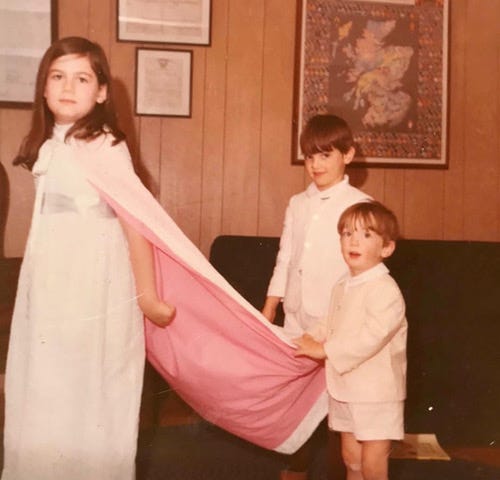
One: 9-ish when I was bossy and undaunted, putting on plays (always directing and starring, obviously) with the neighborhood kids and my long-suffering brothers; voraciously reading all the books about plucky English orphans, and building fairy houses out of birch bark and moss in the Vermont woods, before I was self-conscious about my soft belly and developing breasts and strong opinions, before I was quieted down by being a girl in the 1970s.
Two: Mid-to-late-20s when I was at graduate school in the summers at the Bread Loaf School of English, and my brain was at its absolute finest. Analytical essays flowed out of me; I read theory and underlined Chekhov and Morrison and Dante and Kushner while curled in an Adirondack chair; I danced in the cavernous barn with Melissa, Blair, and Jane, and we were known as the “barefoot maidens”; I lay on the warm asphalt of Route 125 at midnight as meteor showers dazzled the sky. Everything was a poem.
Three: All of my 60s so far—three years of the unexpected and amazing: writing and selling my debut novel, launching it into the world at the Strand in NYC, traveling to indie bookstores and meeting so many lovely bookish people. I’m grateful and lucky to have this experience, and I’m still milking it for all it’s worth: Come to your book club? Yes, please! Submit to book festivals: don’t mind if I do! Promote relentlessly on IG? Absofuckinlutely!
If my publishing a first book in my 60s impresses upon a few young women that life can be rewarding and surprising when you’re a crone, and if it inspires a few crones that it’s never too late to realize a dream, well, that is more than enough to make now my favorite age.
Is there someone who is older than you, who makes growing older inspiring to you? Who is your aging idol and why?
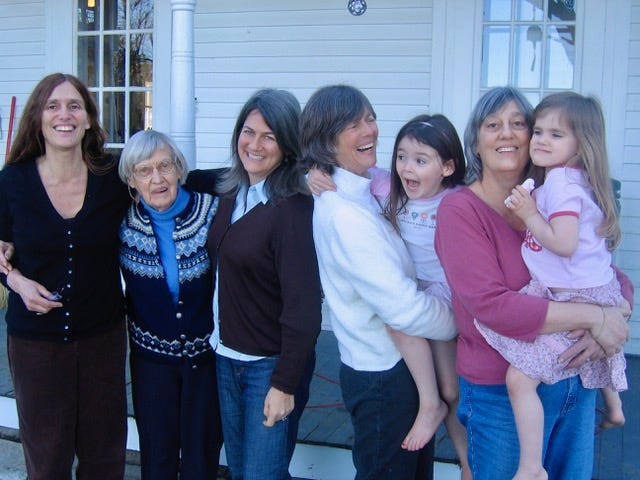
I am lucky that both of my grandmothers, my mother, and all my aunts were and are naturally beautiful—they never had “work done,” and most of them went gray (or silver, as I prefer to say). I remember my grandmother at a fancy dress store saying, “Let’s get out of here! This place is for old ladies!” She was in her 80s. She outlived two husbands, ate chocolate ice cream every night, and died at 97.
My other grandmother loved a stiff drink, a dirty joke, garlicky escargot, a leopard print, and sneaking a cigarette. My own lovely mother at 85 still knits sweaters, shovels snow, and bakes blueberry coffee cake. Aunt Susie had gorgeous hippie hair down to her waist for most of her life. Aunt Marty is my aging idol: not just because she travels and tells hilarious stories and writes letters, but because she is the best listener: always asking questions, seemingly fascinated by the answers, truly engaged in the world, and deeply connected to other people.
If my publishing a first book in my 60s impresses upon a few young women that life can be rewarding and surprising when you’re a crone, and if it inspires a few crones that it’s never too late to realize a dream, well, that is more than enough to make now my favorite age.
What aging-related adjustments have you recently made, style-wise, beauty-wise, health-wise?
Scrutinizing myself on Zoom has given me an intimate understanding of why Nora Ephron felt bad about her neck. I haven’t gone so far as to cover up with a jaunty silk scarf like a Parisienne madame, but I did fall prey to targeted IG advertising and spent a small fortune on special neck cream. It has its own fancy little application shovel!
What’s an aging-related adjustment you refuse to make, and why?
I started going gray (silver?!) in college and have never dyed my hair. I hate needles, and my skin is sensitive, and now that you know about the women I come from, you understand that I’ll never undergo cosmetic procedures. But if someone invented a pill with no side effects that eliminated my wattle, I would sign up for that tomorrow. I also refuse to have short hair: I will go to my grave looking like a witchy Vermont ceramicist.
What turn of events had the biggest impact on your life? What took your life in a different direction, for better or worse?
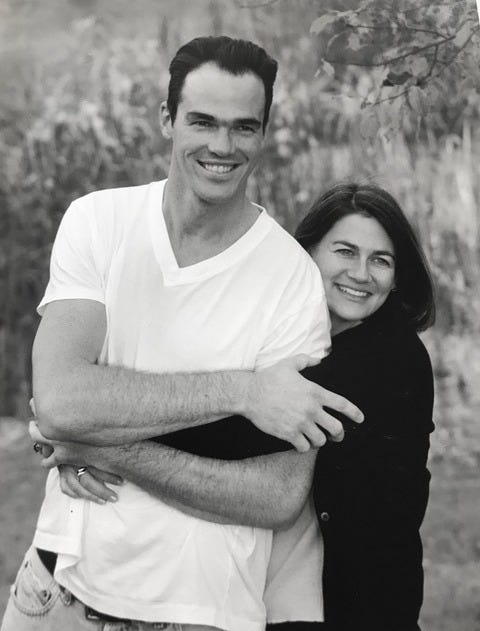
I was 35 when I met my husband, Bill. I had a pretty romantic idea of what I wanted in a partner and no interest in settling. My life in NYC was exciting and full—teaching high-school English, dancing in dive bars, volunteering, “dating” (see below for regrets re: waiters…), throwing parties, tutoring. I even had a plan in motion for becoming a single mother.
When I walked into The Otheroom bar on Perry Street in the West Village on May 16, 1998, it was love at first sight for me. It took my best friend, Jen, to cajole us together (I was uncharacteristically shy), and it took our first date two weeks later at the now-defunct Grange Hall for him to fall in love back, but after that, it was never of question of if it was going to work out, only how.
Bill saw everything about me that was “a lot” and said, “more.” Having a passionate love in my life, having my daughters, and having Bill’s support and encouragement helped me to continue building a beautiful life on an already strong foundation. The other day I started telling him a story, and he said, “Oh, you already told me that.” I was chagrined, but then he said, “I forget what happens, so tell me again!” And in that way, I hope we will grow happily old together.
I started going gray (silver?!) in college and have never dyed my hair. I hate needles, and my skin is sensitive, and now that you know about the women I come from, you understand that I’ll never undergo cosmetic procedures. But if someone invented a pill with no side effects that eliminated my wattle, I would sign up for that tomorrow. I also refuse to have short hair: I will go to my grave looking like a witchy Vermont ceramicist.
What is your number one regret in life? If you could do it all over again, what is the biggest thing you’d do differently?
Regret is helpful only in that I am motivated to do better. That said, if I could do it all over again, I would always choose kindness, especially when I was younger and more concerned with being cool. And instead of flirting with waiters, I would strike up conversations with the women eating alone and reading a book. Better yet, I would be a woman eating alone and reading a book.
What is high up on your “bucket list?” What do you hope to achieve, attain, or plain enjoy before you die?
If I had done this questionnaire three years ago, I would have said “publish a book.” It gives me great joy to have done that, especially in my 60s. I hope to write and publish another novel or two; I hope to enjoy good health; I hope to get another tattoo; I hope that I am always curious about what “kids today” are up to; I hope to live in NYC again and host weekly dinners and monthly book clubs; I hope to stick around long enough to see the arc of the moral universe bend a little more quickly toward justice for all; and I hope that Bill and I never stop patronizing the bar at great restaurants, getting to know the bartender, having a glass of champagne, and splitting the fries.
Is there a piece of advice you were given, that you live by? If so, what was it, and who offered it to you?
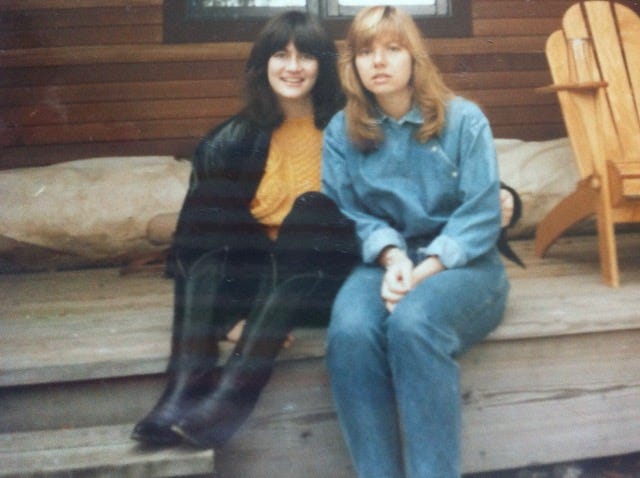
In the early 1980s, I really wanted a pair of green cowboy boots, but that felt like a pretty radical sartorial choice for me. I don’t know how I got the idea that cowboy boots, let alone green ones, were my future, but I could think of nothing else. I was caressing them covetously, nervously, and I remember saying to the man holding the empty shoe box, “I just don’t think I’m the kind of person who wears cowboy boots.” He told me to pull them on, and I did. He looked at me and said, “There. Now you’re the kind of person who wears cowboy boots.” Is this even advice? Is it advice that I actually live by? I don’t know. But I think about that moment a lot. And I wore those boots for years.
Regret is helpful only in that I am motivated to do better. That said, if I could do it all over again, I would always choose kindness, especially when I was younger and more concerned with being cool. And instead of flirting with waiters, I would strike up conversations with the women eating alone and reading a book. Better yet, I would be a woman eating alone and reading a book.
What are your plans for your body when you’re done using it? Burial? Cremation? Body Farm? Other?
Wrap me in fine linens, lay me down on a Cleopatra-like barge, scatter lilacs and anemones around me, use a few of those Game of Thrones torches to light me on fire, and launch me to the middle of a primeval, mysteriously deep mountain lake. Let there be keening and wailing and gnashing of teeth and perhaps a Mary Oliver poem.
What do you expect to happen to your “soul” or “spirit” after you die?
I believe that what we think of as our “spirit” or “soul” is mostly the memories that live on in people who knew us. That’s why it’s so important to be a good listener to other people’s stories and to tell your own stories! But maybe the energy that cannot be created or destroyed will give me a chance to haunt those who deserve it and to keep an eye on my children.
What’s your philosophy on celebrating birthdays as an adult? How do you celebrate yours?
With abandon! Always cake and usually dancing!
I love this interview so much. Will you please be my friend, Laura?!
Do the bangs!