

Letter from the Editor #22
My misgivings about Love Story, and biopics in general; The state of family caregiving in America; Introducing "Oldster Bookshelf"...


Readers,
What a week I’ve had since the article about Oldster appeared in The New York Times Style section. It’s been a tremendous thrill receiving so many kind and thoughtful notes from friends, family, and readers. (And hard to keep up with them all!)
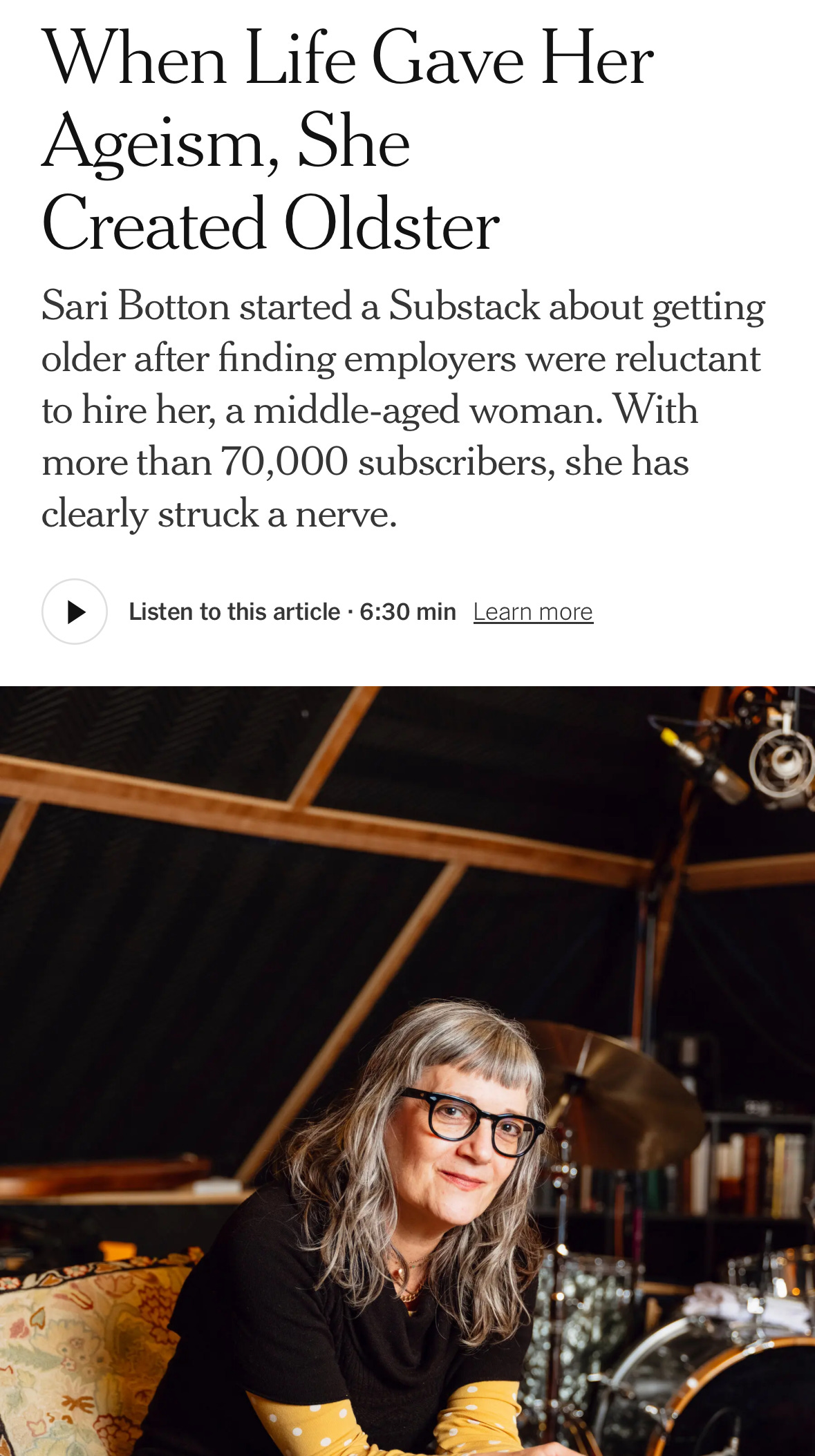
I’ve also gained more than 13,000 new free subscribers. There are now more than 83,000 of you here in Oldster Land. Welcome!
Only a small fraction of you are paid subscribers, though. (A huge thanks to those of you who are! 🙏) Oldster runs on paid subscriptions, and pays essayists and interviewers, so if you’d like to help keep this ship afloat, please consider becoming a paid subscriber.
Check out the rest of this series here. P.S. Typos happen. Please forgive me if you find any!
My misgivings about Love Story, and biopics in general…
In my letter from a couple of weeks ago I wrote about how Love Story on FX/Hulu was really scratching a certain itch, transporting me back to the 90s in a way that made me recall the best things about that era—the fashion, the music, life before arthritis—even though I’m pretty sure I was miserable at the time.
From the start I took the show’s representation of JFK Jr. and Carolyn Bessette’s relationship with a grain of salt, because I know that biopics are at least somewhat fictionalized, a tendency I hate. Then I read Daryl Hannah’s guest essay in The New York Times about the show’s slanderous portrayal of her, and it has made it difficult for me to continue watching.
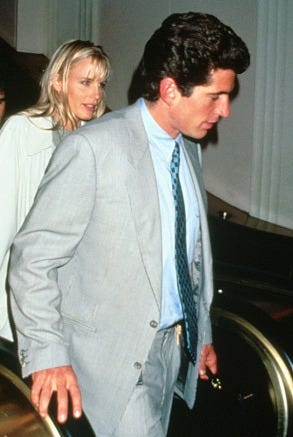
In the piece, entitled “How Can ‘Love Story’ Get Away With This?” Hannah writes about being presented as “irritating, self-absorbed, whiny and inappropriate.” She adds that the show not only misrepresents her character, and her dynamic with JFK Jr. and his family, it also manufactures outright lies about her—depicting her in one scene crashing Jacqueline Kennedy Onnassis’s funeral to which she was invited, and in another snorting cocaine and sharing it with friends at a party in John’s apartment that he’s surprised to come home to, when in reality she’s never even tried the drug.
It’s a version of her the show’s producers have admitted to deliberately fabricating. Hannah writes:
In discussing the show, “Love Story,” one of its producers explained: “Given how much we’re rooting for John and Carolyn, Daryl Hannah occupies a space where she’s an adversary to what you want narratively in the story.”
Imagine being so uncharitably—and falsely—turned into some show-runner’s convenient narrative device. How did Ryan Murphy and company get away with rewriting history, including the stories of characters who are still alive?
It’s a question I’ve asked myself many times before, for example, after wathcing—and enjoying—Bohemian Rhapsody, the 2018 biopic about Queen frontman Freddie Mercury, then stumbling upon Andy Greene’s fact-check of the movie in Rolling Stone. There are so many flubs called out in just the article’s subhead: “Contrary to claims in the movie, the group didn't break up before Live Aid, John Deacon wasn't the original bassist, and they never battled an executive named Ray Foster…”
I was similarly let down after I learned that The Crown, a six-season series on Netflix that I liked, plays fast and loose with the truth about the British Royal Family. It takes more liberties than I have the space to list. Check out Lauren Cahn’s Reader’s Digest article, “What The Crown Gets Wrong About the British Royal Family,” for a run-down.
Each time I’ve encountered the gap between reality and the falsities biopics cook up, I’m not only disappointed, I’m astounded that it’s allowed. As someone who spent a fair amount of my earlier working life in newsrooms, as a reporter and editor, I just don’t understand how it’s acceptable, not to mention commonplace, to add lies to representations of history. Think of all the young people whose only source of knowledge on these subjects is the fictionalized movies made about them.
For this reason, I prefer documentaries to biopics. They hew more toward journalism and historical record, and they’re fact-checked.
That said, I’ll probably finish watching Love Story. I’ve got just three episodes left, and I’m curious to see how the rest of the story is played out. I don’t mind stepping back into a glorified version of the late 90s for a few more hours. I’m irritated, though. What I’m doing now might actually qualify as “hate-watching.”
What’s your take on biopics vs. documentaries? On ‘Love Story’?
The state of family caregiving in America
In case you missed it, on Monday I published “Raising Mom,” a personal essay by Melanie Chartoff about the ways in which her mother thrived, the last two decades of her life, while living in a retirement community her daughters worked hard to afford.

So many of you “liked” and commented enthusiastically on the essay, which points to how advantageous it can be for elders to reside in well-run independent- and assisted-living facilities. It’s a great piece.
However, not everyone has the means to do this, for themselves, for their parents, or for their partners. The very week I was editing Melanie’s piece, Pew Research Center contacted me about a new study called “Family Caregiving in an Aging America,” which revealed that across this country, the day-to-day, hands-on caregiving for those 65 and older tends to fall to family members.
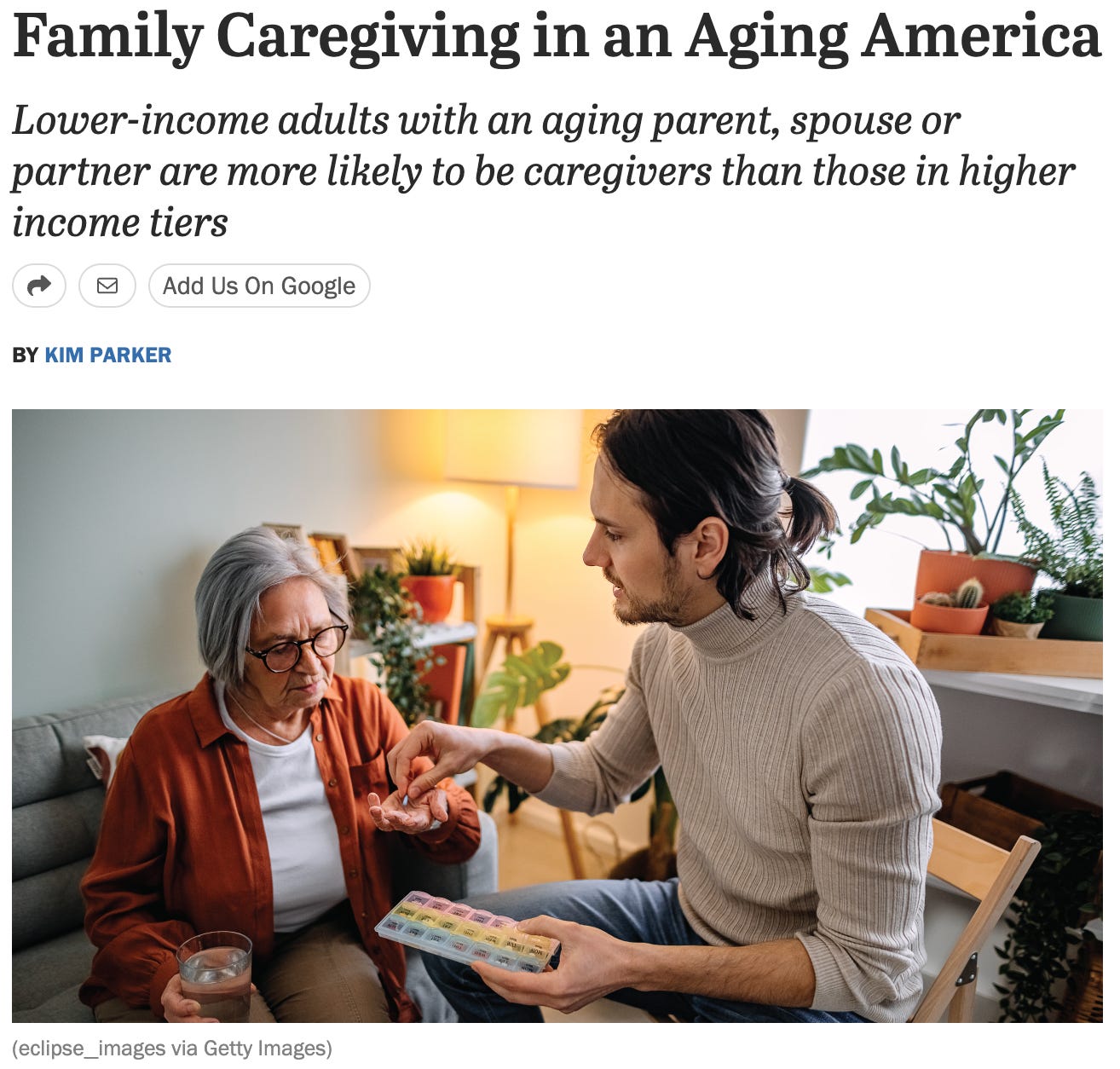
The study highlights who bears the greatest burden—those with lower incomes, and women—but it also reveals that it’s not all a burden. There are emotional benefits to caring for older family members: “A majority of adults who regularly help an aging parent say this positively impacts their relationship with them.”
I reached out to Kim Parker, Pew Center’s Director of Social Trends Research, and here’s what she had to say about it:
This project was part of a broader look at aging in America. We know that as our older population continues to grow, the need for caregiving will increase. This research looks at family caregivers, specifically those who are caring for a parent, spouse or partner age 65 or older.
One key takeaway is just the sheer number of people who have taken on this role. Among adults with an aging parent, 24% say they consider themselves to be a caregiver. And the share is almost identical among adults with an aging spouse or partner (25%).
One of the most striking findings is the gender gap that we see in the impact of caring for an aging parent. While both men and women say helping their parent has had a positive impact on their relationship with their parent, women are much more likely than men to say it’s had a negative impact on their own emotional well-being and their physical health.
Learn more by checking out the study.
Are you the caregiver for a parent, spouse, partner, or other family member over 65? Tell us about your situation…
Introducing “Oldster Bookshelf”…
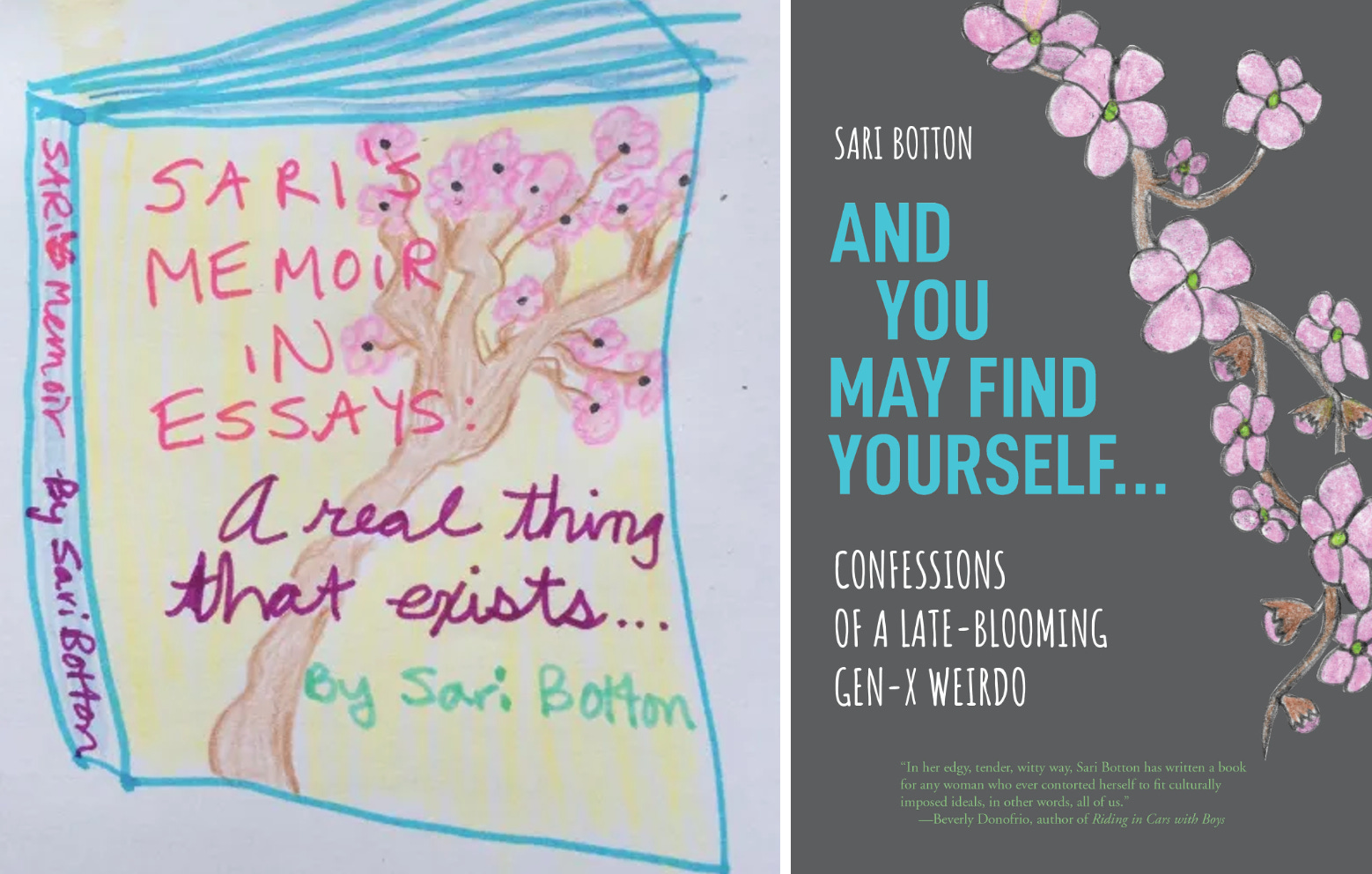
Frequently I receive emails from readers about the triumph of debuting as published authors later in life—in their 50s, 60s, 70s, 80s, and beyond. As someone who published my debut memoir at 56, I appreciate how meaningful it is to finally make it over that hurdle.
In fact, yesterday I came across a crayon and pencil drawing I made ten years ago today—March 12th, 2016—to inspire myself to keep going. It would be another six years before my book was published.
I’ve featured a number of personal essays in Oldster on the subject of publishing later, and have included a number of late-debuters in the Oldster Questionnaire series (including magazine legend Tom Junod yesterday).
But there’s only so many times I can dedicate whole posts about this admittedly wonderful phenomenon without the story arc growing stale. Also, calendar-wise, I’ve only got so many slots to fill with posts about this. I’m not saying I won’t ever publish more full stories along this line. Sometimes I will. But I’ve come up with an alternative way to handle the growing volume of these:
Soon I’m going to launch something new called “Oldster Bookshelf,” an occasional series of posts in which I’ll feature four or five books at a time—with cover images, buy links, and a paragraph or so about each one, with the caveat that I have likely not read the books. (Hey, I have only one brain, and I’m already using it to publish Oldster and Memoir Land five days a week.) I will have been told about the books, by their authors, and if they sound intersting to me, I’ll feature them. (If they don’t, I won’t. No guarantees.)
I’ve created an email address, oldsterbookshelf@yahoo.com, where you can send me:
A press release.
A brief synopsis of the book.
A brief bit on your background as an author and how you came to publish it.
A cover image.
Your preferred buy link.
You’ll be making my life easier if you keep it all short and sweet. I imagine the first edition of “Oldster Bookshelf” will appear some time in April or May. Stay tuned…
That’s all for today. Thanks as always for reading, and for all your support. 🙏💝
-Sari
I've updated the link to the Reader's Digest piece so that it's correct. Here it is: https://www.rd.com/list/what-the-crown-gets-wrong-british-royal-family/ Also, I corrected the spelling of "uncharitable." And as some of you have pointed out, the gmail address oldsterbookshelf@gmail.com is currently not working. I got an email from gmail saying they think it was created by A.I., not me, and that is not the case! I wrote them back assuring them I'm real, and will alert you as soon as that email address is back up and running. I apologize for any inconvenience! //UPDATE: New yahoo email address instead: oldsterbookshelf@yahoo.com
I am my father's primary caregiver and, though he lives "independently," there's a lot of nuance in that designation. He never leaves his apartment, except for doctor's appointments and haircuts when I am chauffeur and escort. I manage his food, laundry, meds, appointments, and make desperate daily stabs at bringing joy. I take him books, show him pictures, tell him what he's missing outside his four walls. He is fairly despondent about the state of the world (aren't we all?) and we commiserate each afternoon about the latest madness. It does feel like a gift to get all this time with him and help him, but it's a lot and I struggle to understand why he's just given up and doesn't engage in his own life. He's compromised in many ways, for sure, but he could take the reins a bit and enjoy his days more with just a little effort. I am learning how I DO NOT want to be in my 80s, assuming I make it. But there's a lot I don't understand about the aging, failing body and its effect on mood, motivation, and the ability to grasp at joy - hopefully, I won't repeat his resigned sadness. The world is trying to beat us, but there is still beauty, yes? There is still the capacity for joy and it is my resistance to find it, even if he can't.