

Letter from the Editor #37
"Yesteryear," my PBS period comfort watches, and the problem with nostalgia for "the good old days"...


Readers,
First, a big thank you to those free subscribers who converted to paid this week. 🙏Oldster runs on paid subscriptions, it pays essayists and interviewers, and—at least for now—no content is ever kept behind a paywall. Paid subscribers make that possible, and I appreciate it!
Check out the rest of this series here. P.S. Click here to get more out of this post by reading it online instead of in your email…
“I have loved reading these posts every day since I subscribed. I am finding all these different stories and perspectives very valuable." - Katie Haegele paid subscriber.
Yesteryear, my PBS period comfort watches, and the problem with nostalgia for “the good old days”...
Over the weekend I tore through caro claire burke’s bestselling satirical thriller, Yesteryear. The novel was so absorbing that for the greater part of 48 hours, I could not put it down. (Actress Anne Hathaway is adapting the book for Amazon, and will star in the film.)
Its protagonist, Natalie Heller Mills, is an Idaho ranch-based right wing Christian “tradwife” who makes her living as an influencer, peddling a back-to-the-land lifestyle (replete with her own popular brand of related products) that naturally also includes a return to retrograde gender roles.
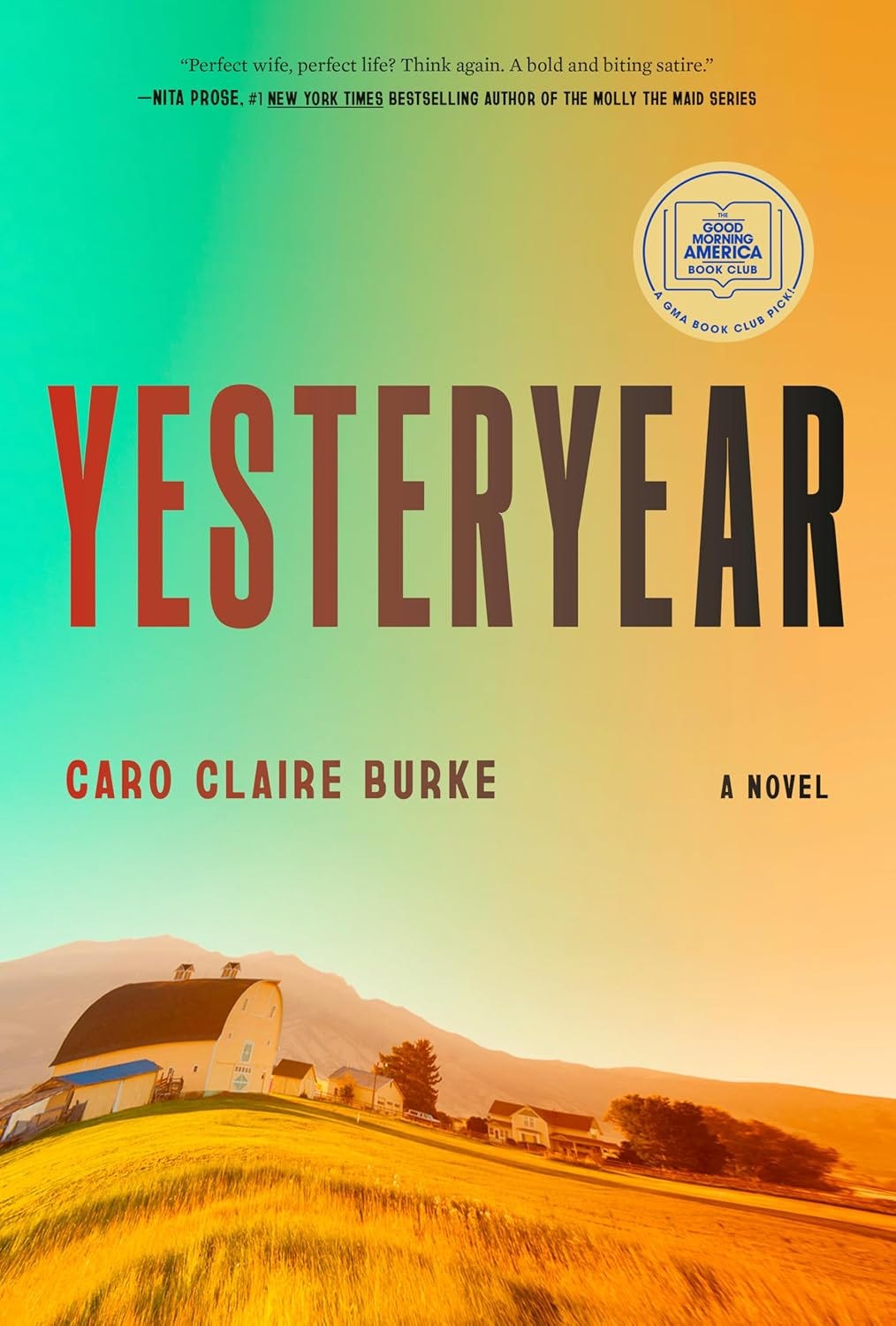
But when Natalie finds herself time-traveling back to 1855—the pioneering period in American history upon which her business profitably casts a halcyon glow—she gets schooled in the dangers of valorizing “simpler times,” particularly for a woman.
I was primed for considering such contradictions because for the past year my “comfort watches” have been T.V. series that take place between the mid-1930s and the early 1960s. I’ve come to realize that I am anesthetizing myself against the news of women’s (and minorities’ and queer people’s) rights being systematically, frustratingly reversed by…doing some time-traveling myself, ironically to times when those groups had many fewer rights, and littler power to speak of.
Don’t get me wrong—I have loved losing myself each evening in the British early(ish) 20th century as depicted on PBS Masterpiece shows like Grantchester, All Creatures Great & Small, and most recently Bookish. And let me make clear that each of those nostalgic shows—all produced within the past decade or so—presents the limiting social conditions of the past as problematic. The viewer is meant to perceive the characters’ struggles as unfortunate matters of the past, and to appreciate how far we as a culture have since progressed past them.
That’s driven home in this behind-the-scenes look at how Grantchester head writer Daisy Coulam portrays the women on that show:
But when I watch Detective Geordie Keating struggle to “allow” his wife Cathy to take a retail job so she can get out of the house and be more than a homemaker…when I watch the endearing curate Leonard Finch go to jail for being “a pansy,”…when I watch the show’s third vicar, Alphy Kotteram, get physically and verbally assaulted for being Indian…I want to scream.
Because it wasn’t so long ago that those were the accepted attitudes and strictures, and in the time since, we really haven’t progressed far enough past them. And now there are people in charge in this country (and other countries) who are working in overdrive to re-establish them—people aligned, ideologically, with Yesteryear’s protagonist and her followers.
I’ve come to realize that I am anesthetizing myself against the news of women’s (and minorities’ and queer people’s) rights being systematically, frustratingly reversed by…doing some time-traveling myself, ironically to times when those groups had many fewer rights, and littler power to speak of.
I feel similarly when I witness Mrs. Hall on All Creatures worrying she won’t be allowed to divorce the abusive husband from whom she’s been estranged for decades. And also when I watch her performing hour upon hour of unpaid emotional labor in an effort to teach Siegfried Farnon, the temperamental veterinarian she keeps house for, how to act like a reasonable human being.
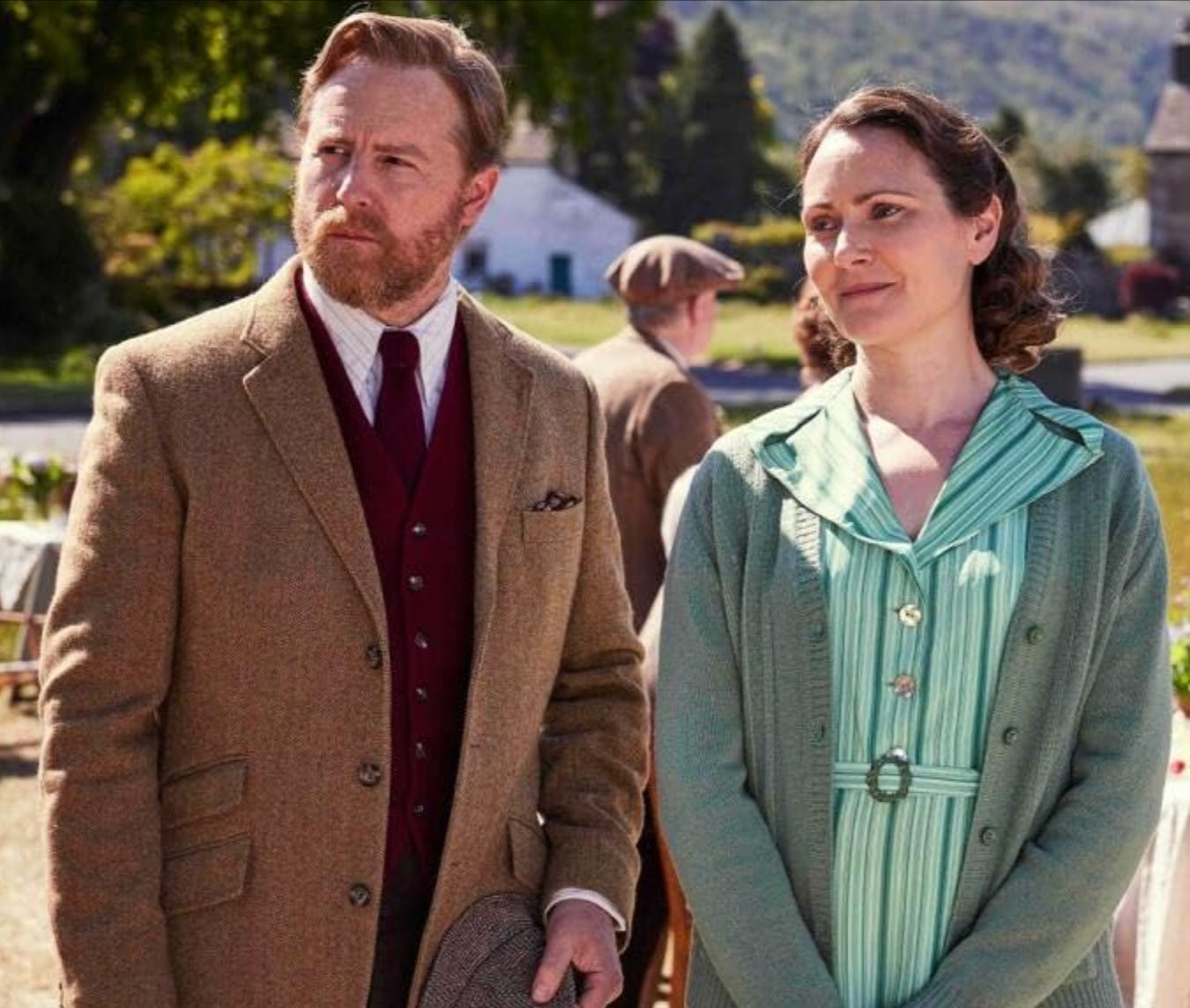
Ditto when I learn that Bookish’s protagonist, Gabriel Book, had to enter into a “lavender marriage” with his wife Trottie as the only reliable way for both of them, in 1940s London, to avoid imprisonment and discrimination, respectively—him for being gay, her for being a sexual libertine. As I watch, I think, How long before that kind of arrangement resumes being the only safe resort for some in this country?
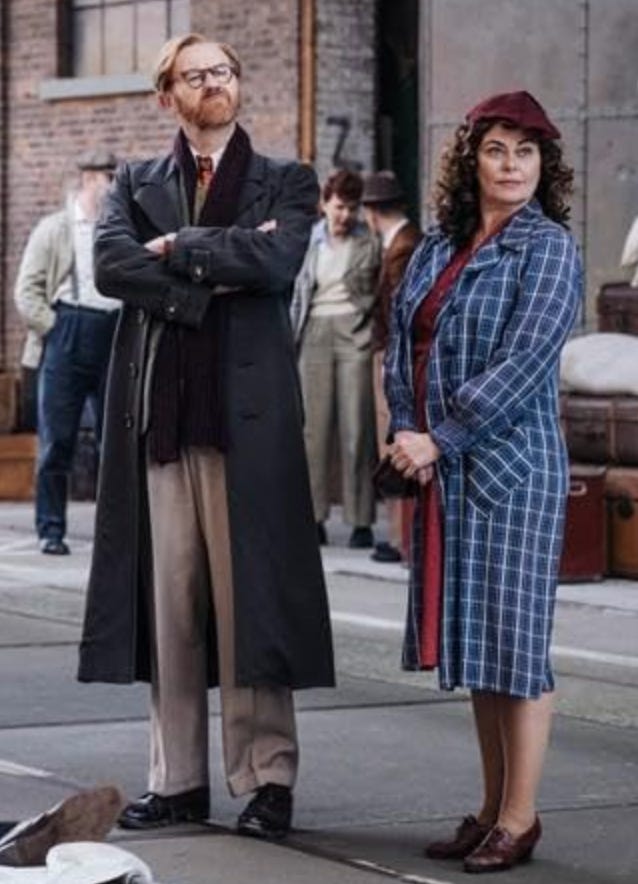
What’s more, in all of these programs, so many of the characters are dealing with the effects and after-affects of one or both of the World Wars—whether they’re conflicted about enlisting, have injuries and/or PTSD from serving, or are grieving those they’ve lost.
Watching them, I find it unnerving to realize that since those wars, as a species, we’ve learned absolutely nothing. No matter how much art is made reflecting the human cost of war, no matter how much history we have to learn from, we just go on putting (mostly) young men in harm’s way so we can obliterate our enemies. We didn’t start the fire, etc., etc., but neither have we any clue as to how to extinguish it.
In spite of all this, though, I absolutely love those shows. I welcome the way they transport me to other times so that for an hour or so each night, I don’t have to think about the one I’m stuck in.

On the flip side, I have found refreshing the contemporary Magpie Murders and Moonflower Murders, and I’m looking forward to the forthcoming Marble Hall Murders (landing September 6th). They all feature the wonderful Lesley Manville as Susan Ryeland, a book editor with a knack for solving murders by channeling Atticus Pünd, a fictional detective from a series of books she published.
It’s a nice change to see a woman in the lead role—an older woman, as Manville is now 70, and would have been 66 when the first of the series appeared. Not to mention that she is unapologetically childless, unmarried, and appears to have commitment issues.
Incidentally, this also describes all three vicars who appear throughout Grantchester’s eleven absorbing seasons. But they’re men, so no problem. (Like one of those vicars, Alphy, Susan gets to drive a cool vintage red convertible.)
Surely Yesteryear’s Natalie Heller Mills would outwardly hate Manville’s Susan Ryeland. Inwardly, though, I wonder whether she might envy her. Me, I just love her.
What have you read or watched lately that made you think?
That’s all for today. Thanks as always for reading, and for all your support. 🙏💝
-Sari
Everyone PLEASE watch Ride or Die on Prime!! The two leads are played by Hannah Waddingham and Octavia Spencer, which is really all I need to tell you, but I'll keep going by saying it's a spy action thriller and a comedy and a beautiful meditation on friendship. Highly recommend.
What I love about the first three series you mention is that you see people struggling mightily with these issues.
What I love about the Lesley Manville character is that she doesn’t struggle at all.
But then again I love Lesley Manville in anything she does.