

The Talk
Ruth Pennebaker and her husband finally get around to discussing end-of-life plans (when their pushy adult children demand it).


Readers,
Today we have an essay by Ruth Pennebaker about how her grown children nudged her and her husband—both in their 70s, and in a bit of denial about their mortality—to finally make end-of-life plans. It’s down below this section. ⬇️
They had some things in order—an old will, some advance directives, and financial paperwork. But their kids got them to ask themselves questions they’d been largely avoiding—about what kind of memorial service they’d each like, who might speak, what kind of music or readings should be incorporated, what to do with their remains, and more.
It occurs to me (even as a person who has not made any end-of-life plans), that there are great benefits to planning ahead in this way—for ourselves, and for our loved ones. How else might we have things go our way when our time is up? And how thoughtful and kind to eliminate any guesswork for those we leave behind.
It’s a very Oldster topic, so I thought I’d prompt all of you on the subject. In the comments please tell us…
How old are you? Have you made end-of-life plans? If not, what’s keeping you from doing it? Fear? Avoidance? The illusion of immortality? If you have made end-of-life plans, what got you to make it happen? Was it a relief to get it out of the way? Any highlights you’d like to share?
Me, I’m 60…and I got nuthin. I keep saying I’ll get on this…and then I don’t. But I know I have to, and this year I will. (I swear.)
Ruth Pennebaker’s essay is here. ⬇️
The Talk
Ruth Pennebaker and her husband finally get around to discussing end-of-life plans (when their pushy adult children demand it).
by Ruth Pennebaker
I like to think I’m pretty cool and with-it about my own death. “I don’t want to be a vegetable,” I tell my family. “I don’t want to be on a ventilator. If I’m that bad, just pull the plug.”
After a few of those vehement declarations, my husband and two grown children began to tell me yes, they knew what I wanted and frankly, I was becoming kind of a bore on the whole topic, so why didn’t I just drop it?
All of which explains why I was mortified by my reaction when our daughter, 43, approached me with an idea. Since she and her 39-year-old brother would both be in town for the Christmas holidays, she said, they should sit down with my husband and me to talk about end-of-life plans with us.
End-of-life? Really? Good grief. I panicked.
Wasn’t this a little sudden? Pushy, even? After all, my husband and I are only 75 and 76, respectively, and we’re both in good health and have most of our marbles and we exercise and he won his age group in a recent 10K race and I lift weights even though it’s boring as hell and we eat well, kind of. Also, we updated our wills 10 or 15 years ago and I’m just about positive we know where to find them.
I was mortified by my reaction when our daughter, 43, approached me with an idea. Since she and her 39-year-old brother would both be in town for the Christmas holidays, she said, they should sit down with my husband and me to talk about end-of-life plans with us. End-of-life? Really? Good grief. I panicked.
Time passed, the holidays came, and I calmed down. The four of us gathered for our scheduled dinner a few days after Christmas. The four of us! How long had it been since only the four of us had been together? It had been several years.
Our son, his wife, and their two children live in Chicago, more than 500 miles from our home in Austin. I remember when he took me out to dinner in 2014 to tell me he’d decided to move there. I kept searching his face, watching him closely, struck by his maturity and how carefully he’d thought about this decision. That dinner was one of those defining moments of parenting an adult child for me—a time when I was simultaneously so proud of him for taking this step and so bereft I wanted to screech, “But what about me? And what about your father? You’re leaving us?”
(To be fair, the move hadn’t been totally mapped out. He left in November, for God’s sake, and arrived in wintry Chicago without a job or a place to live. But it seemed to work out. Within a couple of weeks he had a job and two housemates, both of whom were named Jennifer. And now, 11 years later, he has a career in marketing, a great wife and two kids, and Chicago is home.)
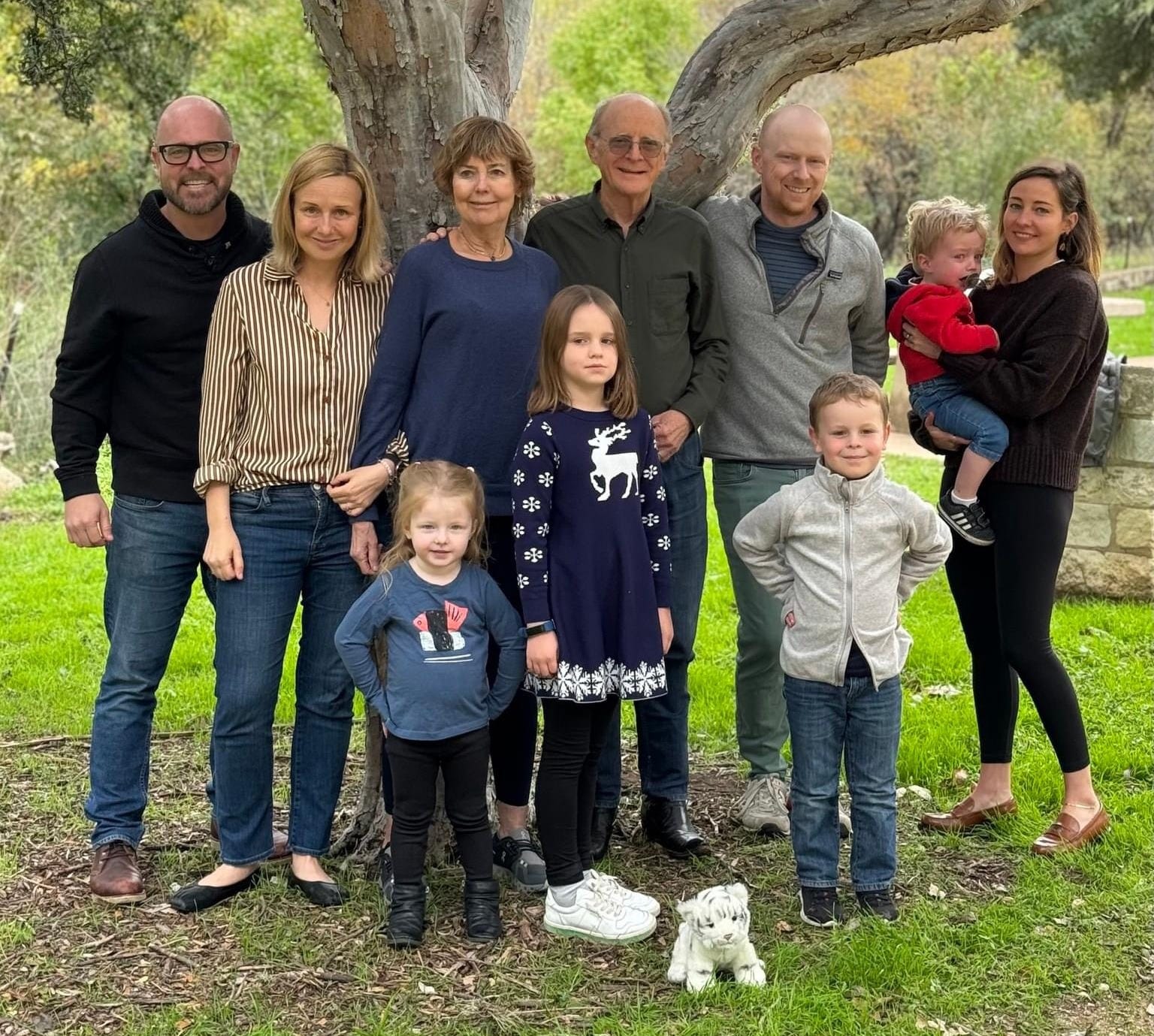
Our daughter, her husband, and two children moved from Seattle to Austin in 2021 when the pandemic was waning and we were all trying to recall what normality felt like. She and her husband brought their jobs with them and bought a house a couple of miles from our downtown condo.
Their move here was like a great gift to my husband and me, offering us the chance to be more involved in all their lives and to know our two oldest grandchildren better. My daughter and I, who’d had a tumultuous relationship over the years, have settled into a newly close friendship. In all, their move changed our lives for the better—and how often does that happen when you’re in your 70s?
***
But anyway, back to our end-of-life dinner. The evening the four of us gathered, our daughter brought Indian food we all ate quickly. “Well, we might as well get down to business,” one of us said. I don’t remember who said that but it wasn’t me. We sat in our small dining room that also serves as my office, passing documents back and forth.
My husband and I had drawn up a list and location of our assets. We also had our wills, our powers of attorney and medical powers of attorney, our advance directives. Sure, the wills were a bit long in the tooth, but we promised to update them. Also, we would write our own obituaries soon. (A great relief to our kids since I’m a loud critic of boring, cliche-ridden obits. For the record, I never lit up a room even when I was smoking, and believe me, I’ve met plenty of strangers.)
Our daughter and son asked us questions. What kind of memorial service—and where? Secular, maybe at a nearby downtown club. Music? We both love Floyd Cramer’s version of “Last Date” and “Feelin’ Good Again” by Robert Earl Keen. I wanted “Amazing Grace” even though I’m agnostic, and my husband mentioned “Toccata and Fugue in D Minor,” played at full-blast. We both inclined toward Willie Nelson and the Beatles, too. Who could attend the services? Oh, anyone, even our mortal enemies.
Speakers? Our children, our son-in-law, a few of my husband’s old grad students for him. Friends? Fine, but who will be alive? No headstones. Cremation, with our ashes scattered on Austin’s Hike and Bike Trail and the top of Mount Bonnell—places we have loved.
Our daughter and son asked us questions. What kind of memorial service—and where? Secular, maybe at a nearby downtown club. Music? We both love Floyd Cramer’s version of “Last Date” and “Feelin’ Good Again” by Robert Earl Keen. I wanted “Amazing Grace” even though I’m agnostic, and my husband mentioned “Toccata and Fugue in D Minor,” played at full-blast. We both inclined toward Willie Nelson and the Beatles, too.
I don’t know when it was our daughter began to cry—our hard-charging, accomplished professional daughter with tears flooding her face. Our son claimed later it was when money and finances were mentioned; his sister had always been sentimental about such things, he reminded us. But by then, we were finished with our end-of-life talk.
We moved to the living room with glasses of wine, the original four of us. The two of us who used to be young and invulnerable parents, the two whose births, toddlerhoods, multiple cases of pink eye, and adolescence my husband and I had witnessed. The four of us who’d been inseparable for years until, suddenly, we weren’t.
We sat and talked for another couple of hours. I’m not even sure what we talked about—the past, mostly. Our intertwined lives. How proud we are of them. “We must have been perfect parents,” my husband said, and we all burst out laughing. We all knew better.
What I remember most clearly was the warmth in the room, the comfort in one another’s presence, the laughter, the ease. “I never had that kind of talk with my parents—ever,” my husband said later. “I can’t even imagine it.”
How odd—he and I had gone to what was, in many ways, a reckoning of our lives. The money we’d made, the assets we held, the memories and work we wanted preserved, our earthly accomplishments.
Those end-of-life summaries had passed quickly and easily. But it was those last hours with two adult children we love more than anyone else in the world that will linger with us as long as we draw breath. Of everything both my husband and I have done in our lives, these two human beings with their good hearts and wise-ass humor are our greatest legacy, our proudest earthly accomplishment. They and their families are the treasure we will leave behind.
Previously Ruth Pennebaker took The Oldster Magazine Questionnaire.
Okay, your turn:
How old are you? Have you made end-of-life plans? If not, what’s keeping you from doing it? Fear? Avoidance? The illusion of immortality? If you have made end-of-life plans, what got you to make it happen? Was it a relief to get it out of the way? Any highlights you’d like to share?
Big thanks to Ruth Pennebaker—and to all of you, for reading, subscribing, and for supporting Oldster. I appreciate you all, and couldn’t do this without you. 🙏💝
 | A guest post by
|
I’m pretty sure that the reason we can get out of bed in the morning is because we think we’re going to live forever: our beloved mates will never die, our children will never die, we will never die….. NOT true, sadly! In May of 2024 my 77 year old beloved husband of 45 years died of a vicious cancer in 12 days after his diagnosis. We were pretty sure he was going to live forever as his mom lived to 99 (in strong body with very strong mind) and his dad at 94. We were lulled into denial by his long-lived parents. So…. The very good news is that when my 80 year old mom died in 2002 after 9 months of leukemia, she taught us a very important lesson: have your estate in order. She had a trust (and will), my sister was the executor, no probate. Easy street. We could deal with our grief and forget the rest. The month after mom died, at age 51, I hired an estate attorney (husband Dave never wanted to talk about death and dying! Well SOMEONE needs to!! That was always me, also I’ve always been the financial planner in the family, he didn’t want to talk about money either although in his work he dealt with millions of dollars). We created a reversible family trust, wrote wills, Advanced Directives, etc. We decided this was especially important since we traveled a lot, both overseas and in the states. Lots of flying. Lots of driving…. Buses, trains, ferries… Accidents happen all the time!In 2014, we amended the Trust. In September 2023, we amended it again. We don’t have a great deal of money but we do have a home and a cabin on a lake. And a disabled adult daughter. Dave died May 2024. Now I’ve amended the Trust yet again to reflect my current thoughts with Dave dead. All the kids know who our young attorney is, my young CPA. I tell the kids, when I die just sit down with those two and talk. They’ll help you with all the legal stuff. As Dave always would say to me, none of us are getting out of this alive. Now I live with my broken heart - our kids too - but at least our affairs are in order! Thanks for reading this far! Get to work. And read Atul Guwande, Being Mortal. Life-changing read.
I’m a death doula and see so many fights where nothing has been planned so the loved ones argue about what to do while feeling emotional and overwhelmed. It’s hard enough to just grieve. Making these plans (and talking about them!) is vital to a peaceful death and ultimately a gift of love to the people who must go on living.