

Finding Complexity and Sweetness in Life’s Onion Layers
At 65, Elli Benaiah traces the patterns that have shaped his life over time, recognizing the value in even the more bitter moments that have made him who he is.


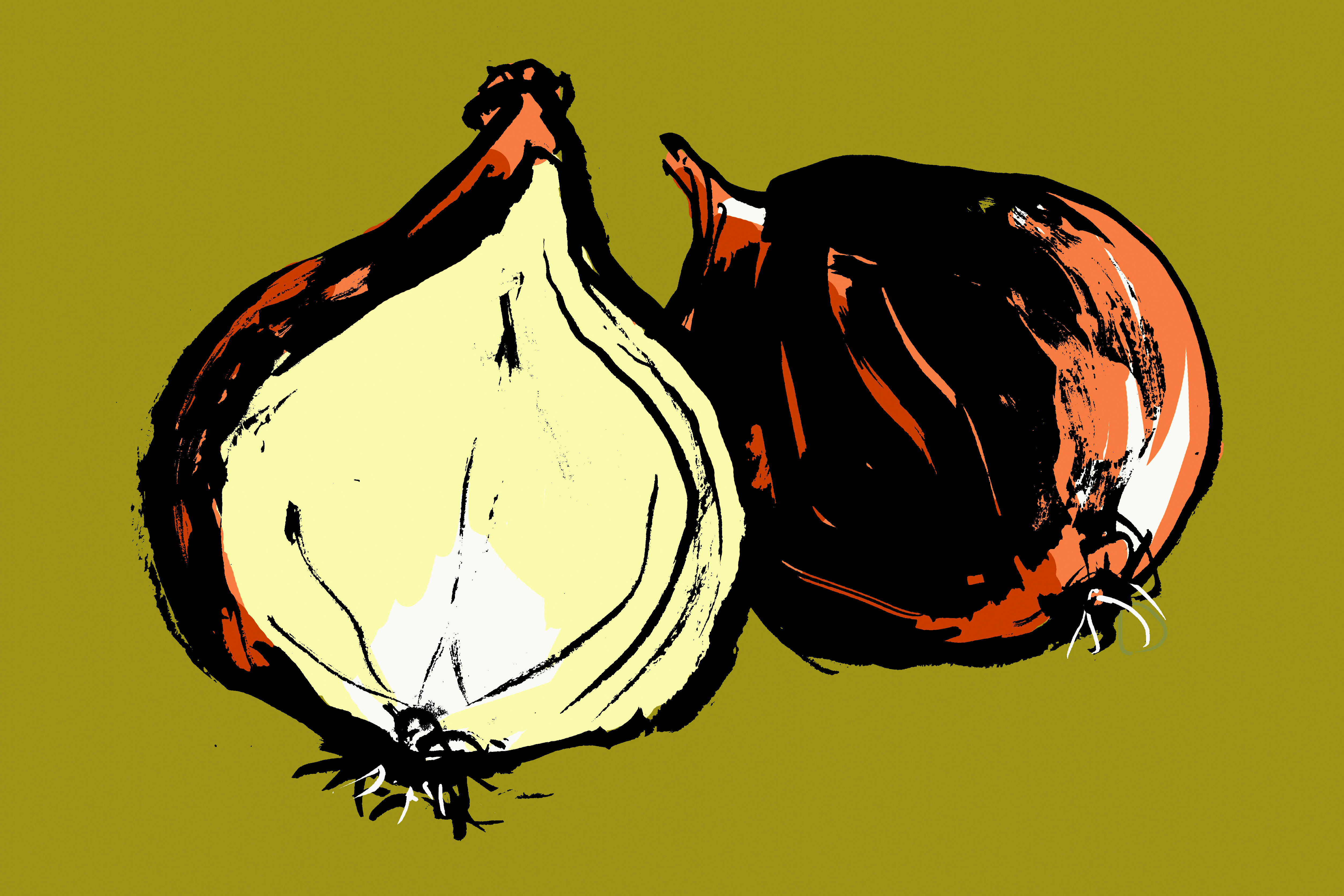
“Chopping onions on my heart” is a Judeo-Arabic expression of grief. Samantha Ellis, in her memoir of the same name, uses it to describe clinging to a vanishing culture. My father also used this phrase, usually to convey how much grief we children caused him.
I had almost forgotten it, but reading Ellis this year gave me the chance to reflect again. For me, the meaning has shifted. It is no longer about grief. That’s because I’ve learned something in my 65 years: cutting onions makes you cry, but the longer you sauté them, the sweeter they become. The layers don’t only sting; they mellow, deepen, and reveal their flavor as they age in the sauté pan of the years.
For much of my life, I thought I was peeling my way towards a hidden centre—a core self that, once revealed, would explain everything. I came across a recent BBC report noting that the human brain continues to rewire and mature well into our thirties, sometimes later - not in a straight line, and not uniformly. I didn’t read this as explanation or excuse. If anything, it clarified something I already suspected: that the pressure to “arrive” by a certain age rests on a false timetable.
Since turning 65 last November, I see the truth more clearly: there is no single kernel waiting at the middle. The layers of a life themselves comprise the core. And they are not isolated. Like onion skins, they interconnect—each layer borrowing flavor from the one beneath it, each one shaping and being shaped by what came before.
I’ve learned something in my 65 years: cutting onions makes you cry, but the longer you sauté them, the sweeter they become. The layers don’t only sting; they mellow, deepen, and reveal their flavor as they age in the sauté pan of the years.
Every layer I’ve added or shed—my premature birth, conflicted parenthood, migration from England to Israel to Canada to Switzerland to Germany, war-shelter childhood, law courts, switching careers, rooftop curries, divorce, shuttered restaurants during Covid, degenerating health, the driver’s seat of a school bus—hasn’t concealed who I am. Each one has contributed to creating—and re-creating me.
***
I came into the world too soon, at just over six months, a premie. From the start I carried the sense of being slightly ahead of the clock. At 30, when doctors diagnosed me with a condition requiring painful injections every three months, I felt that tug on my time again. My body reminded me I wasn’t immortal. At the time, I was training as a long-distance runner, competing in sport—and in life.
It made me think of Run for Your Life, the 1960s TV series where Ben Gazzara plays a man told he has one year left. His response was to live as many lives as he could, fast. That outlook seeped into me. My instinct became acceleration, not delay. Better to widen the surface of contact with life—to run towards something unnamed—than risk vanishing if I stayed still. Funny how the series itself lasted three seasons—two years longer than the character’s life expectancy.
I’ve often described myself as “half-baked.” At first, I thought it was only about being born too soon, undercooked in the oven of time. But with hindsight, I see another truth, not scientific, but symbolic: I was half-baked because my parents were never really a good fit together. Two mismatched ingredients forced into the same recipe. Their tensions marked me from the start, shaping the contradictions that later became my strength.
***
Contradiction was stitched into my DNA. My father was born in Kolkata, raised in British India on jazz, horse racing and curry. My mother, German-born, Ashkenazi, raised on Kartofffelsalat, aristocratic rabbinic lineage, her family scarred survivors of the Holocaust.
The two met improbably in post-war London, he in a British army uniform stationed in Germany, she piecing together a broken world while trying to discover a new one. Their first sparks flew at a Beatles concert.


Their romance produced me, but also a household heavy with cultural clash. We children learned to absorb the explosions in silence. Out of that silence, I grew layered: Iraqi, Indian, German, English, Canadian, Israeli, Swiss—and now Munich is home. I was a child carrying the weight of multiple worlds, identities, languages, and kitchens. But it was the kitchens that most intrigued me, where I felt most at home and at peace.
***
We emigrated to Israel from England. In Ramat Gan, a suburb of Tel Aviv, I lived through three wars before the age of 13. Bomb shelters became my second home. My beloved school principal was killed. My bar mitzvah teacher was drafted, and I taught myself my Torah portion, developing a photographic memory that still serves me today.
But the same Yom Kippur War that built me also broke my father. When he returned, something in him had cracked. Soon after, he left us for Canada, seeking peace of mind and fortune elsewhere. Another layer torn away.
There is no single kernel waiting at the middle. The layers of a life themselves comprise the core. And they are not isolated. Like onion skins, they interconnect—each layer borrowing flavor from the one beneath it, each one shaping and being shaped by what came before.
Eventually we joined him. I wish my parents had divorced. At 15, uprooted to Toronto, cut off from childhood friends, I was dropped into an ultra-Orthodox yeshiva—a disaster I had to claw my way out of. I found refuge in correspondence courses and eventually university at the age of 17. There, philosophy and religious studies opened my horizons. Suddenly the Bhagavad Gita sat beside the Bible, Nietzsche beside the Quran.
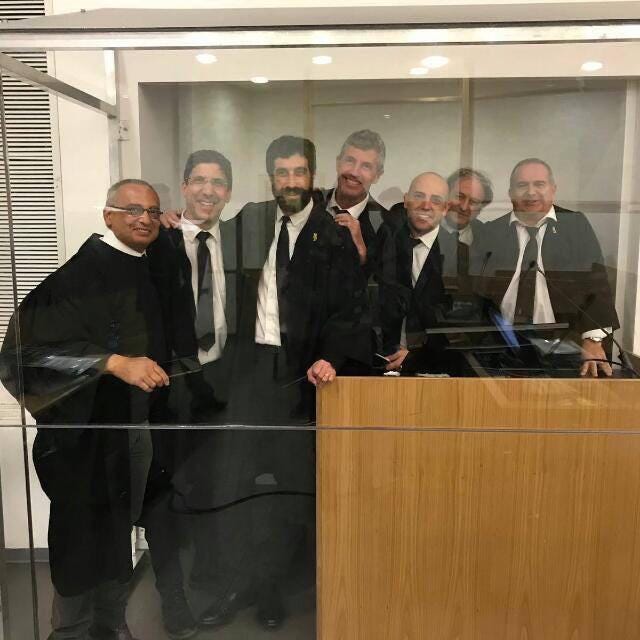
By 21, I was already a lawyer. At 24, a Federal prosecutor. Courtrooms became my stage. Everyone had to look at me: judge, jury, accused. I widened the contact surface, hoping someone, anyone, might see me. I thought I was chasing justice, but perhaps I was chasing an audience. I argued prosecutions, defended the assumed guilty, read the jury’s gaze like a weather vane. But something was missing. Inside, I remained restless. Another layer waited.
At 37, I pivoted, as I so often have. Looking for meaning, I returned to Israel and split my life in two. By day, I defended Bedouins in the south and handled organized crime cases in Tel Aviv. By night, I cooked curries for strangers on a Tel Aviv rooftop. Juggling was exciting, but stressful on mind and body. There was no décor, no menu—just chipped plates, the sea breeze, and pots that smelled like my father’s colonial Calcutta kitchen.
Food became my language, the through-line that bound all the other layers. Each curry carried memory. Each ladleful was proof I belonged to a larger story. I became a curry expert and was proud that my father could imagine his own childhood with his eyes shut.
***
So I decided to follow my spice trail. I decided to shed my robes and exchange them, professionally, for ladles. Then came Switzerland. Basel, with its chocolate-box neatness and suspicious glances. I learned the European kitchen well, and ran the community kosher restaurant that buzzed with energy and served alpine skiers, Five Star hotels, as well as Black Forest-bound families. Business lunches, Shabbat spreads, bar mitzvah meals. For a time, I thrived on the fumes of appreciation.


I also survived the Covid shutdown, but the community dwindled and the restaurant closed. I was then invited to Munich to run the kosher kitchen there. But restaurants are jealous gods. They demand every tendon, every joint, every heartbeat. My arthritic shoulder whispered enough, then my knee. Cartilage thinned, pain crept in. I could no longer lift a bag of onions. I closed shop.
When my body finally said no, I was devastated. It was not something I had ever expected—certainly not after making the leap of faith from the law to food. I felt I had fallen into the abyss. What could I do now? But then I realized: if I could no longer cook professionally, perhaps I could write about it. After all, I had been trained to write briefs. I had taught cooking courses and trained others. So why not put it all together?
So I did something uncharacteristic: I slowed down. Not in spirit, but in pace. In 2024 at 63 became a school bus driver for handicapped children. I learned to sign. Some might call it a comedown. I call it grace. One of the children once asked me how old I was, I said 100. Between the hum of the engine and the noisy chatter of the kids, I finally had time. Time to breathe. Time to write. Time to finally put down the cookbook that had lived in my head since childhood.

Food was still my through-line, but no longer for court exhibits or restaurant reviews. Now it was for memory, for narrative, for the slow simmer of words. Another Judeo-Arabic phrase both Samantha Ellis and my father use is: “You speak like you have a koobah in your mouth.” Koobah is a dumpling, like a kneydl. And speaking like having a koobah in one’s mouth is an insult to those who are tongue-tied. So be it. Writing has become my release. Another way to out myself.
***
At 65, people tell me it’s time to wind down, brace for retirement, accept the decline chronology mandates. But my life has never followed a straight line. And I see an ascent into catharsis, not a decline.
Aging, I’ve come to believe—at least in my case—isn’t about slowing down. It’s about the courage to keep shifting gears, until you reach the right speed for you. My ex accuses me of running away. I never felt that. I have always been running towards—towards the me inside, the me I wanted to meet. And the more I peel back, the more I realize: there is no hidden core waiting. The layers themselves make up the self. They are me.
Onions on my heart—yes, grief has marked me. Wars, ruptures, broken dreams, failures. But like those of sauteed onions, my layers have sweetened over time. They have given me depth I didn’t know I had. I am at peace with myself. Finally.
At 65, people tell me it’s time to wind down, brace for retirement, accept the decline chronology mandates. But my life has never followed a straight line. And I see an ascent into catharsis, not a decline. Aging, I’ve come to believe—at least in my case—isn’t about slowing down. It’s about the courage to keep shifting gears, until you reach the right speed for you.
So here’s the bare-assed truth: the layers are the pattern. They are the core. And the clock? It hasn’t run out yet. There are more layers still to discover. For me, chopping onions on my heart no longer connotes grief for what is lost, but excitement for what can still be uncovered: how to make the onion sweeter, how to trace its etymology, how to follow its preparations and adaptations, as immigrant cultures resiliently take root in new worlds. It is discovery.
Perhaps that is why I have always thought outside the box. Because for me, there never was a box. I was born outside it—between worlds, between kitchens, between careers, between lives. What I inherited was not a container but a mosaic, and what I have built is not a centre but a pattern. That is my gift, and my freedom.
Check out all of Oldster’s essays…
 | A guest post by
|
Thank you, Sari, for sharing and restacking ME.
It was wonderful working with you on the essay - your editorial touch and openness made the process feel like a true collaboration.
Wow! So much wisdom in this story. I'm keeping it so I can re-read (again and again) when I feel a bit lost. Thank you, Thank you Elli.