

Ask a Sober Oldster: First-Year Highlight Reel
Happy first birthday to our "Sober Oldster" collaboration with The Small Bow newsletter! 🎂 Here, tidbits from the first dozen interviews in this popular monthly series.


Readers,
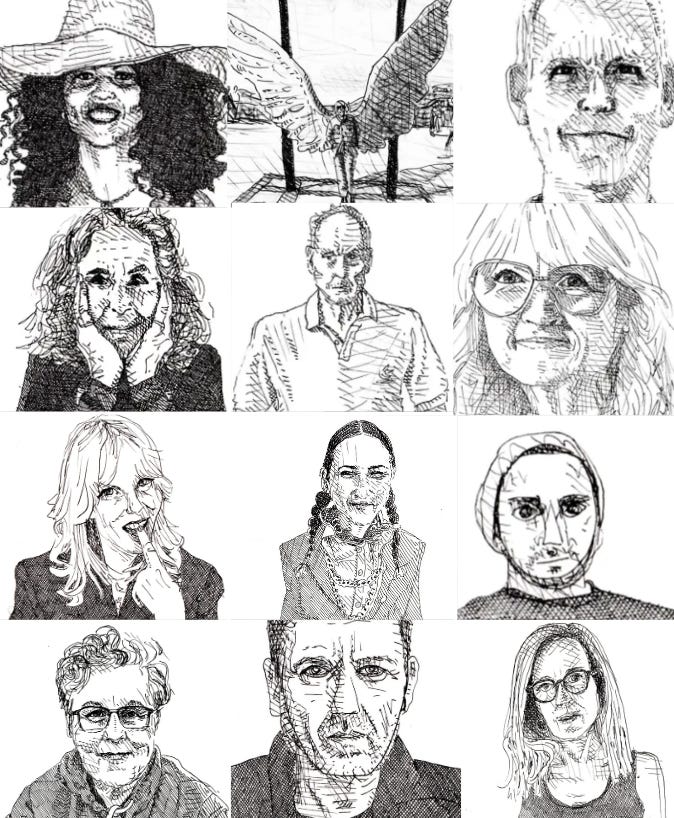
Last year at this time, The Small Bow’s A.J. Daulerio and I began collaborating on “Ask a Sober Oldster,” an interview series that means a lot to me, and which has grown to be quite popular. For this month’s edition—especially since there are nearly twice as many of you here as there were last year, and many of you haven’t seen all of these—we decided to pause and take stock of the first dozen interviews in the series so far, and present you with a little highlight reel.
The Small Bow is one of my all-time favorite newsletters. It’s not only about addiction and recovery; it’s also about mental health, but more broadly, about being fallibly human and learning from life. (Although I don’t drink, I’m not an addict in recovery. Yet I’m always inspired and encouraged by what I read in The Small Bow, and sometimes moved to tears.)
Oldster Magazine and The Small Bow intersect in a couple of places. Both shed light on subjects—aging, addiction—around which there’s historically been shame and stigma, and a need for greater societal understanding and new perspectives. Both also deal with longevity—counting time on earth, counting time in sobriety.
It’s been a fun, inspiring year of collaboration. I’m grateful to all of our contributors! We’ll resume our regular series with a new Q&A in July. Thanks, as always, for reading, and for all your support! - Sari
Here’s a look back at the first dozen interviews…
“I have been addicted to something—drugs, sex, gambling, you name it—from the day my father died in 1965. I was 15. The night he died I went to his room, found the Dilaudid they were giving him, stuck a pin in it and drank half of it. I didn’t start getting high daily after that, but I bookmarked that feeling of oblivion, and I searched for it everywhere. - Martha Frankel” - Martha Frankel
Ask a Sober Oldster #1: Martha Frankel

Martha Frankel has been a writer her whole life. “It’s the only job I ever had, besides waitress and gas station clown. And that clown thing didn’t stick. I am the director of Woodstock Bookfest, a yearly gathering of writers and readers. A few times a year I put on a Story Slam. Sobriety is the central tenet of my life now.”
“The best things about being in recovery are the relationships I’ve made over the past three decades. I feel like I grew up with and became a woman with sober sisters. Never having to be alone in anything that I’m experiencing in the sense that there is always someone I can reach out to is a gift that I wasn’t expecting. My sober sisters especially helped me raise my kids, go back to school, be the best spouse I was capable of being, and they are now walking me through divorce. I am never alone.” - Dionne Ford
Ask a Sober Oldster #2: Dionne Ford

Dionne Ford: “My memoir Go Back and Get It was published in April from Bold Type Books. I’m also the co-editor of the anthology Slavery’s Descendants: Shared Legacies of Race and Reconciliation (Rutgers University, May 2019). My work has won awards from the National Association of Black Journalists and the Newswomen’s Club of New York and in 2018, I received a National Endowment for the Arts Fellowship in Creative Writing. I also teach Creative Writing as an adjunct.”
“I became an alcoholic on my first day in LA, when I turned over my grief to a bottle of prosecco. Five years and two attempts at sobriety later, my sober girlfriend told me she couldn’t reach me when I was drinking—the very same words I’d cried so many times to my ex-wife. I couldn’t do to her what had been done to me, so I stopped drinking that night. She took me to my first AA meeting the next morning. She and I didn’t last, but my sobriety did.” - meredith maran
Ask A Sober Oldster #3: Meredith Maran

Meredith Maran is the author of 13 books, most recently THE NEW OLD ME: MY LATE LIFE REINVENTION, out from Penguin in 2017, and SEXPOT, pub date TBD. She’s a book critic and a culture writer for the Washington Post, LA Times, O Magazine, and other venues. She lives in Silver Lake, Los Angeles, and Palm Springs, CA with her nonbinary fiancée.
“My mom left my father when I was 12 due to his drinking. He would die a year and a half later in a car crash…also due to his drinking. I picked up my first drink a year and a half later and instantly bonded with my father on a much deeper level than any time during his lifetime.” - Kevin Teare
Ask a Sober Oldster #4: Kevin Teare

Kevin Teare attended Ball State and Indiana University as an undergraduate and received his M.F.A. from Bard College in 1997. He has taught at Lacoste School of Art in France, Dowling College, Southampton College, and lectured at Muhlenberg College as well as S.V.A. in New York. He has been the recipient of a National Endowment Award in Painting and a Joan Mitchell Fellowship Award. He has exhibited at P.S.1./MOMA, White Columns, Guild Hall, The Parrish Museum, Indianapolis Museum, Fort Wayne Museum, as well as galleries in New York, Long Island, and Europe. He currently works and lives in Sag Harbor, New York.
“One thing I thought in early sobriety was to make a tee shirt printed with “Instant asshole, just add alcohol.” I’m painfully aware of being emotionally “crippled.” I feel the person I was is someone I know intimately but isn’t me now. The monster lies dormant, though, and could be very easily awakened.” - Ray Cocks
Ask a Sober Oldster #5: Ray Cocks

Ray Cocks graduated high school in 1966 and enlisted in the US Army. His service included eighteen months in Vietnam during the war. After his honorable discharge from the military he worked in the trades—carpenter, roofer, auto mechanic—until 1990 when PTSD-related issues precipitated radical life changes. Since that time he returned to college and eventually earned a BA in music. In 2014 his attendance at a conference addressing veteran incarceration led him to the first of several retreats and conferences for veterans. He has since returned to Vietnam four times on peacetime reconciliation visits with other veterans.
“In my first year of sobriety, I used to go to a coffee shop for lunch with sober friends almost every day. We’d walk a few blocks down Broadway, through Columbus Circle to the Cosmic Coffee shop (RIP) where they always saved us the big round table by the front window. Sometimes we’d fill the table and squeeze in extra chairs, other times there might be a few empty seats, but every time, every time, being with that group of people gave me something I’d never experienced before; hard to quantify the complexity of it, but it was the first time I began to feel that I was a necessary part of something. And we just fucking laughed, and we still do, even though we’re spread all over the country now” - Elizabeth Crane.
Ask a Sober Oldster #6: Elizabeth Crane

Elizabeth Crane is the author of four collections of short stories as well as two novels, We Only Know So Much and The History of Great Things. Her work has been translated into several languages and has been featured in numerous publications and anthologies, and her stories have been featured on NPR’s Selected Shorts. Crane is a recipient of the Chicago Public Library 21st Century Award, and her work has been adapted for the stage by Chicago’s Steppenwolf Theater company, and also been adapted for film. She teaches in the UCR-Palm Desert low-residency MFA program. A film adaptation of We Only Know So Much is now streaming on most VOD services. Her debut memoir, This Story Will Change, came out in August 2022 from Counterpoint Books.
You can get sucked into believing that if things aren’t working for you, it’s because you’re not doing the program “right” or “hard enough.” There are definitely crazy people who will tell you you’re just not “doing it right.” If you’re young, like I was, or insecure, like I was, it takes a while to realize those people aren’t helpful. - Claudia Lonow
Ask a Sober Oldster #7: Claudia Lonow

This monthly interview series is a collaboration between Oldster Magazine and The Small Bow, A.J. Daulerio’s excellent newsletter about recovery and mental health, and will appear in both newsletters. Learn more about this collaboration in this Oldster podcast/videocast episode
I continue to learn (and fail) to put more milliseconds between an external event and my reaction to it. I’m better than I used to be but still regularly embarrass myself. I will be working on this for the rest of my life. I am impatient. This bores the hell out of me. I have learned that impatience does nothing but lessen the quality of my life, but I can still lean into it. Working on it. - Joan Wasser aka "Joan as Police Woman"
Ask a Sober Oldster #8: Joan Wasser aka "Joan as Police Woman"

This monthly interview series is a collaboration between Oldster Magazine and The Small Bow, A.J. Daulerio’s excellent newsletter about recovery and mental health, and will appear in both newsletters. Learn more about this collaboration in this Oldster podcast/videocast episode
I’ve had a helluva time accepting how limited I am in some categories of my life, ones that I never realized I was lacking until I became sober. Losing connections with some old friends has been difficult, but the sober part of me can also see that as its own sign of growth. But the intermittent waves of loneliness are brutal. - A.J. Daulerio
Ask A Sober Oldster #9: The Small Bow's A.J. Daulerio

This monthly interview series is a collaboration between Oldster Magazine and The Small Bow, A.J. Daulerio’s excellent newsletter about recovery and mental health, and will appear in both newsletters. Learn more about this collaboration in this Oldster podcast/videocast episode
One big challenge is that I have long-term PTSD from having experienced gun violence in my early 20s. I sometimes still have irrational reactions to situations I incorrectly perceive as threatening. But as long as I’m sober, I can recognize them for what they are. It’s unpleasant; sometimes it’s more than unpleasant, but self-medicating with alcohol was ineffective and had seriously severe side effects. - Kim Wozencraft
Ask a Sober Oldster #10: Author Kim Wozencraft

This monthly interview series is a collaboration between Oldster Magazine and The Small Bow, A.J. Daulerio’s excellent newsletter about recovery and mental health, and will appear in both newsletters. Learn more about this collaboration in this Oldster podcast/videocast episode
In my old age, I have come to realize that everybody on the planet is recovering from something. And deserves our compassion. It’s pretty much the human condition…. All our secrets are the same. - Jerry Stahl
Ask a Sober Oldster #11: Author Jerry Stahl

This monthly interview series is a collaboration between Oldster Magazine and The Small Bow, A.J. Daulerio’s excellent newsletter about recovery and mental health, and will appear in both newsletters. Learn more about this collaboration in this Oldster podcast/videocast episode
We’re all monsters because we’re all human. (I wrote a book about this.) But of course calling oneself a monster can be a form of self-aggrandizement. The worst part of myself is my occasional feeling that I am a very, very special kind of monster. A dumb story I can get caught up in is this one: No one is as big a monster as me. The grandiosity of my self-loathing (and its attendant self-pity) could blot out the sun if I let it. It’s very boring and annoying for the people around me. - Claire Dederer
Ask a Sober Oldster #12: Author Claire Dederer

This monthly interview series is a collaboration between Oldster Magazine and The Small Bow, A.J. Daulerio’s excellent newsletter about recovery and mental health, and will appear in both newsletters. Learn more about this collaboration in this Oldster podcast/videocast episode
It's a privilege to meet all of these folks.
So interesting to scroll through these and see how many of them mention a traumatic loss in childhood. Maybe my focus on adolescent grief is the reason I’ve always liked this column.