

Tying Myself in Knots
Ellen Goldberg considers how knitting “emotional support chickens”—and crafting in general—in these times is both an act of resistance and self-care. PLUS: An open thread forum on crafting for sanity.


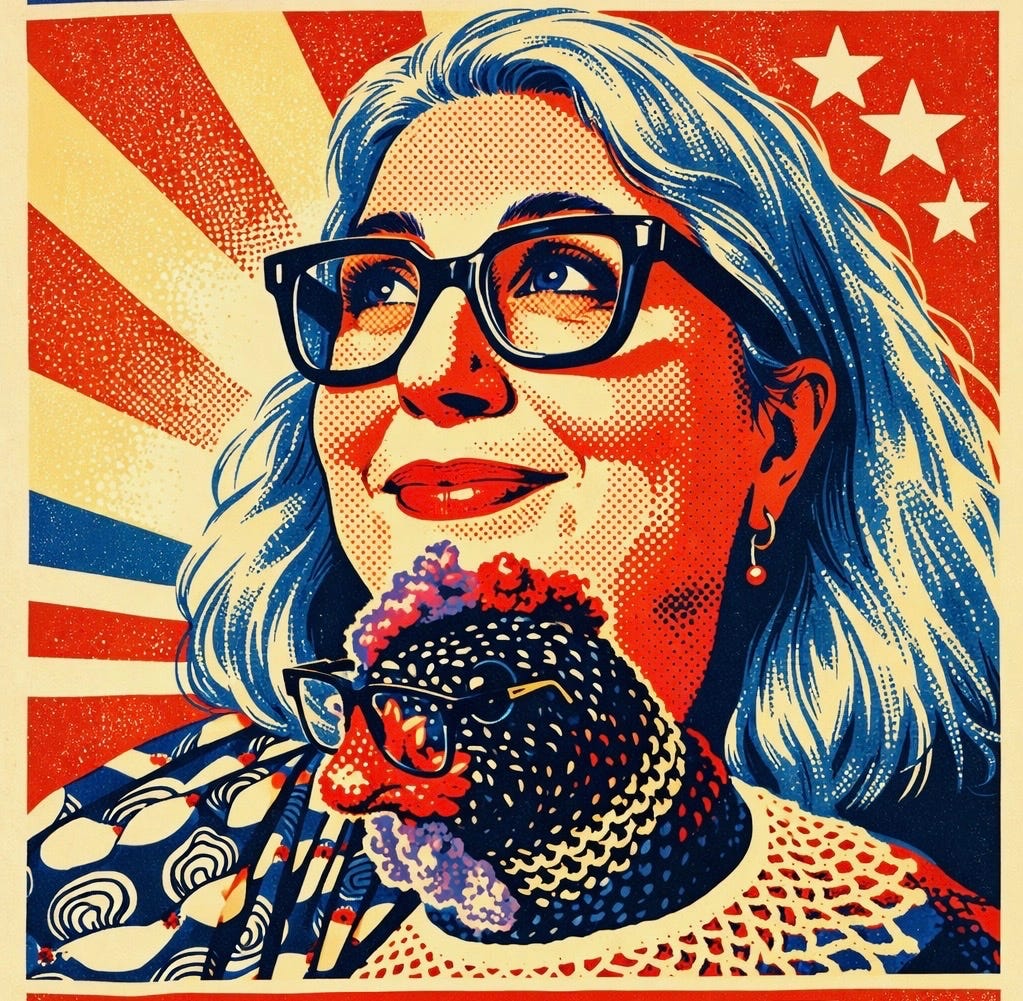
Readers,
Today we have an essay by Ellen Goldberg about how she has been knitting “emotional support chickens” for friends and family, a crafting endeavor (a “granny hobby”) that for her has been both an act of resistance, and a method of self-care in these difficult times. Her essay is down below this section. ⬇️
She’s not alone. As Goldberg explains, there’s a whole movement of knitters making these birds right now.
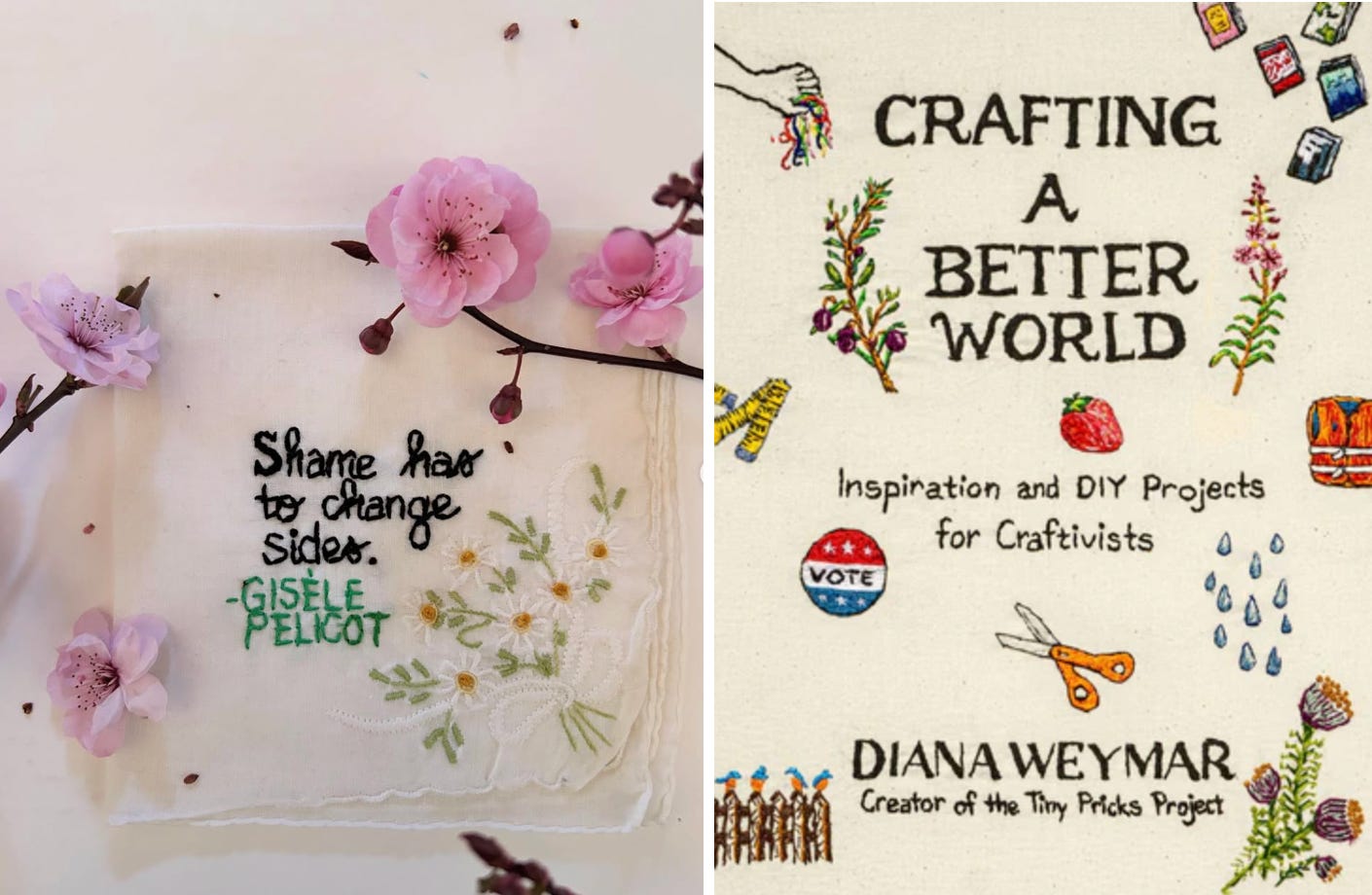
I know a lot of people who are turning to “craftivism” these days, as a way to calm their nerves through our unprecedented political moment, and to make statements with the end products. Diana Weymar comes to mind—author of Crafting a Better World: Inspiration and DIY Projects for Craftivists, and founder of Tiny Pricks Project, though which she emboriders inspirational and political sayings.
So I thought it would be a good topic to prompt you on. In the comments please tell us…
How old are you? Have you turned to crafting as a way to get through the current moment? What about “craftivism,” making things with your hands that have a political message? Are you new to crafting? Either way, how did you learn whatever craft you’ve been focusing on? What have you made? Have you engaged in your craft in the company of others? What effect has this kind of endeavor had on you? Answer as many or as few of these questions as you’d like! (If you’re commenting, please also do me the favor of hitting the heart button ❤️ for algorithmic purposes. Thank you.)
Me, I’m 60, and I have tried a million times to learn how to knit and crochet, and it never sticks. I do like drawing with crayons and cartooning—although I have yet to make cartoons that are in any way political.

Maybe when I have more time in my life, I’ll create some space for that, or some other mode of “craftivism” I can learn and engage in for the greater good.
Ellen Goldberg’s essay is below here. ⬇️
Tying Myself in Knots
Ellen Goldberg considers how knitting “emotional support chickens”—and crafting in general—in these times is both an act of resistance and self-care.
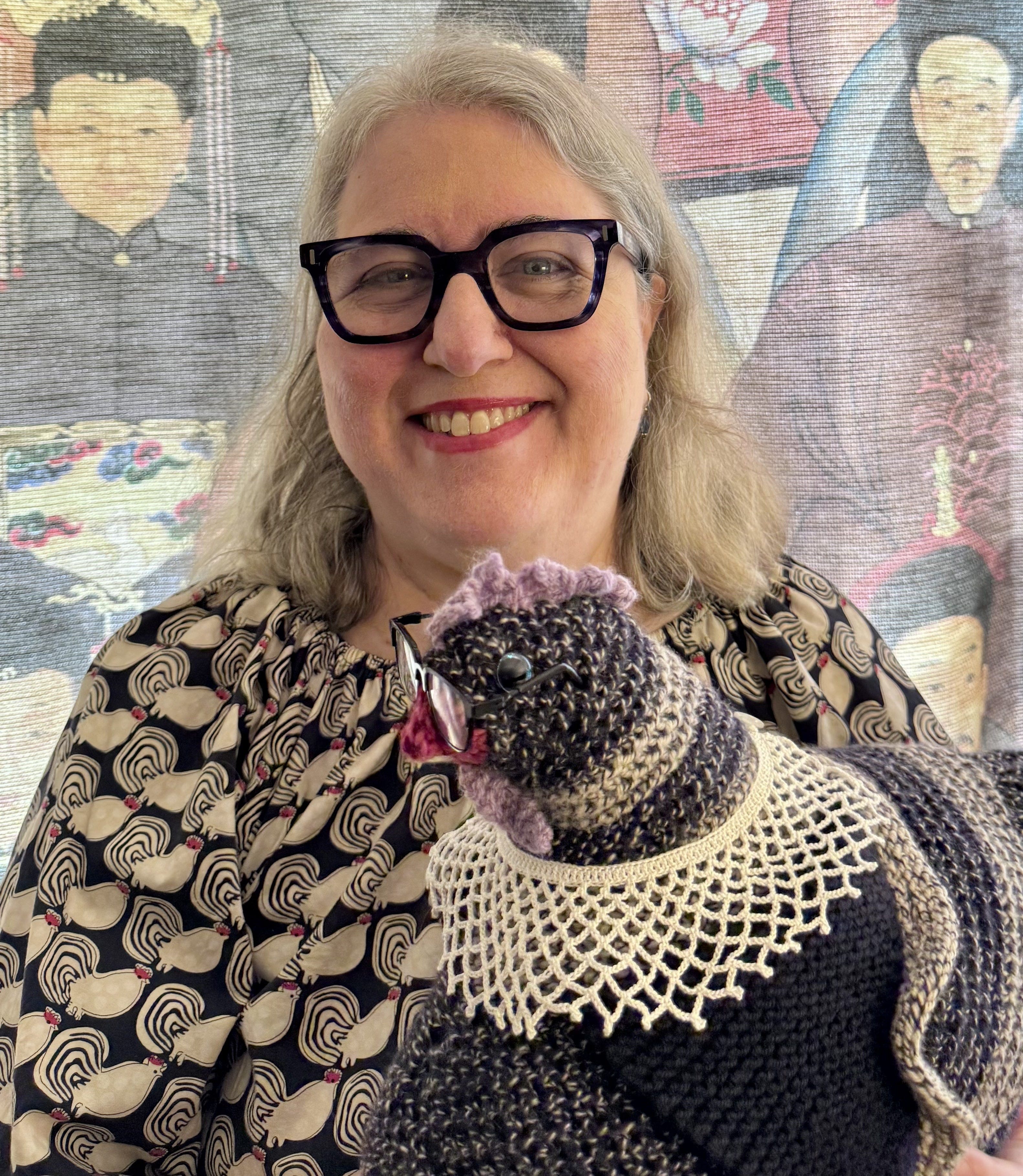
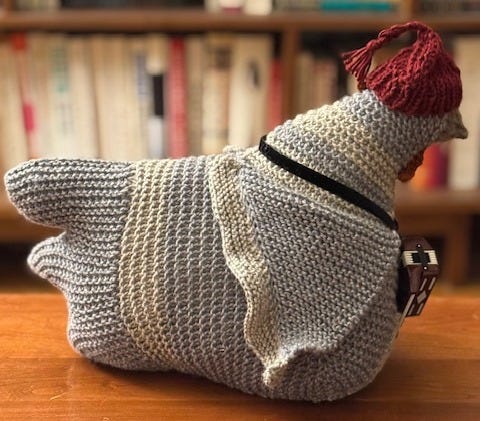
Recently, I spent a weekend rolling cigarettes. No, the onslaught of egregious news hasn’t driven me to smoke. I fashioned the ciggies out of cotton yarn for a chicken—a hand-knitted emotional support chicken that I’m crafting, to be more precise. I’ve made seven such birds in as many months. Since Inauguration Day, I have been knitting compulsively. The state of the world has me literally tying myself in knots.
I measure current affairs by my “yarn stash index,” a direct correlation between the level of geopolitical turmoil and the rapid proliferation of yarn skeins, now multiplying like Tribbles, throughout my apartment. In addition to the flock, since last January, I’ve knitted a blanket, five hats, three scarves, a poncho, two sweaters, eight cowls, and a Victorian house cat. By this measure, the index is bullish, making my local yarn store the sole neighborhood beneficiary of the Regime.
I fashioned the ciggies out of cotton yarn for a chicken—a hand-knitted emotional support chicken that I’m crafting, to be more precise. I’ve made seven such birds in as many months. Since Inauguration Day, I have been knitting compulsively. The state of the world has me literally tying myself in knots.
Never underestimate knitters. In uncertain times, we are able to gauge the political climate. While knitting’s popularity has fluctuated over the years, this “granny hobby” has a long history of political subversion (and my own grannies were formidable). After the 2016 election, a modern day Madame Defarge, I made forty-six pink hats for the January 2017 Women’s March (pink yarn sold out everywhere, so I wasn’t alone). The Pussy Hats followed in a long tradition of women’s craftivism in the U.S., from the “spinning bees” weaving homespun cloth during the Revolutionary War (rejecting British textiles as a symbol of colonial rule), to knitting socks for Civil War soldiers, to the AIDS quilt. While some doubt the political effectiveness of the pink hats, making them, and being part of that sea of pink in Washington, made me feel more connected and empowered.
Nine years later, protest has taken the shape of a red-tassled toque. In January, a Minnesota yarn store started a fundraising campaign for immigrant aid groups by selling patterns for red “Melt the ICE” hats, which draw inspiration from Santa-style caps knitted by Norwegians during the 1940s, to oppose Nazi occupation. By the end of February, the store raised over $650,000 through pattern sales, and since then there has been a nationwide run on red yarn. I just cast on my first one.
Crafters even assisted with the war efforts during the first and second World Wars, most notably Phyllis (Pippa) Latour Doyle, who died in 2023 at the age of 102. Doyle parachuted into Normandy in 1944 as a young British spy. Posing as a French soap seller, she knitted Morse code messages into garments, which were delivered through Resistance networks to the British, helping pave the way for D-Day. She chronicled her inspirational story in her memoir, The Last Secret Agent.
Don’t worry. I haven’t coded secret messages into my birds’ tailfeathers. Yet.
This time around, at age 59, my knitting is driven mostly by joy, rather than rage. Knitting helps me create and share moments of happiness, which is in itself a form of resistance. Beyond politics, this past year has been exhausting, between work, eldercare, and the losses of a friend, two cousins, and my beloved geriatric cat. I spend much of my professional life tackling AI-related legal issues, so it helps to spend my free time hand-crafting tangible items. Occupying my hands with knitting needles also prevents me from doomscrolling. I always tuck a small project into my bag, to calm my daily commute. Transforming a ball of wool into a decorative handmade object is my personal form of magic.
I measure current affairs by my “yarn stash index,” a direct correlation between the level of geopolitical turmoil and the rapid proliferation of yarn skeins, now multiplying like Tribbles, throughout my apartment. In addition to the flock, since last January, I’ve knitted a blanket, five hats, three scarves, a poncho, two sweaters, eight cowls, and a Victorian house cat.
My mom taught me to knit, but my reliance on knitting as a coping mechanism stemmed from my late father, who was a psychiatrist—or, specifically, from one of his patients. Dad was supposed to be a blank slate to his analysands, but let it slip that he had a daughter. Obsessively, to ease her anxiety, one patient stitched tiny, painstakingly intricate, colorful petit point Persian-style rugs which, to my delight, arrived in rapid succession, beginning when I was about 10. Even as a child, I appreciated how much work went into creating those carpets. Dad and I built a dollhouse to showcase them. Constructing it instilled a life-long love of making, from cooking, to writing, to fiber arts.
Lately, I have been channeling that prolific petit pointing patient. Dad might diagnose me with Obsessive Chook Disorder, but there are worse ways to cope. And, like his patient, I give much of my knitting away as gifts.


Last spring, I stumbled across an article about crafters making emotional support chickens. At first, I thought it was a protest against rising egg prices. Research led me to a burgeoning online community of more than 8,400 chicken knitters, who knit to comfort others.
Why emotional support chickens? People keep actual live chickens as emotional support animals—apparently they reduce anxiety and taking care of them gives people purpose. That seems to be the genesis of the chicken knitting groups.
Chickens are fascinating. My friend Nene and his wife also had backyard chickens in Topanga, California. He once told me that chickens enjoy classical music, which calms them and boosts egg production. One day, Nene came home to discover a diaper-clad chicken in the house, clucking along to Verdi. I made them Topanga “Toppi” Hen-dren as a present.
In real life, my preferred emotional support animal is a cat (and I also like dogs but have never had my own). I am catless for the first time in more than twenty years, so that may be part of why I latched on to the emotional support chicken fad.
In my first foray, I decided to make a miniature bird for my cousin, Irene, who went into hospice last June. Irene was a talented quilter, so I knew she’d appreciate a handmade gift. My first instinct had been to bake, but she could no longer swallow. Her younger sister, Laura, told me the story of a neighborhood chicken that used to wander into Irene’s yard. I made Irene a pink chick, using wool left over from the pussy hats. She welcomed it with a smile, and named it Rosie. Her kids told me it was her constant companion until she passed away two months later.
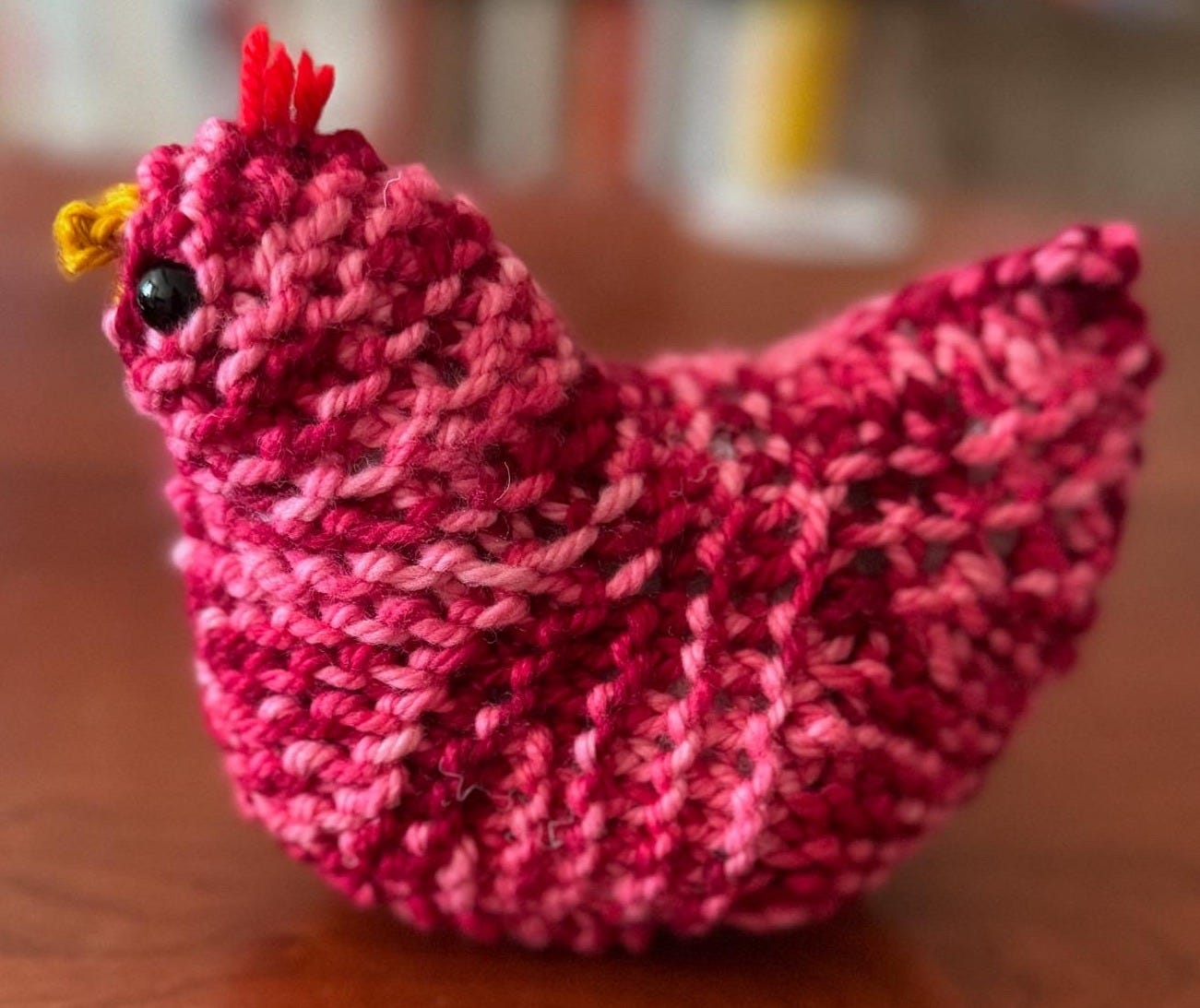
Having learned the basic technique, and armed with evidence that the chick provided actual emotional support (for both maker and recipient), I decided to make another. I stitched a bigger hen, which I gave to my lawyer friend Mel, who has a backyard henhouse. She named it Judge Cluckmeyer and, as a thank you, gave me a dozen eggs from her girls.
This “granny hobby” has a long history of political subversion (and my own grannies were formidable). After the 2016 election, a modern day Madame Defarge, I made forty-six pink hats for the January 2017 Women’s March (pink yarn sold out everywhere, so I wasn’t alone). The Pussy Hats followed in a long tradition of women’s craftivism in the U.S., from the “spinning bees” weaving homespun cloth during the Revolutionary War, to knitting socks for Civil War soldiers, to the AIDS quilt.
Crafting cultivates crucial connections, especially when done collectively. Over the past year, my friends reconstituted our decades-dormant stitch and bitch group (spoiler alert: more bitching than stitching). As we knit, we discuss issues that impact our lives. This creative coterie, which I affectionately dubbed the Knitterati, has evolved into a political giving circle under the leadership of these crafty women (and one man).
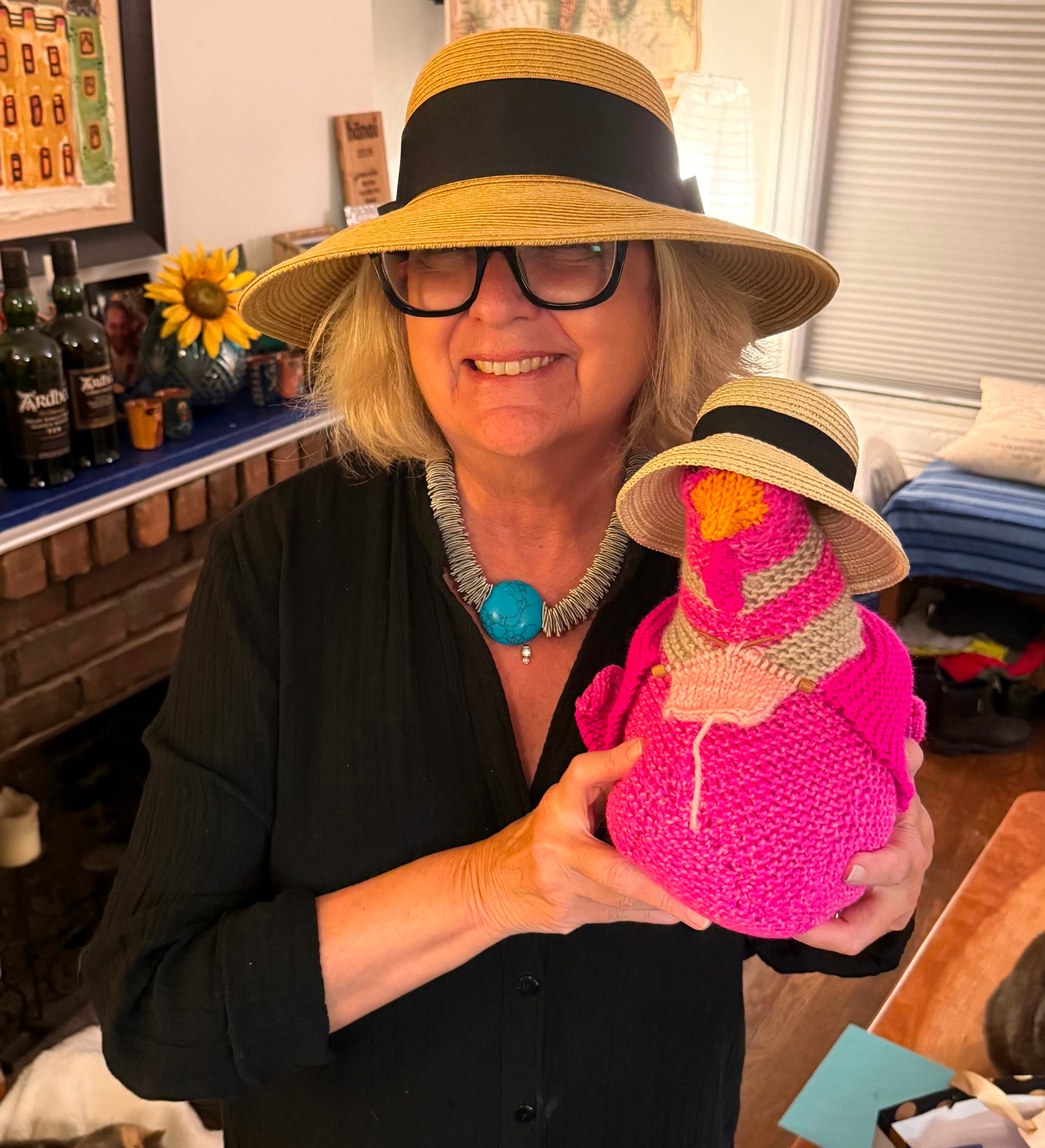
I’ve discovered a similar sense of community in writing workshops. For my friend and writing teacher Ann Hood, a voracious knitter and traveler (and author of Fly Girl), I crafted “Hen Hood,” a hot pink doppelgänger sporting tiny knitting needles and a traveling hat.
I decided to up my game and try a more complicated bird, which brings us back to the knitted smokes. I made the cigarette pack as an accessory for “Chickstina the Astonishing,” a cigarette-smoking hen, wearing a nun’s habit, inspired by the cover photo of my friend Marianne Leone’s debut novel, Christina the Astonishing, based on her childhood in parochial school.
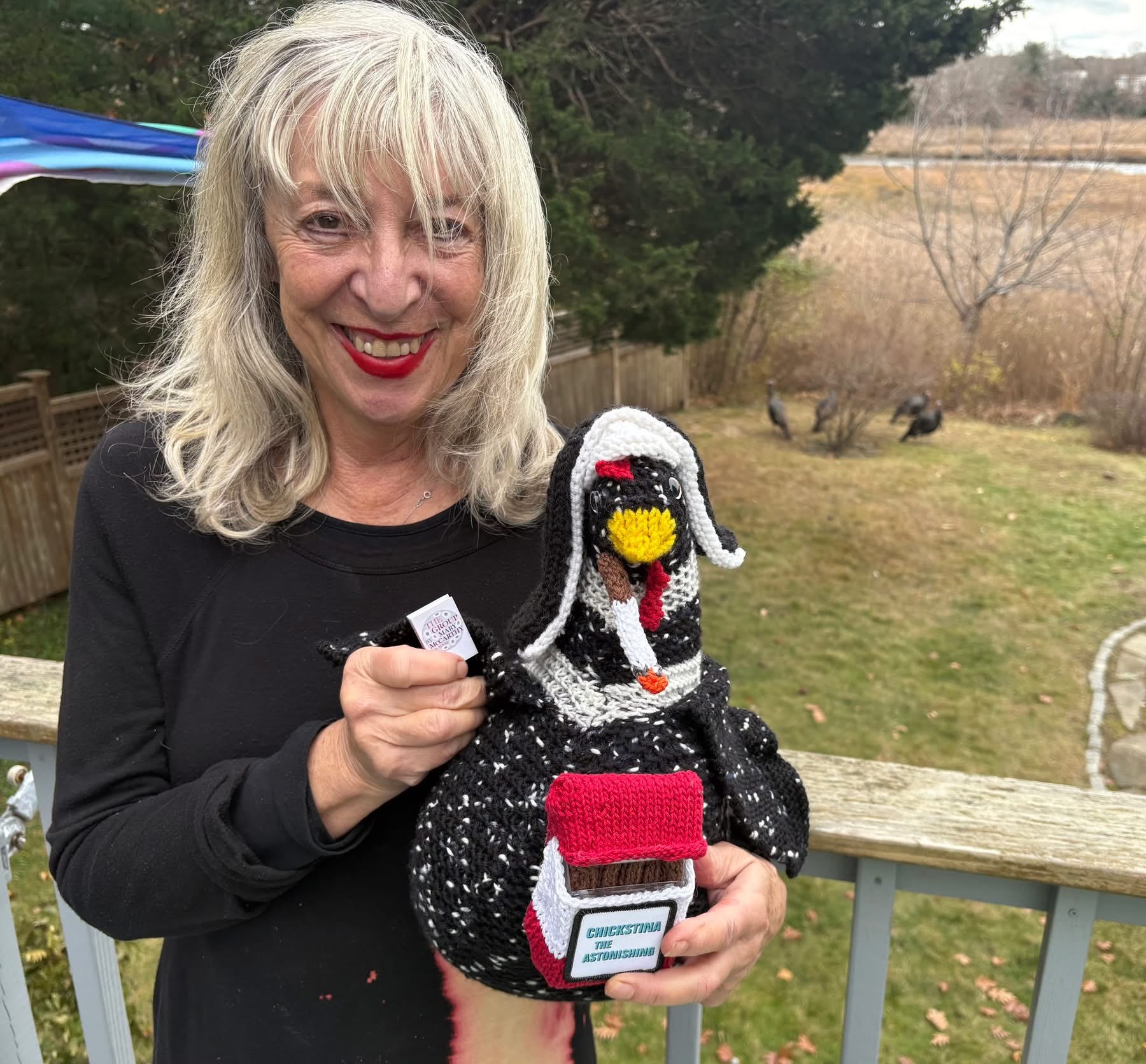
For this smoking nun, the devil was in the details. I started by knitting a speckled black hen. It took me three attempts and a hot glue gun to finish the cigarette box. I couldn’t track down a pattern for a habit, but found one for a nun tea cozy, which was roughly the same size as the chicken, so I deconstructed it and made a wee wimple. I fashioned a little yarmulke to sew inside the veil, to balance it on this ecumenical bird’s head. The headgear detaches in case she decides to leave the flock. An orange-tipped “lit” cigarette snaps under the wattle, so Marianne can detach it if this chick goes cold turkey. And there is a little pocket under one wing, to hide a miniature banned book.
I hesitated to tell my workmates about my knitted poultry obsession, but they embrace my quirks, and several have requested their own chickens. One declared that I am in my “Hen Era.” When I showed a colleague Chickstina, he regaled me with the story of his stepmother, a former nun. And I discovered a group of knitters (and some unexpected needle-pointers) in our legal department.
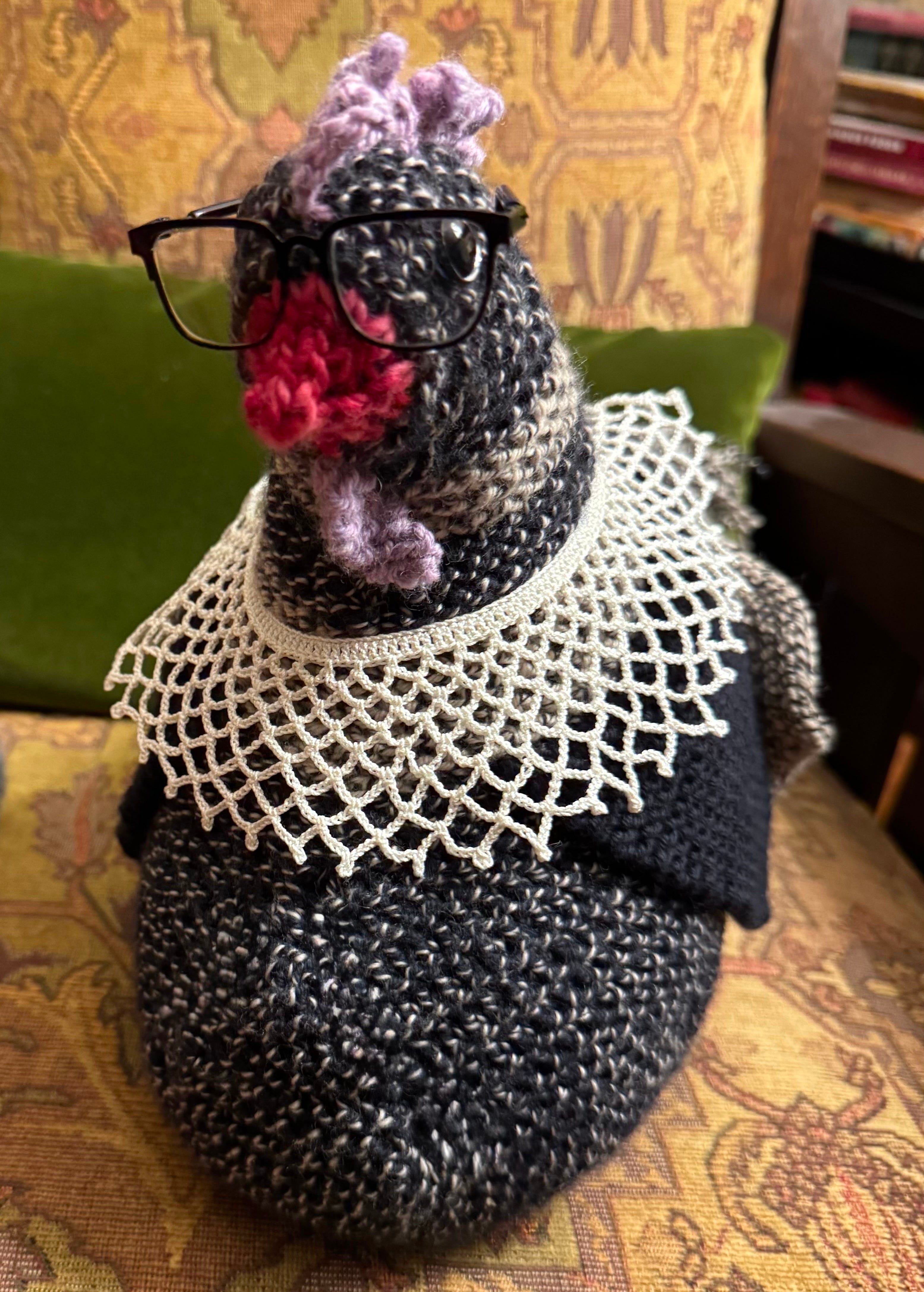
I just finished a chook for myself, Ruth Bader GinsBird—complete with tiny metal spectacles and a crocheted dissent collar—to reassure me that the rule of law will survive. This notorious little chicken makes me feel brave. Perhaps I’ll knit an entire avian Supreme Court to tide me over until the real one returns to order.
Crafting makes me better at any endeavor, from cooking, to lawyering, to civic engagement. Find your people. Be resourceful. Do your research and search for precedent. Read the directions and formulate a plan. Make sure you have the necessary tools, skills and materials. When required, ask for help.
Once you have mastered the basics, push yourself to make it more complicated. Embrace the joy that comes from using your imagination to create something that makes you laugh. When it feels like the real world is unraveling, stitch something together. Engaging in crafts offers a sense of agency, control and accomplishment, providing order amidst the chaos.
Most importantly, make mistakes—learn from things that go awry, and improve the next iteration, be it a legal argument, a knitted chicken, or our wobbly democracy.
Previously Ellen Goldberg wrote “How the Turducken Stole Thanksgiving,” and “Beating Around the Bûche (de Nöel)” for Oldster.
Okay, your turn:
How old are you? Have you turned to crafting as a way to get through the current moment? What about “craftivism,” making things with your hands that have a political message? Are you new to crafting? Either way, how did you learn whatever craft you’ve been focusing on? What have you made? Have you engaged in your craft in the company of others? What effect has this kind of endeavor had on you? Answer as many or as few of these questions as you’d like! (If you’re commenting, please also do me the favor of hitting the heart button ❤️ for algorithmic purposes. Thank you.)
Big thanks to Ellen Goldberg. And to all of you for reading, and commenting kindly and thoughtfully. Oldster has the best comments section around!
Thanks, too, to those who support Oldster with paid subscriptions. 🙏💝
 | A guest post by
|
This is so wonderful! Thank you.
I am 71 and this articles made me smile which is a great way to start the day. I have almost finished my “Melt the Ice” hat. I find knitting a wonderful tool for relaxing and my favorite is to sit with my dear friend while she embroiders and we talk about many things. We have known each other so long you never know what comes up. I basically self taught myself but I did join one class. I would like to try more complicated patterns but for now I have been knitting hats. I have not been able to learn other crafts so far but I have a spinning wheel and yarn from sheep I have raised. I love chickens and have ordered chicks that I will pick up May 14 so I am looking forward to that!