

Imagine You’re Her
Jessica Handler on channeling her novel's singer-songwriter protagonist so that she can sing the songs she wrote for her unabashedly.


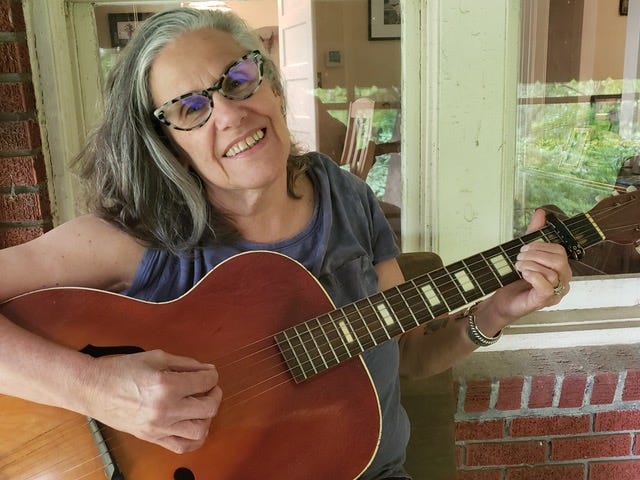
“Imagine you’re her,” my voice coach tells me. She’s at the piano, and I’m bouncing on my toes beside her, trying to relax as I gaze at the lake view from her living room. The voice she wants me to imagine is big, loud, and full of emotion, a voice with the power to reach past that lake. A voice that belongs to a character I made up.
Several months earlier, I’d come up with the idea to record two songs that I’d written, on a whim, for the rock star character in my new novel, The World to See. These would be fun, I thought, a way to create a little extra environment around the book. I was happy with the lyrics I’d written, and thrilled when a singer-songwriter friend agreed to put them to music. But when I tried the chords she’d written on the guitar I rarely touch, the tremulous sound of my own voice reminded me that I’d overlooked something crucial. I hadn’t sung in public for nearly half my life, and this wasn’t fun at all. This was a bad idea.
I read once that when we hear a song we like, we either imagine ourselves the singer or the person being sung to. In high school, I imagined I was the singer. I styled myself a Janis Joplin wannabe; cigarette in the corner of my mouth, torn jeans, my “wild child” attitude obscuring my anxious heart.
Back then, my friends and I all wanted to sing like Joni Mitchell, Carly Simon, Joan Armatrading, the Beatles, the Stones. We sat cross-legged in circles on the grass in the park and sang. We sang in the school’s smoking lounge. (This was the ‘70s.) We sang in each other’s bedrooms and rec rooms, and most of us toted guitars everywhere, even if we could barely play.
In college, my Joplin persona splintered into Maggie Roche and Donna Godchaux-shaped pieces. With those singers in mind, I attempted close harmony in dorm rooms and apartment kitchens with friends, but I accepted that where I belonged was wailing backup vocals behind the band boys at parties.
“Imagine you’re her” meant putting myself in my novel’s rock star character’s place. “How does she feel about that guy in the rock song,” my voice coach asked. “How deeply does she miss her mother in the ballad?”
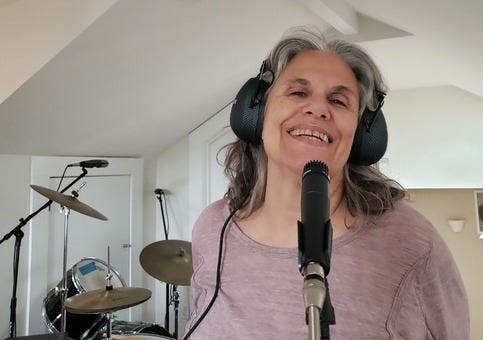
A character in a novel, if she’s going to feel real, shares some of the author’s emotional DNA. If I was going to sing reasonably well, I had to stop pretending I was singing alongside Joni Mitchell or Grace Slick, and instead open up my heart and allow myself to be vulnerable. The pain of missing my mother had to overtake me. My rage at any number of boys and men who’d seen me only as a body had to shake the room. But if I did, I might crack open, and what would I do with that ruptured mess of me?
But I’d said I’d do this. Four friends, talented musicians with years of experience on stages and in studios, had agreed to play guitar, bass, drums, and piano on these songs, with me singing. One is a gifted sound engineer, and we would record in her basement studio. There was a tab on my website ready for the song links. My anxious heart wrestled with the promises I’d made, and when I wasn’t practicing the songs at home, I practiced excuses for giving up.
In the lesson, my voice coach played the rock song’s opening chords again, and I closed my eyes and imagined her voice: Celeste, my fictional young woman at the microphone who wants more than anything to be heard for who she really is.
I knew that feeling of not being heard. I knew it because once upon a time I’d convinced myself that I was a good girl, a polite girl, although rarely a quiet girl. I know it now because I’m 66 and people don’t always see me. When they do, they assume that I’m sweet or meek because of the gray in my hair. (Never mind my tattoos or my propensity for elaborate swearing. I’ve been described as having “punk rock” energy, which I think means that some people don’t quite know what to make of me.) As my voice rang out in that room, more than heard, I felt my book’s main character inside of me, and I let those feelings reach almost as far as the lake.
I knew that feeling of not being heard. I knew it because once upon a time I’d convinced myself that I was a good girl, a polite girl, although rarely a quiet girl. I know it now because I’m 66 and people don’t always see me. When they do, they assume that I’m sweet or meek because of the gray in my hair.
The day we recorded, my nerve faltered under the weight of my own expectations. I’d been in studios before: in my 20s, I worked closely with the music producer on a song-themed television show in Los Angeles. My favorite thing to do in those days, in addition to bringing armloads of charts—chord notations for various instruments—to the soundstage, was to page through the massive PhonoLog Reporter loose-leaf binders and read up on every recording by every artist I could think of. (The show’s writers sometimes needed this information, but mostly I was nerding out on arcane music trivia.) When I moved to another show, I was sometimes the person tapped in a crisis to phone the instrument rental company on Sunset Boulevard for replacement drum heads, extra guitars, or an esoteric instrument I’d never heard of. I loved being in the thick of things while professional musicians did their work.
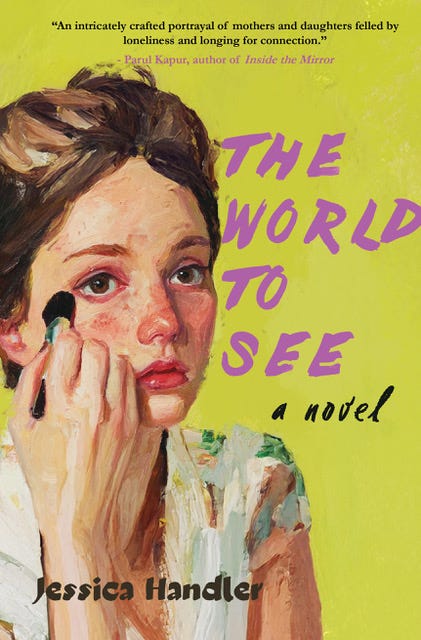
My mouth was dry and my hands were sweaty in my friend’s studio, but when I slipped the headphones on and stepped up to the mic, I realized that my novel’s character could feel nervous, too. I’d read about Carly Simon’s stage fright and Janis Joplin’s fear of failure; the women I’d wanted to be when I was young had been afraid, too. When I had trouble singing a slower tempo bridge, I took my friend’s advice to “talk it through.”
When I was asked to sing the chorus to the rock song several different ways, I went for it, knowing that the plan was to multi-track my voice so I’d sound like I was harmonizing with myself. And at the end of the night, when I heard my own voice in playback, I was stunned. I sounded, if not confident, fully present. I could still carry a tune. And more than anything, I heard myself in a way I’d never heard before. Vulnerable. Ferocious. My anxious heart, open to the world, and having fun.
I can’t be great, or even good, at everything. I can be just okay. Writing those songs, then trying to play the chords, and finally trusting my friends–and myself–to record them gave me a deeper understanding of the singers I’d admired as a young woman. I’d thought they were perfect (never mind that that “Perfect” was Christine McVie’s original surname.) They’d sounded great to teenaged me. They sound even better now.
What took me decades to learn was that their voices were guiding me toward finding my own, and how hard it can be, sometimes, to hear ourselves.
Listen to Jessica Handler singing “Blossom Queen” and “Doll Named Body”—two songs she wrote for her protagonist’s “band,” “Celeste and the Heart’s Desire.”
Jessica Handler is the author of the novel The World to See. Her novel The Magnetic Girl was awarded the 2020 Southern Book Prize. She’s the author of the memoir Invisible Sisters, one of the “25 Books All Georgians Should Read,” and the craft guide Braving the Fire: A Guide to Writing About Grief and Loss. Her writing has appeared on NPR, in Tin House, Drunken Boat, Five Points, Image Journal, Another Chicago Magazine, The Bitter Southerner, Salvation South, Brevity, Creative Nonfiction, Newsweek, The Washington Post, Oldster—where she previously wrote “Owning My Worth,” and elsewhere. www.jessicahandler.com
 | A guest post by
|
Thank you. "Vulnerable and ferocious" are a perfect pair of attributes.
Wow. You are a great singer, a bit Patti Smith-ish (and Carly Simon yes!)
Love the whole endeavour you went into, so brave, and I will go buy your book now.
You are an inspiration! 💜