



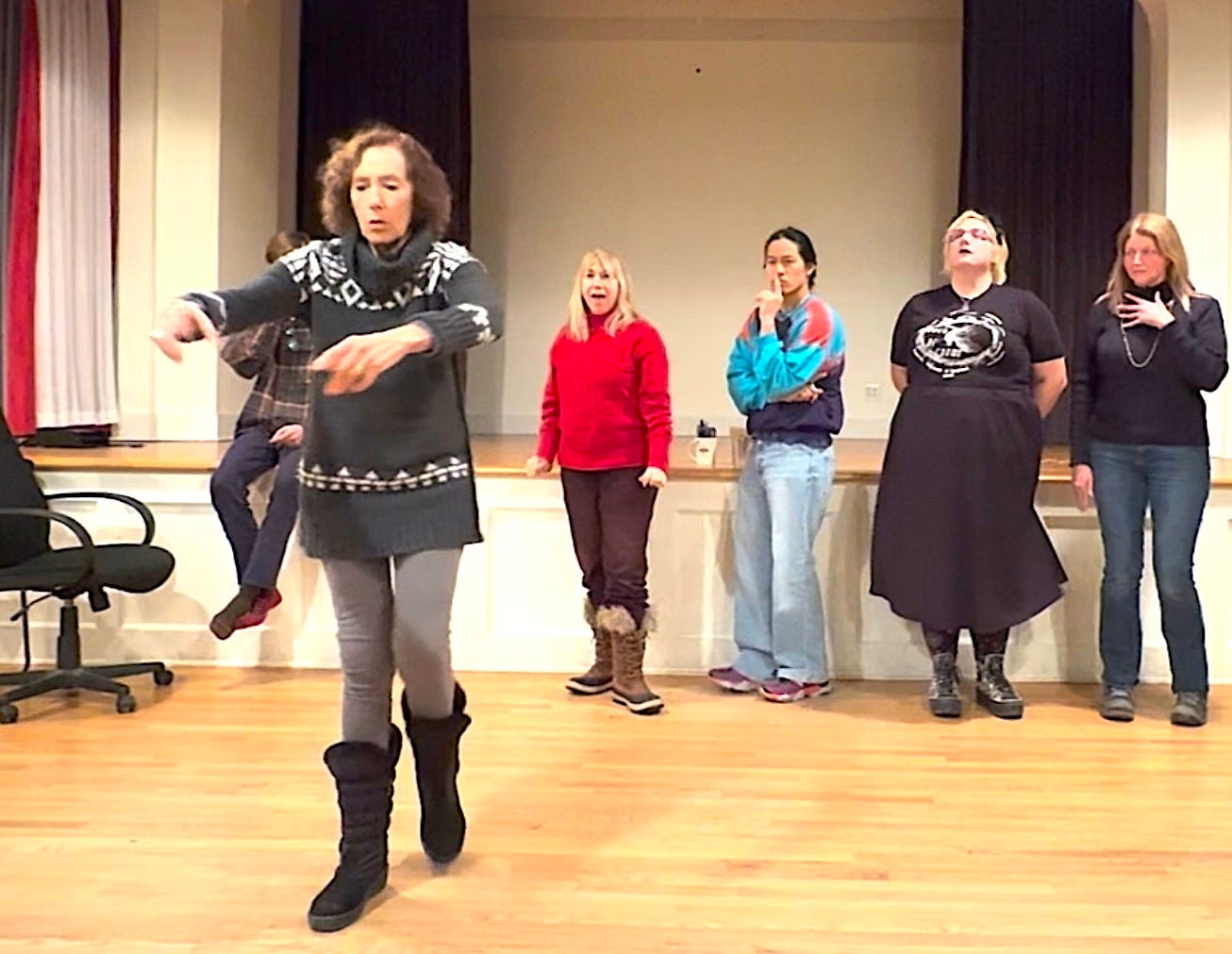
Sam could’ve been a drill sergeant the way she shouted out what I was to feel: “Sadness! Fear! Anger! Fear! Joy! Sadness! No words!” I was supposed to let my partner know only with my eyes what was going on with me. A few decades younger—imagine thinking like that, in decades—the woman I was paired with must’ve had practice. Her eyes teared up on command. Me, not exactly. Call it body literacy. Getting out of my head would take time.
I was participating in the second improv class of my life, the first having taken place only the week before. I’d signed up for Level One Improv because I decided that at almost 78 it was time to free my inner child. That child, Sam said, didn’t think twice before throwing imaginary balls in the air, or galloping across a field, or swimming upstream. That child didn’t second-guess herself. That child lived in the NOW.
Zen Mind, Beginner’s Mind, “In the beginner’s mind are many choices, in the expert’s mind are few. Write with your beginner’s mind.” -Bill Roorbach
Getting in touch with that child was going to take a lot of work, which was why I was there. To let go. As a writer, I wanted to be free of my ready editor, who stood on duty before any words even hit the page. I don’t write fiction because I’m not good at spinning stories. Improv is all about spinning stories, and quickly. How would improv impact my memoir and creative nonfiction writing?
Could I give myself over to being embarrassed? Imperfect? Characterized as emotional nudity, improv would test me beyond my expectations.
“What makes you a good performer?” -Ezra Klein “I have no fear.” -Patti Smith
I’m not a performer. In fact, as a writer and psychologist, what I do is just the opposite—my work is done either in solitude or with one or maybe a few other people.
I was participating in the second improv class of my life, the first having taken place only the week before. I’d signed up for Level One Improv because I decided that at almost 78 it was time to free my inner child. That child, Sam said, didn’t think twice before throwing imaginary balls in the air, or galloping across a field, or swimming upstream. That child didn’t second-guess herself. That child lived in the NOW.
The premise of improv is adopting a “Yes and…” mentality. Whatever your partner offers, you accept it, then build on it. You’re in a conversation with someone else. There’s no pre-planning or thinking ahead because that would put you in your head with your thoughts, causing you to miss what they’re going to say next. Questioning is a no-no because it burdens the other person, and takes them out of the moment, spoiling the unconscious-mind immediacy vital to improv. Instead, they’re challenged with doing something, saying something, answering whatever you asked.
I broke that rule, asking questions because I was not yet oriented toward creating on the spot. It felt like instances in which I needed to make small talk, also not a strength of mine. And as a therapist I’m all about asking questions. It took me the entire first Level One workshop series to unlearn that.
But let’s begin at the beginning. Level One, Day One: We opened by sharing basic information about ourselves, including our ages. I told them, No effin way. Next we were introduced to a warm-up routine that had us flinging and flailing our bodies around the room, yelling and squeezing each other’s hands. I learned this was how every class would start.
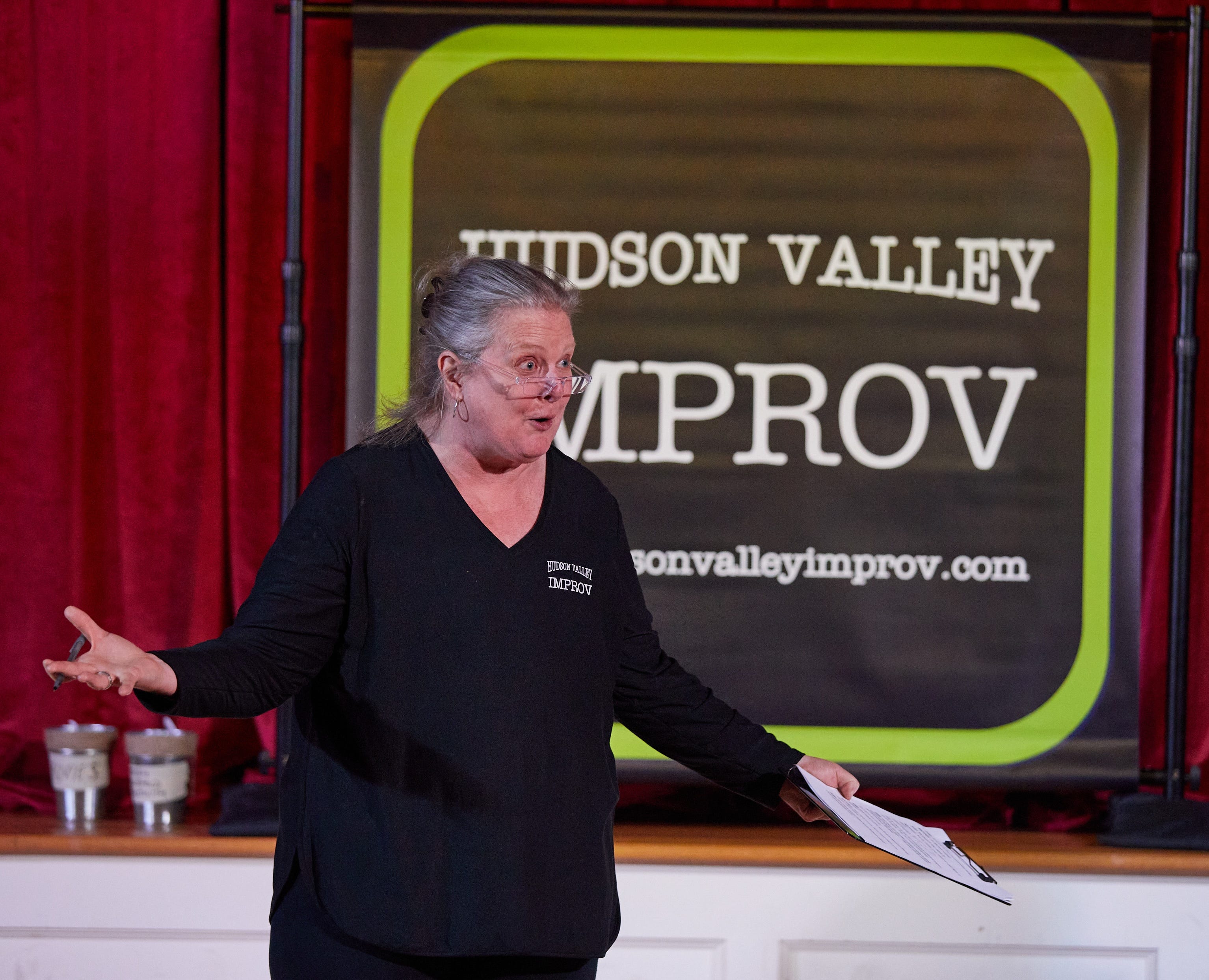
Fortunately I wasn’t the only one who couldn’t throw herself on the floor with abandon, wasn’t the only one with a hip replacement. And there were several others with wonky knees.
The crux of the classes was the “exercises.” To illustrate, a partner and I were tasked with pretending to paint very high-end bird houses, keeping track of what had been painted and what still needed to be done. Adding tension to the bit was the notion that Oprah would be showing up within the hour to pick up the bird houses for her country estate. My “co-worker” and I were to have a conversation. We could talk about what we had for dinner or movies we’d seen or anything else—just not about bird houses or Oprah. Our only tools for communicating the story: the air and our imagination. It was kind of like the trick you did as a kid, rubbing your stomach and patting your head at the same time. Parenthetically, I thought, Maybe at least this has the same brain health benefits as doing crossword puzzles.
After the first class I was filled with dread about the second class. After the second class I thought about going on to Level Two. Not so fast. At the end of the last session I learned I had to repeat Level One. Who knew you could “flunk” improv? I was challenging a lot of years of being cautious. And of asking questions.
Mid-September, the sun already setting earlier than I liked, I reminded myself of my goal of mental liberation, and embarked on round two of Level One.
After the first class I was filled with dread about the second class. After the second class I thought about going on to Level Two. Not so fast. At the end of the last session I learned I had to repeat Level One. Who knew you could “flunk” improv? I was challenging a lot of years of being cautious. And of asking questions.
For so much of my life, for reasons I won’t get into here, I’ve battled to be “good enough.” And now, here I was engaging in an activity where I was flagrantly not “good enough.” A friend of mine who’s known me since college (and that’s a very long time), would clarify that for me it’s actually about being more than “good enough.” Probably more like “better than,” and she’s right. By placing myself in an arena where “better than,” let alone “good enough” weren’t on the table (yet!), I was taking vulnerability to a new height.
At the beginning of each session I’d announce that I had a love-hate relationship with the experience. I’d have the same kind of anticipatory anxiety that I used to get before a school exam. But it’s the damndest thing, I laughed more once I was at improv, than anywhere else.
“If improv could be snorted, I would have cooked it and injected it. To put it mildly, I was all in.” -Jeff “Boom Boom” Hiller, who plays Joel on Somebody, Somewhere
Readying myself for the last class of my second round of Level One, I didn’t know whether I wanted to succeed or not. If I did, that would mean four more classes to challenge me. My graduation to Level Two remained tenuous, and I was beginning to feel bad. Improv isn’t supposed to feel bad. During the last class of Level One I found myself clanging and sirening across the stage as an emergency vehicle. I really threw myself into it. Before I knew it, I’d broken out and clanged my way to Level Two.
My induction into Level Two wound up being delayed, so instead of having just a few weeks to second guess my plan to advance, I had a few months. What was I doing? Why couldn’t I be satisfied with completing Level 1? What was I proving and to whom? Maybe, I thought, there are improv people and non-improv people, and I just fall into the latter group.
Yet once I walked through the door and up the flight of stairs, I arrived back in Never-Never land. A place where we’ve given each other permission—a gift—to participate in the absurdity of life without risk.
So there I was the first night of Level Two class, charged with instantly transforming myself into an ant farmer who needs to deliver 500,000 ants to Excelsior, Vermont for a fishing convention taking place there at the end of the week. Don’t try and find the town on the map.
Moving through Level Two, the skits became more involved and interactions with other players became more interactive and demanding. On the spot songs were incorporated. I, who early-on was told I was tone deaf and to mouth the lyrics, “found my voice,” but this had nothing to do with staying on key.
The culmination of Level Two is a performance in front of a real audience. Rehearsing for our big night, for not the first time, Sam reminded the class about our inner child who’s just busting to get out. “Go back to that child,” she instructed. “She didn’t have to make sense. As kids, we went wherever our unfettered minds took us.”
Ah, but Sam, so much has happened since then.
I went to a public elementary school in New York City. My first years there I was known as “Johnny’s sister.” Johnny was a very smart boy and whether I, his younger sister, would prove to be of like mind was an unknown. Yes and no. Graduating from sixth grade (back then elementary school finished after sixth grade) the school selected a boy and girl valedictorian to represent the grade. I was selected to be the girl valedictorian. Why I was selected, even with hindsight, is unclear to me. I didn’t feel so smart. The memory that stands out is not graduation day or my appearance onstage then, but rehearsal. The discomfort I felt sitting on stage, flinging myself in the chair. I sat sprawled awkwardly, the skirt of my red shirtwaist dress in disarray.
“Nancy, sit up like a lady.” The instinct not to be seen had already taken root.
“We are social creatures to the inmost centre of our being. The notion that one can begin anything at all from scratch, free from the past, or unindebted to others, could not conceivably be more wrong.” -Karl Popper
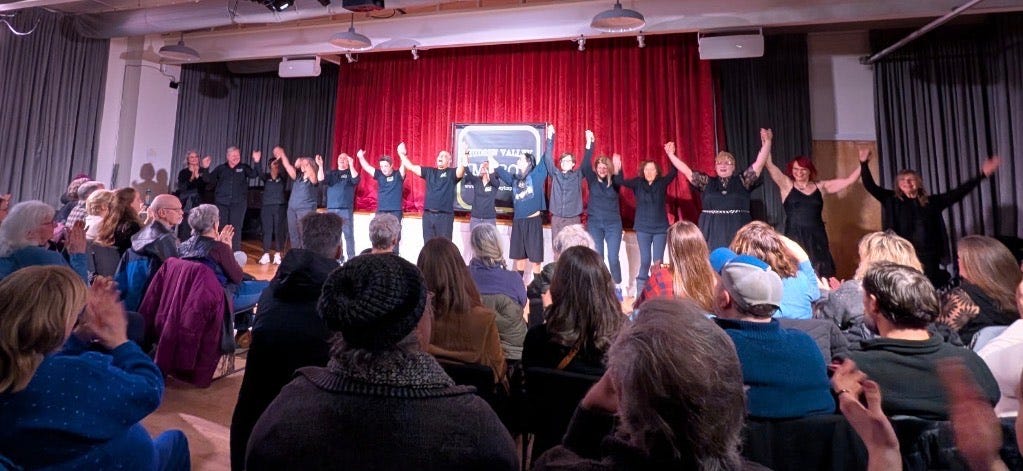
Before the final improv performance, we were sent an email with a link to a recording of our dress rehearsal. I debated whether I should watch it, whether I’d become more upset, more anxious, seeing myself. I decided to take a chance and look. It turned out to be surprisingly helpful and not utterly demoralizing. For example, I got to see that I tend to keep my arms stuck in a right angle position, as if I’m about to offer alms. And I learned that when they’re not stuck, I have a habit of repetitively swaying them from side to side. I could be soothing a baby or about to toss one out the window. In the middle of a boring song about roses that I’d created on the spot, swaying away, Sam came up to me, and took my hands mid-sway. “Tell me how you hate roses,” she said.
“I hate roses,” I began. “I hate roses. Roses are a trite gift. When I was a girl no one gave me roses. I didn’t get roses because no one loved me. Poor me. Poor poor me. Waaah.”
My induction into Level Two wound up being delayed, so instead of having just a few weeks to second guess my plan to advance, I had a few months. What was I doing? Why couldn’t I be satisfied with completing Level 1? What was I proving and to whom? Maybe, I thought, there are improv people and non-improv people, and I just fall into the latter group. Yet once I walked through the door and up the flight of stairs, I arrived back in Never-Never land. A place where we’ve given each other permission—a gift—to participate in the absurdity of life without risk.
Flip the script. Be absurd. Life is absurd so much of the time. And with improv we get to laugh at that absurdity.
And to stop thinking. Reawaken our beginner’s mind. Or, as Sam says, improv is about living in the truth. Also, I’d say, living with trust. As Grant Faulkner writes in his newsletter, Intimations: A Writer’s Discourse, “Trust defines our relationship with ourselves.” Yes, and I’d suggest that it also defines our relationships with others. When we’re young, kid-young, we don’t understand how vulnerable we are. With age and experience we become aware—and often afraid of—our vulnerability. We become all too conscious of the potential consequences for putting ourselves out there. Reverting to kid-young again—that’s improv.
“Live your life as an experiment…It comes down to keeping your heart open and being vulnerable.” -Pema Chodron
I ask myself, why has improv been so destabilizing for me? As it turns out, my foray into it, though initially about fear with a little “f,” was really about fear with a big “F.” About coming to terms with how Fear has dominated so much in my life and the choices I’ve made. I hope I’m on my way to unlearning that, scene by scene. It’s time, I thought—it’s time to not give a damn. That’s what got me climbing the sharp flight of stairs on Monday and Wednesday nights, on my way to learning how to let go.
January 31, one day shy of the full moon—the snow moon—it was show time. While performing improv—I often find myself laughing, even as I feel how my body holds tension. Laughter, for the actors and the audience, is such a gift. That night I made people laugh.
“You were hilarious—a very funny pelican,” my friend said. How great is that? Flapping and croaking and slurping fish—who knew that I had pelican in my blood?
Driving home I had a sense of hope the likes of which I haven’t had in a long time. A hope that transcended my concerns about my old-ness, and the myriad other things that make me fret—a hope that gave me a sense of renewal. A sense that this was Day One of whatever might be next.
“A shout out to Samantha Jones and her partner Michael Withall at Hudson Valley Improv, who took me where I didn’t know I could go, and to my fellow players.” - Nancy Jainchill
Previously Nancy Jainchill wrote “What I Learned From Doing Amateur Porn in my 20s” for Oldster.
 | A guest post by
|
Nancy, you are a pelican, a lion, a Victorian child rolling a hoop down a hill, and anyone else you want to be in a flying moment. It’s fun and inspiring to see you cut loose in this essay.
Improv is definitely a life-changing path. And yikes. Your class sounds like the deep end of the pool. good for you. As a therapist you might be interested in InterPlay.org. Our practice is less performative and more about restoring one’s ability to create and unlock the wisdom of the body individually and collectively. Leaders are all around the world and apply InterPlay principles and practices across disciplines.