

Where’s Caroline?
Sallie Reynolds contemplates the fate of a girl a few years older who disappeared from her midst in 1951.


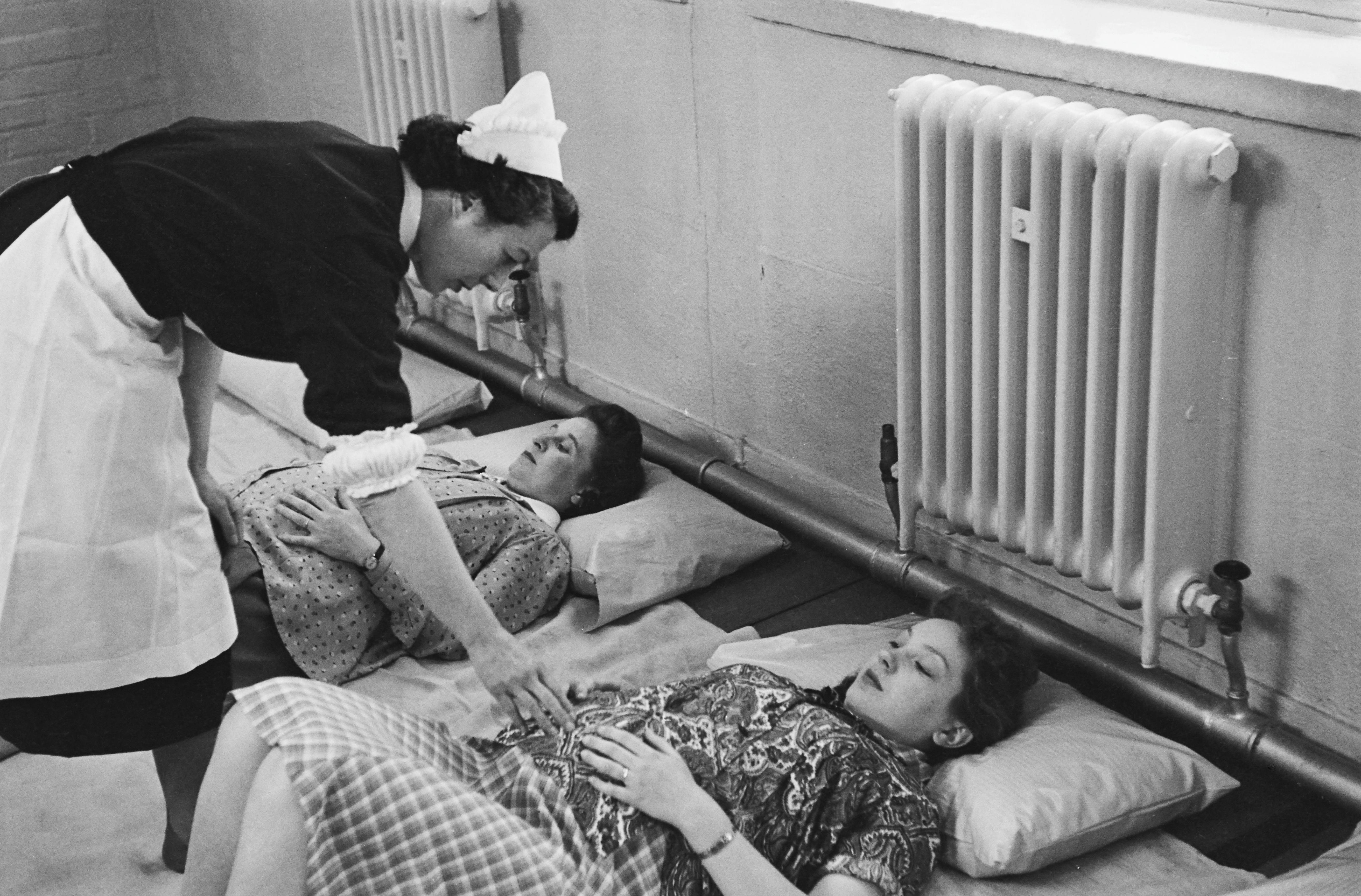
When I was 12, Caroline, two years ahead of me in school—pale, bony, cotton-white hair and eyelashes—got “knocked up.” A quiet girl. But with that ghostly hair and skin, and eyes that would suddenly flash, you knew she was there.
Then one day she was gone.
Knocked up. Kicked out. Banished forever to Whisperland.
This was rural Virginia, 1951. Except for avid attention to animals, we kids knew nothing real about sex. No internet, sex-ed, anatomy books, not even Playboy. My father was a doctor, but even so, his theme-song was “Wait till you’re older.” We were stuck with school-yard gossip.
What’s knocked up?
Preg-a-nant.
How did Caroline get preg-a-nant?
A guy put his thing in her hole.
He put a baby in there? Didn’t it hurt?
The baby grows inside your stomach, stupid, and comes out through your hole.
Your hole stretches from the width of a soda-straw until a grapefruit can pass through.
No “fact” ever had a tenth the power of that straw.
One day she was gone. Knocked up. Kicked out. Banished forever to Whisperland. This was rural Virginia, 1951. No internet, sex-ed, anatomy books, not even Playboy. My father was a doctor, but even so, his theme-song was “Wait till you’re older.” We were stuck with school-yard gossip.
Where was Caroline?
With her grandmother, someone said. Sent away to an aunt. Maybe in the preventorium, a kind of temporary insane asylum.
My mother said to me: The minute you start mens’strating, you can wind up just like Caroline.
When I was 5, she taught me that my hole was called vagina. She taught me the word mens’strating. But at school, no one said the “v” and “m” words. We said, hole and Aunt Flo’s visiting.
My father was Caroline’s doctor. I heard him tell my mother that her family didn’t know who the baby’s father was. She didn’t have a boyfriend they could go after, but they’d taken her back when she agreed to give the baby up for adoption. Like a puppy they didn’t want.
“What did she have?” I asked my father.
“Bouncing baby girl, cotton-candy hair just like her mother.”
“Is Caroline sad about her baby?”
“That child,” my father said, “is a thousand times better off with a responsible family.”
“Caroline’s lucky they took her back,” my mother said.
Caroline had fallen into that world where nobody cared what she felt. “Why are they being so mean?” I asked.
“They’re Baptists,” my mother said.
Then Caroline ran away.
And that, I tell you now, is the last real thing I know about Caroline.
***
In gym one day, my pants were wet. I felt down there and my fingers came up dark. One of the girls said, “Oh, now all the blood in your body is coming out!” I knew better, but I was scared anyhow. I balled up my bloody underpants, stuffed them in my pocket. At recess, I sneaked them into a trashcan. Some boys found them and waved them around on a stick, gagging and cat-calling. But nobody knew they were mine.
Now I could have a baby.
But I wasn’t going to. I wasn’t going to be Caroline.
The restroom at the dime store near our school had a machine where you could buy pads, 15 cents. I’d been menstruating a year before Mother found out and told my father.
“Well!” he said. “Time for your baseline pelvic exam.” A rite-of-passage, secret and frightening. There were no women doctors—some man was going to look at my naked body. My father took me to one of his friends, “Uncle Buck.”
My father was Caroline’s doctor. I heard him tell my mother that her family didn’t know who the baby’s father was. She didn’t have a boyfriend they could go after, but they’d taken her back when she agreed to give the baby up for adoption. Like a puppy they didn’t want.
Uncle Buck led me into a room with a small table—so small, only half my body fit on it. “Take off your clothes,” he said. “Get on the table, pull the sheet over you, and put your feet in those stirrups.”
The sheet just covered my front. My bare bottom hung over the end. My legs, those things you need for running, were spread apart, held up in metal loops. I was helpless. What if I farted? What if I fell off the end of the table – naked?
Uncle Buck pushed his hands inside me. It hurt.
He put his finger up my ass.
Was that what my father did to Caroline? I could see her, blazing with the hatred I felt. A wonder his fingers didn’t burn.
When it was over, my thighs were sticky, my insides ached. My father and Uncle Buck shook hands. On the ride home, I leaned against my reflection in the car window, nose and eyes swollen from crying. I whispered, Nobody will ever do that to me again.
I needed some facts. What was my vagina? What did it do? What was my womb? What could go wrong? What did men do to you? How could I make sure no one ever stuck his hand inside me again?
In a box under my father’s bed, I found a little Japanese bowl with a painting of a couple, faces expressionless, fancy robes pushed aside showing white thighs, a red rod, and – spiders’ legs? My introduction to penis and pubic hair.
In my father’s med-school books, I found a diagram of my secret girl-parts, another one of a boy’s parts, and then the two locked together like a jigsaw puzzle. There were pages and pages about vaginas and wombs—uteruses. Hysterectomy: cutting out your uterus. The Greeks called it hystera, because it wandered all over your insides, making you into a crazy. Whenever I got really upset, my mother would say, “Hush, or you’ll turn into one of those crazy women screaming in the street.”
I learned you can die when you have a baby. The baby can die. I learned the words “miscarriage” and “abortion.” One was an accident, the other was murder. Doctors who did abortions went to jail. If you were bleeding to death, you might have a legal abortion – the baby could be scraped and sucked out of your uterus. But your husband got to decide which of you lived.
The baby begins as a little cell that grows into a curled-up worm. Using your body, your food, your oxygen, your very bones and teeth, the worm grows into a baby. Made out of you. Living inside you. And comes out of you, through that straw.
Then what? Who helps you? Who loves the two of you?
No wonder Caroline ran.
My mother said to me: The minute you start mens’strating, you can wind up just like Caroline.When I was 5, she taught me that my hole was called vagina. She taught me the word mens’strating. But at school, no one said the “v” and “m” words. We said, hole and Aunt Flo’s visiting.
I made up stories: my Caroline became a famous movie star, a beautiful opera singer, a bank-robber like Bonnie-and-Clyde. She was rich. When her family came smarming around, she said, Who the hell are you?
I knew she couldn’t get her baby back—she’d signed a paper. But in all my stories, Caroline finds her baby.
The girls at school said, “She’s probably working some awful job.” Waitressing in a white uniform with smudges around the buttons. Or she was drunk in the gutter. My mother said that: That girl is probably in a gutter somewhere. She said, A thousand stubborn, disobedient Carolines are out there.
Behind my eyelids I saw her plainly. Tall, pale, white braid over one shoulder. A stubborn, disobedient ghost. Not in a gutter. And she owned herself. I wanted to own myself.
After Uncle Buck, I obsessed about being safe. I refused sex or even playing around, and at 17, I went off to a college where girls couldn’t study science and they locked us in at night. Safety was insulting.
At 20, I bravely transferred to a school far from home, where the “rules” for girls weren’t so stringent.
Then, against my father’s wishes, I married the first boy I slept with. He was too young to be as powerful as my father or Uncle Buck, so I’d still own me, right? My diaphragm meant I’d decide on babies. And when I got pregnant, he’d make our baby “legitimate.”
***
When I did get pregnant, my whole body rebelled—fever, vomiting, cramping. I knew it was a boy. Could that even be true? Later I learned that some of our babies’ cells escape the placenta, go into our brains, hearts, bones. We know because they find male cells in us. Little imps, slipping along our deepest pathways.
Inside me, my son kicked, bubbled, drummed—Let me out! “There’s no door,” I whispered. “All I’ve got is a straw!” We were locked in one elastic skin: two heartbeats, four eyes, four arms, four legs.
On the phone, my father said, “Sounds like you could have a hydatidiform mole.” He started describing symptoms and I hung up. But he’d snagged me: A baby whose cells melt, or turn into a cancer?
“No, no,” my doctor said, “you and your baby are fine.”
“I have to know everything,” I said, thinking of Caroline and the theft of her baby. “I have to be awake when this child comes out of me.”
“Oh, you don’t want all that pain,” he said.
I was awake, though. In the middle of my labor, before any medication, the doctor went to lunch, and my son made his break for freedom. Powerful waves swept through me. “My god,” I said to the nurse, “I’m splitting open!”
I made up stories: my Caroline became a famous movie star, a beautiful opera singer, a bank-robber like Bonnie-and-Clyde. She was rich. When her family came smarming around, she said, Who the hell are you? I knew she couldn’t get her baby back—she’d signed a paper. But in all my stories, Caroline finds her baby.
But my little straw—magic straw—stretched. Until at last, my son lay, belly to my belly, bloody but whole and sweet, thick blue cord of flesh connecting us. We breathed together. I touched his head, where the skull was still open, the delicate brain beneath its thin blanket of skin throbbing against my fingertips. His eyes were tiny bright slits, light from a crack under the door.
I would have died before I gave him up.
And I knew then exactly what had happened to Caroline. Living with that baby girl growing, moving inside her, pushing out of her body—she was overwhelmed. The possibility of this fierce connection is really in us, our flesh, our hormones. I felt it. Caroline too. When her baby was taken, she ran.
Could anything good have happened to Caroline?
I thought about these things. We were urged—commanded—not to think, just do what you’re told. The hierarchy was clear: Father, Mother, Baby. Women alone with their children were welfare queens and dirty lesbians. But I found that women alone with their children really are in trouble. When my son was two, his father died. I was a “respectable widow” and my son wasn’t a bastard, but keeping your child safe and fed without eating yourself alive turns out to be an art. I did it. But with fear and error. And time. A long time.
In the dim light of remembrance, Caroline’s hair and eyes shine. We whisper – two old post-menopausal ghosts, half-insane from the follies of life. Did you find your baby? I ask her. Yes! Or: No, never. Never.
Sometimes she says she had other children, a boy, a girl. Sometimes she tells how, through DNA, her daughter found her. The responsible new mother had been good, but still – where was Caroline? And Caroline, sorrowing, tells how she’d been a child herself, punished, demeaned. Shamed. I let them take you.
We talk about our granddaughters. Girls, whose mothers, raised in the wake-up days of the 1970s women’s movement and living in relative freedom for 50 years, let their daughters explore more freely.
Wonderful modern girls. They know things impossible to imagine back in 1951. My granddaughter is six feet tall. Caroline’s has a cap of snow and wise eyes. The two of them discuss everything. If they don’t know something, they google it, they dive into modern medical books, investigate doctors, the latest birth control, morning-after pill, abortion drugs. These girls own their bodies, their minds. Even my little neighbor, 10 years old, calls her vagina my temple.
Look! They’re flinging off their clothes, getting out their iPhones, snapping pictures of the world between each other’s legs. Oh—pink lips! Little tutu!
They own themselves.
But watch out, sweet girls—the old controllers are on the move again.
They want you.
Previously Sallie Reynolds wrote “Writing his Obituary” for Oldster.
 | A guest post by
|
I hope Caroline is still alive and I hope her daughter found her. One of my oldest friends who is turning 80 just told me that she had a baby that she was forced to give up for adoption. And that daughter contacted her in the last couple of years. She was so grateful to finally know the daughter. I will send this to her.
I read this twice, in honor of all those girls who “disappeared” when I was in high school.