

The Good Old Days?
Offering a lift to an elder walking along the road leads Sydney Lea to evaluate our nostalgia for times that were, in retrospect, quite challenging.


The growing good of the world is partly dependent on unhistoric acts; and that things are not so ill with you and me as they might have been, is half owing to the number who lived faithfully a hidden life, and rest in unvisited tombs. - George Eliot, Middlemarch
A north wind had kicked up by the time I took our dogs out for a bit of exercise today, yet between gusts I drank in the glory of upper New England in late February. Some might find it perverse, but this is my favorite month, at least in good weather. Climate change has lately deprived us of a winter like this one: even as the season wanes, there’s generous snow, and the sun stretches long shadows across it. Skies are the year’s bluest. Hardwood buds show a subtle hint of red.
When I heard the town highway crew’s plow truck a half mile down the road, I called in my dogs, all three innocent of motor traffic. I dawdled, soaking up the day’s radiance until the noise became a hum.
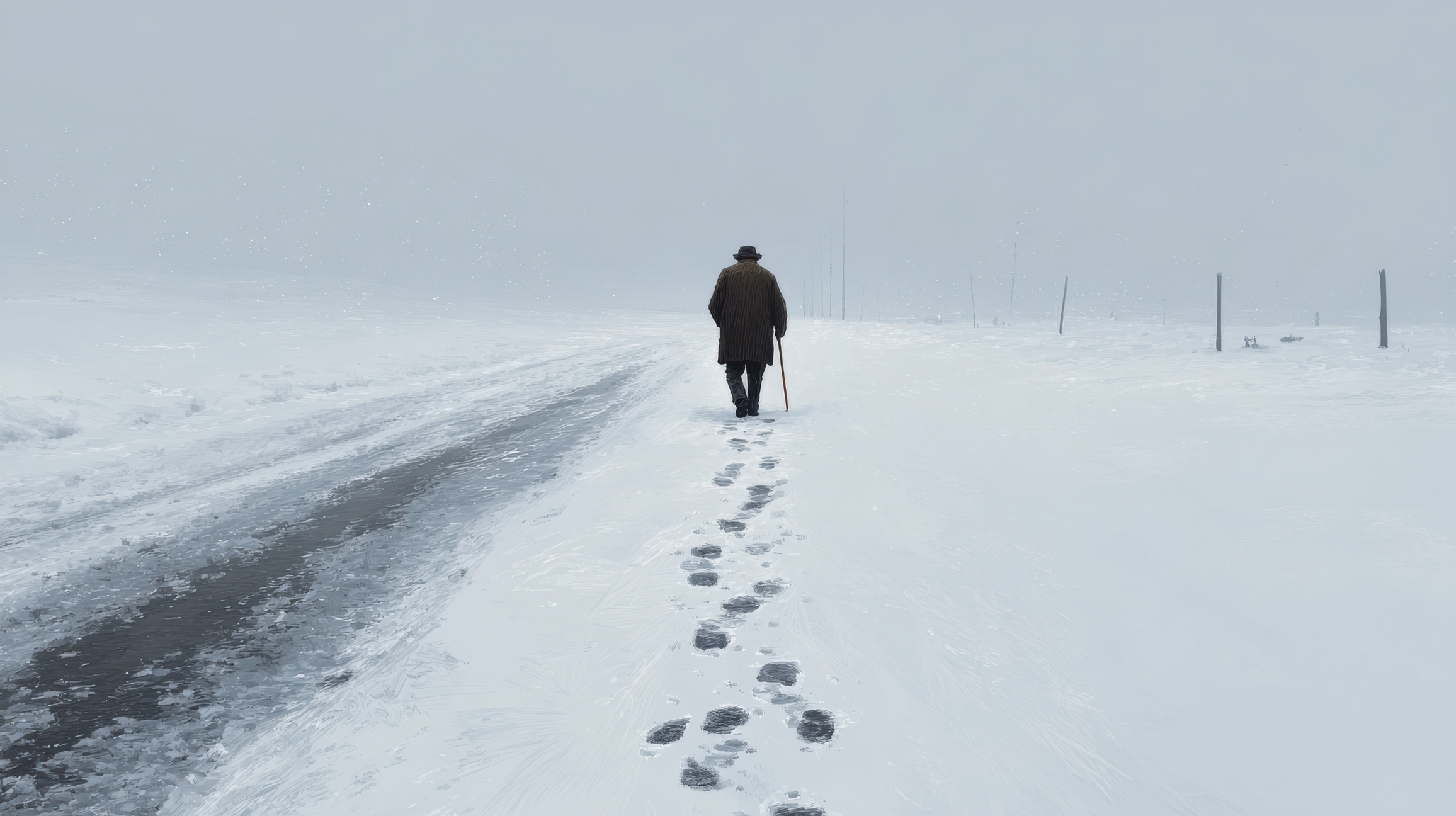
That plow got me thinking about an encounter almost 60 years old. New to this section of the north country, I was traveling Vermont Route 5 after a storm, its snow not yet cleared. I saw a short, barrel-chested man plodding along on foot, the tails of his overcoat flying in the blow. He didn’t have a thumb out, but he was making his way on the right side of the road. I’d seen just two other cars in the preceding half hour, and my rearview mirror showed none coming now. So I pulled up beside the old man. The grimace on his face showed that, unlike me today, he wasn’t walking for pleasure.
I cracked my passenger window and offered him a ride. He nodded laconically and got in, his movements so deliberate that snowflakes flew through the door and across my dashboard. When I asked where he was headed, he said Dan & Whit’s in Norwich, one of the few general stores that’s thriving even now.
Before long, my passenger began to reminisce. He told me that as a young man, his family’s farm having foundered, he drove a horse-drawn roller on this very stretch, flattening the snow for sleighs and for the rare automobile.
The roller was weighted with water. When it iced up, he’d let his Belgian mare stand by while he jacked up the roller and, with logs and coal oil, he kindled a fire underneath the cylinder. He needed to warm it enough for his purpose but not so it would burn the roller’s wood.
As we rode, my passenger moved on to grimmer recollections. He described waking up in a dug well with water up to his chin on an April night in 1915. Fever had driven him there, though he didn’t remember leaving the house. He gulped great draughts of water and, he claimed, the frigid well broke his fever.
Each of his five siblings died in that dreadful year of the Spanish Influenza. Their mother had succumbed to pneumonia a decade before, and now this new epidemic felled their father as well in the room where he and all those children had been born. Of his entire clan, my passenger was the only survivor. All by himself, he could do no more than forestall the farm’s failure.
It would be obscene to thank fortune for the Spanish flu, but I do owe my existence to it. The scourge had taken my maternal grandparents’ son at 15, and my heartbroken grandmother decided—at 40— to have another child. The baby girl would become my mother. Then, just five years after Mom’s birth, Grandmother lost her husband to a coronary.
The fellow who rolled that reach of Route 5, sparsely traveled to this day, was surely close to my grandmother’s age. She was born in 1878. Both had doubtless listened to first-hand reminiscences on the Civil War.
We imagine we live in an age of monumental change, and we do. But haven’t we always? Just now, the hot topic is artificial intelligence, “A.I.” How far that seems from my grade school days, when Miss Knudsen would hover over me, inspecting and clucking her tongue at my slow progress with the Palmer method of handwriting. Yet has our rush into the era of cybernetics been any more dramatic than the one from my grandmother’s automobile ride, to Neil Armstrong’s moon-walk toward the end of her life?
After my grandmother’s death in her late 90s, we found a box of letters from friends and relations. Among them was one she’d written, which described her first ride in a car. She testified that it traveled “as fast as a wild animal.”
We imagine we live in an age of monumental change, and we do. But haven’t we always? Just now, the hot topic is artificial intelligence, “A.I.” How far that seems from my grade school days, when Miss Knudsen would hover over me, inspecting and clucking her tongue at my slow progress with the Palmer method of handwriting. Yet has our rush into the era of cybernetics been any more dramatic than the one from my grandmother’s automobile ride, to Neil Armstrong’s moon-walk toward the end of her life?
On a related matter: any impulse to celebrate the Good Old Days needs checking. We can visualize that blond Belgian draft horse and her equally stalwart owner, the quaint snow-roller, that roadbed uncluttered by fossil-fueled traffic, a jingle of sleigh bells, the hills and pastures swathed in white. If the vision clamors for Currier and Ives, a sober reckoning must include the labor involved in making a living as my old passenger did, indeed making a living of any kind in the north country a hundred years or so back—and, of course, untreatable, lethal illness as well.
For another example: long ago, my siblings and I inherited a north country camp, and, honoring our father’s tradition, we cut ice there every February and store it under sawdust. I say “we,” when in fact the family hires local men to do the job. We aren’t often on hand ourselves in late winter, and we’ve all grown too old for the effort anyhow. But I used to participate now and then, and I can assure you it’s backbreaking work.
We have propane-powered refrigerators now, so it’s also work on which no one depends. Cutting and storing ice, however, was essential in olden days. And it was expected that men of the community would cut that ice (and firewood) for widows, widowers, the ill, and shut-ins– a convention that stirs me when I think about it.
I can’t resist one last recollection. As a young man, my beloved mentor George, born in 1890, was a railroad tie-maker in winter, during which he never saw the lumber camp in daylight: it was out by lantern before dawn, back the same after dark, the one break coming on Sunday, when he’d trek home for a day with his family.
Having swamped away surrounding secondary growth, George would fell a cedar with a crosscut saw. He’d trim the boughs, peel the bark, and cut the trunk into 8 ½-foot lengths. Standing on each log with a broad-bladed sleeper axe (“sleeper” was a synonym for “tie”), he’d hew both faces. Finally, he’d lug the ties out to a tote rode to be piled onto a sledge. Then on to the next cedar.
George gave me his sleeper axe just before he died. Someone later broke into our camp and the only thing stolen was that axe, of all things. I could write a long account of my emotions following that theft, but I’ll stick with George’s trade, for which he was paid by the tie, not the hour. He once fashioned 32 in a single day, a record never approached by any peer. At fifteen cents per sleeper, that meant a reward of $4.80.
Good Old Days? I ask you.
Once, however, when—full of 1960s indignation—I asked George if he resented getting paltry wages while the lumber tycoons amassed their fortunes, he said no: “Hell, I was proud to be the best at what I done, and if the country needed trains, then they needed me. I was doin’ my part.”
His response is a bit like one I heard from the aged Vermonter on Route 5, whose memory generated these reveries. “You know? I hated losin’ the farm,” he told me, “but I didn’t mind the rollin’. Oh, it were hard work, Mr. Man, but I figured I was doin’ the world a mite of good.”
As he opened the passenger door in Dan and Whit’s lot, I said, “Be well.”
He lingered in his seat a moment. Then, with a faint smile, he answered, “I’ll try, but at my age, every morning I get up I’m temptin’ the Lord.”
I offered to run him back home after he finished shopping, but he waved me away, saying “You got more important things to think about, young fella.”
Read all of Sydney Lea’s essays for Oldster.
 | A guest post by
|
Just beautiful. I could feel my own body slowing down as I read it, pulling me into a different time.
Thanks for this: “The growing good of the world is partly dependent on unhistoric acts; and that things are not so ill with you and me as they might have been, is half owing to the number who lived faithfully a hidden life, and rest in unvisited tombs.
George Eliot, Middlemarch