

Shift Happens
When a geriatrician asked an audience of people working in healthcare how many of them expected to die, very few raised their hand. Then she asked, “Would you prefer to be old when it happens?"



Most of us want to get old, not be old or look old or feel old or seem old. In the hands of the beauty and wellness industries, “aging gracefully” is a faux-positive phrase used to sell anti-ageing products, like luxury skincare firm Estée Lauder’s campaign to “reframe the conversation from anti-aging to visible age reversal.”
We’re not supposed to age, but if we must, we’re supposed to embody active aging, plus graceful aging, and successful aging, too. I’d say, if I wake up tomorrow, I’ve aged successfully. If I’m able to sound coherent, I’ve aged consciously, too.
We defied aging. It didn’t work. We got older. We ate more kale. We got older. We got more fresh air. More exercise. Drank red wine. It didn’t work. So now, when it’s spring, one of the things we most look forward to is being alive. Same when it’s summer, and winter and fall. My body? It’s great. Great, I still have one.
I live in the land-of-the-getting-old and the land-of-old and the land-of-the-very old and the land-of-the-even older than that. It’s called a CCRC—a Continuing Care Retirement Community. Which means it’s also the land of the sort-of-okay, the almost-okay, and the not-okay at all.

You know the phrase, a place to die for? This is a place to die in. We’re here ‘til death do us part. Celebrations of life, or what used to be called “funerals,” take place nearly every week in a room called the Rotunda, which expands to include the Chapel and the ping pong room. Though ping pong can’t be played during eulogies or hymns.
In good news for the Old Age Industrial Complex, old people are this country’s fastest-growing industry. And the fastest-dying, too. If you think you might—just possibly—get old at some point, perhaps you should read this piece. If you think you won’t ever get old or die, you should read it, too.
Sunny Hills (not its real name), the CCRC in which I’m installed, is located in a large university town, which means our resident roster is filled with retired academics who often teach classes here. These are on topics like:
The relevance of relativity.
The dancing plague of 1518.
Death and dying in contemporary America.
That last one was taught by two people who must really have known their topic well, as they died shortly after teaching it.
The Sunny Hills administration has lots of so-called “working groups.” One group has been working on an End-of-Life Planning Guide for over ten years. That means that the residents who died in the meantime and those dying now must manage to do so without the benefit of the promised plan.
In good news for the Old Age Industrial Complex, old people are this country’s fastest-growing industry. And the fastest-dying, too. If you think you might—just possibly—get old at some point, perhaps you should read this piece. If you think you won’t ever get old or die, you should read it, too.
The older brain does not provide optimal operation for your mouth, your gut, arms, legs, love life, finances, or private parts. So how does one age gracefully? You can start by running the phrase past ChatGPT, which told me “ageing gracefully” means “embracing one’s age without excessive resistance or denial, nurturing overall wellbeing, and cultivating purpose, joy, and connection.”
Sounds great! But what does it mean? Hair where you want it, not where you don’t? Ability to feel like we are still part of life around us whether or not we are? Here are a few things I’ve learned.
People do not want to hear about your ailments or all the remedies you’ve tried. Or every appointment or every test you’ve had, or plan to have. Nor every test result.
If someone asks how you slept last night, do NOT discourse on the subject at length, or include the number of times you went to the bathroom.
Even if the weather outside is frightful, and the news appalling, you don’t have the right to be cranky. That would just be galling. (May be sung to the tune of “Let it Snow.”)
Boundaries. Act like you have them. Don’t scowl at the cashier or scold someone for something of which you don’t approve. So what if you don’t approve?
Do NOT compare yourself to other people. For example, “Alice doesn’t cook anymore, but I do.”
Don't throw a fit about "new" stuff like QR codes.
Shift happens. For example, in our lifetimes, we’ve played music on 45s, LPs, cassettes, 8-tracks, CDs, and Spotify. Now your grandkids collect vinyl.
How old am I? Old enough to have pleats on my sclera, otherwise known as wrinkles on my eyes. The whites of my eyes. Old enough to hear quite often from the Prepaid Cremation Society—even though I can sometimes sound coherent and still sport boots and jeans. And yet, sometimes I find myself watching someone I love start saying things that make me quietly Google: “Early signs of a stroke.” Sometimes I Google the same thing for myself.
My mind? It’s like a browser with 47 tabs open, or 87, and most of them are playing stuff you don’t want. Didn’t ask for. Can’t understand or care about. But sometimes we remember the love we made, the hell we raised, the lives we may have changed. Or even improved.
My friend Ned is 95. He walks holding a very tall rollator he calls a “chariot.” Every Friday, when they bake cornbread here, Ned spreads first extra butter, then extra honey, on two pieces and savors them slowly. He also goes to the gym four times a week, eats ice cream every day, stays smart, strong and slim. When I tell him “It’s good to see you,” he retorts, “It’s good to be seen.”

In other I’ve-Become-an-Antique News, management here has hired high-priced consultants to preview and produce Active Shooter’s Drills. If however, an active shooter doesn’t take us down, they know what will. As in how many of us will decline, then depart—plus more or less when. This is accomplished with assistance from actuaries and the Mortality and Longevity Oversight Advisory Council, a subgroup of insurers.
In an outstanding sign of the health of Sunny Hills itself, there are way more people waiting to live here than there are people living here now. In fact, as of this moment, we have 430 residents, and a waiting list of 960. Spaces open when someone dies. If we all die tomorrow, they can fill the place twice over in the next two days.
Oh, dear, I hear the voice of the Wizard of Oz. He’s not a small guy, but he does operate more or less behind curtains and rarely comes out. He’s not a resident. He’s the CEO. An empty suit, if I’ve ever seen one. He speaks with a feigned self-assurance learned in some course with a title like How to Run An Old Age Home so it Doesn’t Look Like an Old Age Home.
American society uses all sorts of markers to define old age. The Age Discrimination in Employment Act began to protect me from ageism in the workplace when I turned 40. I qualified as “near elderly” under the rules of the Department of Housing and Urban Development when I turned 50, and started receiving a senior citizen discount at my favorite food store the day I turned 60—though for some reason, only on Thursdays.
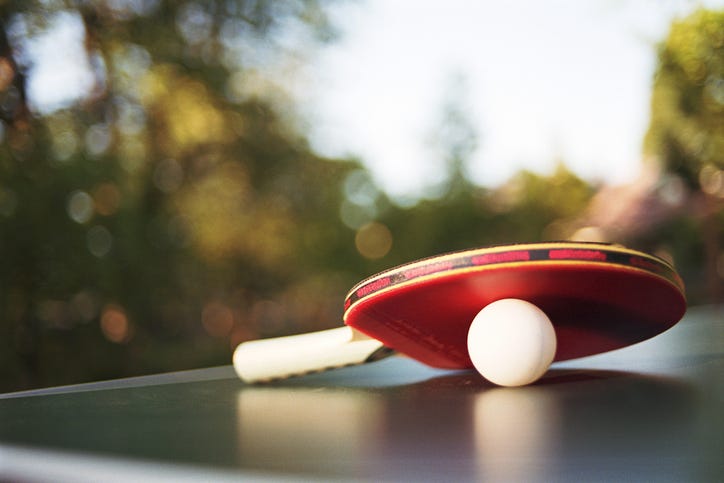
We are all going to lose people, until it’s us that’s gone. Until then, we look forward to being alive. We play ping pong and pickle ball, take walks and hikes, swim, bike and go to the gym for strength, balance, yoga and aerobics classes. While most classes are for people still on their feet, others are for people seated on chairs. We make dinner dates and sometimes lunch dates and we keep them unless we have a heart attack or a stroke or break our hip or forget we have a date.
Speaking of dates, the only single men here are 85 or older and there aren’t that many of them. Some of them haven’t driven for two decades, but one or two of them still drive and when they do, they drive over curbs and gardens that are near curbs. They use the left signal when they’re making a right or the right signal when they’re making a left or no signals at all, but do tend to remember the difference between the gas and the brakes.
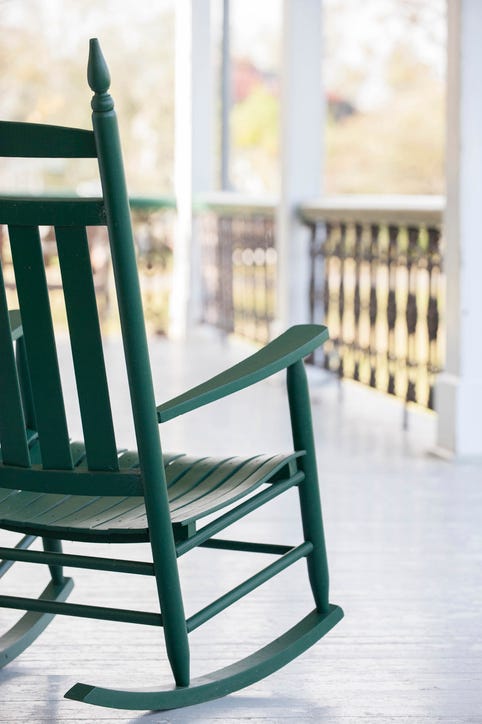
Some old people spend most of their time doing two things in one spot. An old rocking chair in which they rock mildly or wildly. That’s it. When they rock wildly, it makes the floor creak. Which causes the ceilings of downstairs neighbors to make sounds that drive them nuts.
In real life, most of us are happy-sad, and by degrees, vanished or vanishing. For example, my Christmas memories come in sets, like dishes. I have several, each associated with a particular era of my life. One set, from my childhood and adolescence, is mostly chipped and cracked. Though few of us have exquisite narrative clarity or faultless comic timing, most of us have hope and heart.
The writer Grace Paley wrote: “You may begin to notice that you’re invisible. Especially if you’re short and gray-haired.” I’m short, gray haired, and getting older 24/7. The writer/physicist Alan Lightman, wrote this about the last moments of a dying woman:
“There were 3,147,740,103,497,276,498,750,208,327 atoms in her body. Of her total mass, 63.7 percent was oxygen, 21.0 percent carbon, 10.1 percent hydrogen, plus the ninety-odd other chemical elements created in stars. Released from their temporary confinement...within sixty days, her atoms could be found in every handful of air on the planet.” This means that though the particles of which we’re made are not destructible, we are. Does that make you feel better? Me neither.
Not long ago, Carson Bradley, a teen TikTok influencer, went viral with a video of her 25-minute skincare routine, which is meant “to slow the aging process as a 14-year-old.” A search for “baby Botox”—smaller injections than regular Botox—yields an astonishing 91,000 results.
Speaking of kids, I was an invisible child. I had three parents or two parents or one parent depending on your point of view. My point of view is I had a small bit of one parent, slightly more of the second parent (who was really a wannabe), and nothing from the third. (He was the didn’t wannabe.)
They weren’t dealt a great hand, either. For example, one of them was blind and got polio when she was 2 and never learned to walk. She was the wannabe. My aunt Nen, missing her eyes and her legs; my dad, missing his legs and his life. My mom, who could walk, ran away from home each day, or so it seemed to me.
As I grew up, I went to few events and if I somehow got to one, I tended to hug the wall, not comfortable as a person moving legs and feet and hips and hands—nor with being seen. Then I became a freelance ghostwriter, paid to be invisible, which worked well for me. And then? I started getting old and kept doing it. For which I thank genes and God.
Check out all of Judith Hannah Weiss’s essays for Oldster Magazine. And check out her newsletter, Dispatch From Bewilderness.
 | A guest post by
|
Great advice. Aging is a horror show in slo mo. So eat the ice cream 🍦, laugh at the irony, stop looking in the mirror and stay up late enough to see the stars. ⭐️
I belong to a weekly breakfast group, the ROMEOs, Retired Old Men Eating Out. Politics and religion are off limits. But health issues are not. As the physician, I am the go-to guy. Sorta. Guess what? It's interesting, and most of the time, we make it fun. Oh, one other thing. We ALL believe the breakfasts will never end.