

Resisting Retirement: When Your Identity is Bound Up with Your Profession
I interview my 82-year-old uncle about his struggle to move on from ophthalmic surgery, and what he gleaned from Arthur C. Brooks' "From Strength to Strength." PLUS an Open Thread on retiring or not.


Readers,
Today we have an interview I conducted with Dr. Samuel Masket, my 82-year-old uncle, a highly accomplished ophthalmic surgeon—a leader and esteemed thinker in his field—who has been gradually winding down his work for the past seven years.
He’s been wrestling with the idea of fully letting go of his career, a big component of his identity—although he realizes that as a surgeon he’d be better off stopping a day too soon than a day too late, and as a lecturer he’d be wise to pass the baton to younger doctors in the field who possess more cutting-edge knowledge.
Video and text versions of our conversation are below this section. ⬇️
The interview came about when Sam asked whether I’d read Arthur C. Brooks’ 2022 book, From Strength to Strength: Finding Success, Happiness, and Deep Purpose in the Second Half of Life, because he was interested in talking with me about some of Brooks’ ideas. I read the book so Sam and I could discuss it, and I’m glad I did.
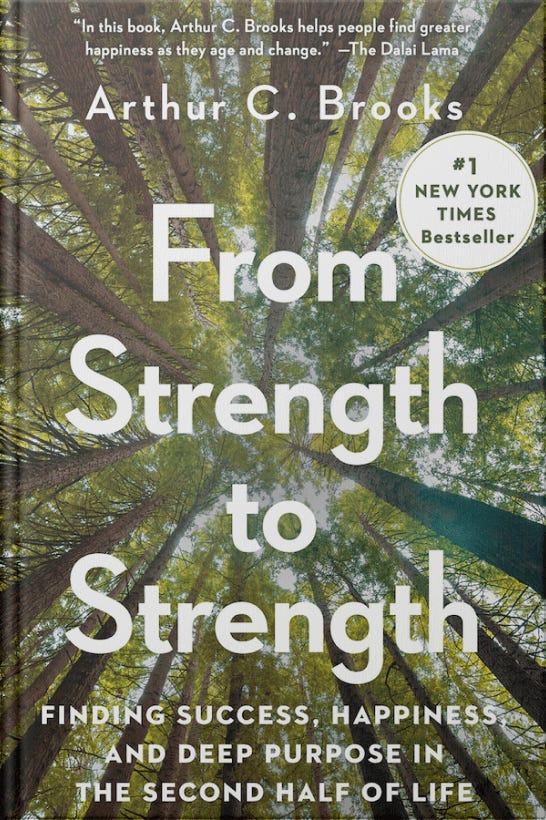
Our interview was informed by the aspects of From Strength to Strength having to do with: facing the inevitability of professional decline as we age; letting go of our addiction to success and the sense that we are what we do; and finding new ways to feel purposeful and relevant when we’re in partial or full retirement.
(By the way, you might recognize Uncle Sam from the Oldster Questionnaire he took three years ago, and also as the guy I keep mentioning here, who provided the earliest impetus for Oldster: circa 1975, at my 10th birthday party, Sam told me, “Well, you’ll never be one digit again.” The notion that I’d just passed through some kind of portal I couldn’t go back the other way through really blew my little ‘tween mind.)
I thought the reluctance to retire—to let go of careers that have long defined us—would be a good subject to toss out to all of you, as well. Are you perhaps grappling with this, too? In the comments please tell us:
How old are you? Are you still working full-time? Or are you retired? Partially or fully? Are you having a hard time moving on from working? If so, is it because of a strong identification with your profession? Or is it something else—like finances, or other logistical matters? If you have retired, what now provides you with a sense of purpose and relevance? Are you involved in mentorship in your field? (If you’re commenting, please also do me the favor of hitting the heart button ❤️ for algorithmic purposes. Thank you!)
Me, I’m at the tall end of 59. It’s hard for me to imagine ever really retiring, at least not fully, for two reasons: 1) I haven’t set myself up well for it, financially. 2) I think of a lot of what I do as “my art,” and does an artist ever really want to stop making things? That said, if and when the time comes that I no longer need to earn a living, I’d love to drop the parts of what I do that fall under the heading of “day job,” and just write and draw and sing. Okay, onto today’s interview…
Here’s the video version of our interview.
Here’s the (edited) text version of our conversation:
Sari Botton: I’m here today with my uncle, Dr. Samuel Masket, who read From Strength to Strength: Finding Success, Happiness, and Deep Purpose in the Second Half of Life by Arthur C. Brooks and had some things to say about it—and is having difficulty retiring. I'm interviewing him today about hanging on to his career, taking his time into retirement. Welcome, Uncle Sam, aka Dr. Samuel Masket.
Samuel Masket: Hi, Sari. I want to thank you very much for giving me the opportunity to express some of the thoughts that we'll explore. I think it to be a subject of great importance to many people as they age.
And also, I want to say how much I appreciate Oldster. I'm a paid subscriber, even though we're related. And I'm a regular reader. I rarely comment, but I do let you know what I think. And I've really enjoyed learning so much from the people who are in your program. Congrats on a job really well done. I'm thrilled to be part of it.
Sari Botton: That means so much to me. You’re a highly esteemed ophthalmic surgeon; a leader in your field. You have been for decades. And you recently turned 82. Tell me what drew you to From Strength to Strength? And was it where you are in your career or was it being retired but not quite?
Samuel Masket: Well, we have such an emphasis on expanding our life, living longer. Not just living longer, but quality of life. While we have an aging or a graying of our society, there's an impetus to maintain an expanded health span, as it were.
The problem is though, if you age well physically and mentally and retain these capacities as you go on, there's no place for you to be. You're taking up a spot that some junior person might very much want. In the US there are rules about working and aging for a few professions. As an example, an FBI agent must retire at 57.
Sari Botton: Really?
Samuel Masket: That's correct. Some other government positions as well. Airline pilots at 65. But there are no rules for physicians. And I've been heavily involved in that subject of how do we know when it's time for medical doctors to stop working or to limit the work we do?
I was a prolific eye surgeon, and I always felt that it would be much better if I stopped doing surgery one day too soon, rather than one day too late. I also feel that if the surgeon is working for themselves and not for the benefit of their patient, they don't belong in the operating room. I had a friend, a colleague, who was senior to me, and an internationally regarded ophthalmologist who also became a patient of mine. But he said to me, "You must stop operating when you're 75." He just chose that arbitrary number. And I said, "Why that? Or why around then?" He said, "Because if you do have any problems in surgery after that, they will blame it on your age, and you cannot defend that."
The problem is, if you age well physically and mentally and retain these capacities as you go on, there's no place for you to be. You're taking up a spot that some junior person might very much want. In the US there are rules about working and aging for a few professions. As an example, an FBI agent must retire at 57.
I also love sports metaphors. As the old saying goes, "Father time is undefeated." They usually speak about that in regard to professional boxers, but it's true in everything else we do. As a youngster, I was a baseball fan, and in my younger days, the best pitcher I ever saw was Sandy Koufax and the best overall player who ever lived in my lifetime was Willie Mays.
And I contrast their careers in the following way: Sandy Koufax, due to an arthritic elbow, retired at age 31 at the peak of his career. He won 27 or 28 games in his last year. He will turn 90 very soon, and he is still very much revered. During the baseball season, there isn't a week that goes by that his name doesn't come up in the sports pages in some manner, and I always felt it was because he left at the top of his game.
Contrast that to Willie Mays who didn't retire until he was 42. Almost all of his career was with the New York and then San Francisco Giants. But the last year or two were with the New York Mets. And at age 42, which was old for a ballplayer 50 or more years ago, he embarrassed himself in the World Series. He was known as among, if not the very best fielders ever or surely of his time, but he dropped two fly balls in just one game. Clearly, he just didn't belong there.
I wanted to be Koufax, I didn't want to be Mays, so I decided to stop doing surgery at age 75, now seven years ago. The problem is that I really enjoyed what I did. I don't mean to be self-aggrandizing in any manner, but I did the challenging cases that other people either wouldn't or couldn't do; that gave me great pride. I loved being uniquely able help to my patients. And all of a sudden there's a void. In stopping surgery, I'm no longer important to those people albeit yet able to do so, as I was blessed by being physically well and mentally sharp at 75. Where does one’s measure of their societal relevance go when they stop doing what brought them prominence while, at the same time, being of service to many people?
Most likely I learned about the Brooks book, as I do most of the books I read, from The New York Times Sunday Book Review section. The opening paragraph drew me in. Brooks describes an elderly gentleman: Brooks is on an airplane, he's sitting directly behind the subject, and this man is lamenting to his wife, "I might as well be dead. I don't have my power anymore."
I contrasted that story to a patient of mine who was a very, very prominent interior designer in the West Hollywood area of Los Angeles. He came to see me in his young 60’s and we developed a very brief relationship wherein he said, "I used to be a very, very prominent professional. I may be a has-been, but at least I'm not a never was." And he seemed to be very comfortable with being in that position. And so I wondered, what's the difference between these two men? Why is somebody very satisfied that he was an important productive individual? Now age has changed that, versus the other person who would rather be dead than powerless. And that's really the essence of that book. And it's become somewhat of a Bible to me.
Sandy Koufax, due to an arthritic elbow, retired at age 31 at the peak of his career. He won 27 or 28 games in his last year. He will turn 90 very soon, and he is still very much revered. Contrast that to Willie Mays who didn't retire until he was 42. And at age 42, which was old for a ballplayer 50 or more years ago, he embarrassed himself in the World Series. He dropped two fly balls in just one game. Clearly, he just didn't belong there. I wanted to be Koufax, I didn't want to be Mays, so I decided to stop doing surgery at age 75, now seven years ago.
I wanted to know where I fit into all of that. One of the very important messages that Brooks conveys and that a very recent interviewee of yours said, "It's important to distinguish yourself from your profession." And he also said, "We are not who we think we project we are. We're somebody different inside." And I've not solved the personal riddle here. But that's a very important distinction.
Now, what I did professionally was very immersive. From a very, very early stage of my career, I thought about nothing but eyeballs. I could go to a movie, a concert, an opera, and all the while, I'm thinking about eyeballs and how I can improve a surgical procedure or how I can manage a complex problem. What new methods can I devise? And so to be frank with you, I never really appreciated what entertainment was all about until more recently. I truly do now.
Eye surgery was very much a huge part of my life. Call it my hobby. I did ophthalmology 18 or so hours a day, whether I was taking care of patients, or writing. I've published over 200 scientific papers, etc. Again, I don't want to appear self-aggrandizing, but I want to give the sense of how deeply immersed I was in my field, traveling extensively, teaching all the time.
Sari Botton: My understanding is that even though you somewhat retired at 75, you're still doing some ophthalmic surgery through The Masket Foundation. I want to ask you about the work that you're still doing. And also, can you tell us about The Masket Foundation?
Samuel Masket: One of the things that I learned from the book, from Arthur C. Brooks, is that our skills erode much earlier than we think, both our physical skills as well as our mental capacity. And he defines them in terms of both fluid and crystallized intelligence. As a result, he teaches us that it is important that we transfer what skills and wisdom we have accumulated, or what I call “passing the baton.”
He uses the wonderful example of Johann Sebastian Bach and how Bach had 20 children. But Bach felt it was most important in his career not just to promote his own work, but to teach and promote his children's work. And there are indeed some Bachs whose music we do listen to, but none ever really as important as Johann Sebastian Bach’s. But nevertheless, Brooks gives that example of how important it was for Bach to do that as an example of how we can continue to be of value by sharing our wisdom with other, younger people.
It took the better part of my career to find a young Ophthalmologist who I could mentor, develop and take what we do to the next level. But, in Nicole Fram, who joined my practice 17 years ago I saw the opportunity to develop the talents that Nicole possessed.
For her first year in the practice I went to every one of her surgeries, and so doing transferred as much information as I could to her, and I gained huge pride. I did for her what I would have loved to have been done for me. And I found that that was hugely, hugely rewarding. While I might have preferred to be the one learning and growing, I came to recognize that, just as Brooks suggests, we can realize new meaning and purpose to our lives by “passing the baton”.
As she gained prominence in the field, she felt that we had an obligation to transfer more and more information to others, not just limited to what we do in our practice. She convinced me that we had an obligation to start a Fellowship and transfer information to trainees.
At the time of my 70th birthday, now 12 years ago, she and my children gave us the framework for a nonprofit Foundation that we could use to raise to care for people who are uninsured or underinsured, and patients who required specialized care but were unable to get it elsewhere.
One of the very important messages that Brooks conveys and that a very recent interviewee of yours said, "It's important to distinguish yourself from your profession." And he also said, "We are not who we think we project we are. We're somebody different inside." And I've not solved the personal riddle here. But that's a very important distinction.
This Foundation, which bears my name and my wife's name, The Samuel and Barbara Masket Foundation, has, among its missions, to train the next generation of ophthalmologists in management of complex eye surgery cases, giving me purpose in helping others develop and hone their surgical skills.
And so, I retired from making a living, but not from working, as I need to raise funds to pay for surgery center and anesthesia fees.
At the Foundation we have a monthly clinic where I go with the fellow, we examine patients who were referred with problems, we decide on their management; mostly it's surgical. And then we do surgery at the surgery center where we always worked with our regular practice patients.
For routine cases, I generally don't have to assist behind the microscope, but with the complex cases, I do. And very fortunately, I'm still capable of doing that. I haven't seen an erosion of my manual skills. I stay involved through the Foundation, giving me purpose.
One of the problems with what we do is that, as a nonprofit, we have to raise the money. Not only do I have to go to the OR with the trainee, I have to raise money to pay for their surgery. We pay a cash base price to the surgery center and to the anesthesia people.
A Masket Foundation fundraising video featuring Martin Short:
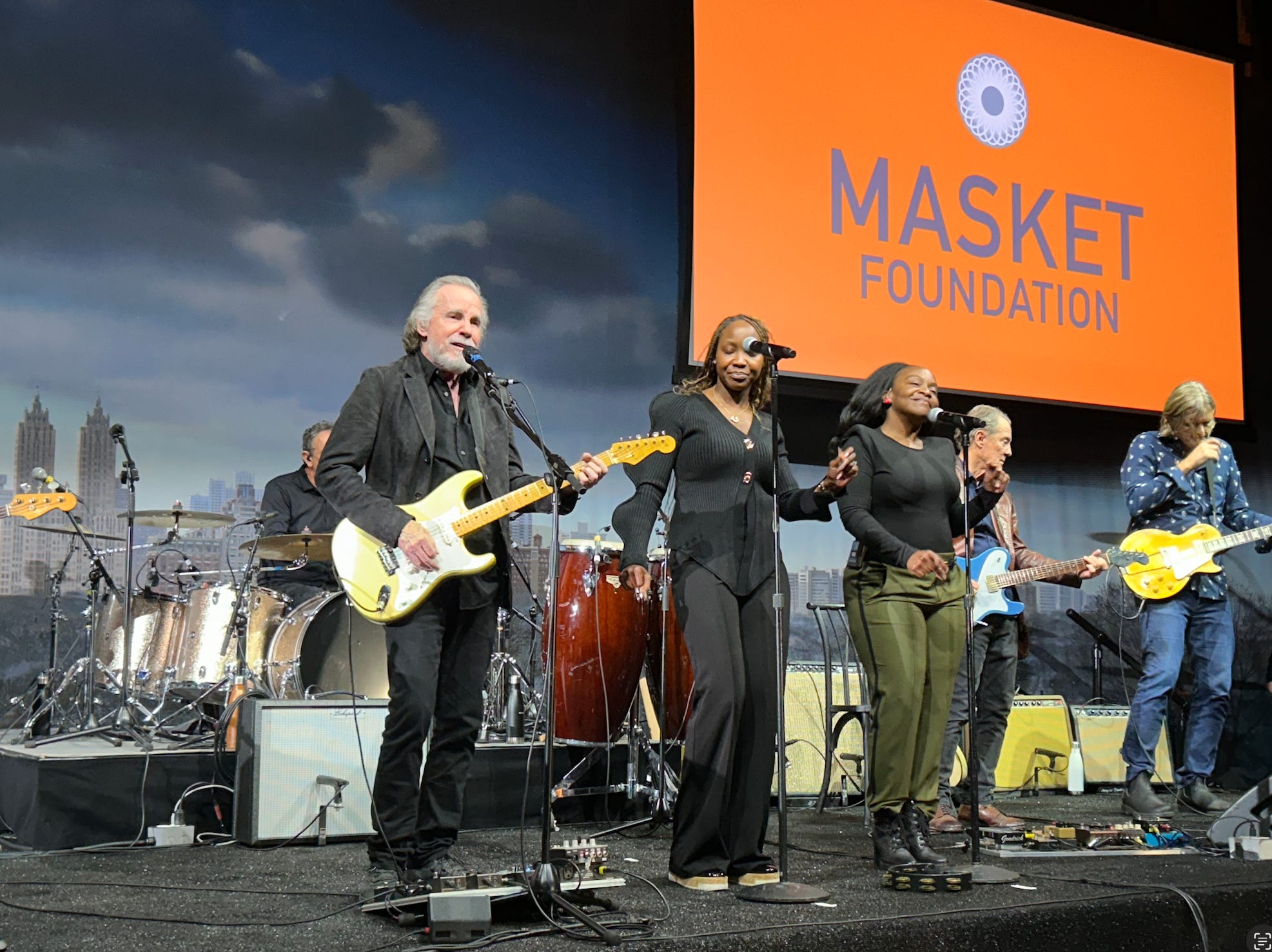
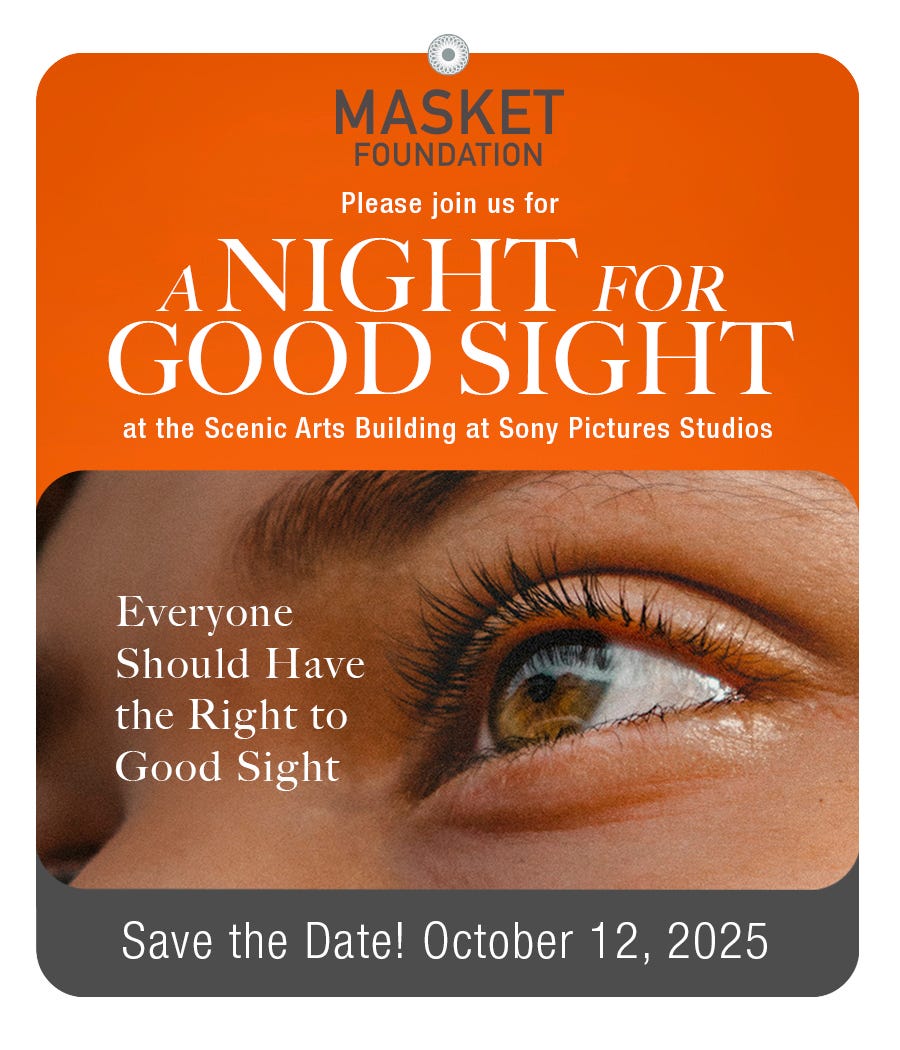
Our services are growing, which is a positive thing, but for the first time last year, we spent more than we raised. We have a Gala every year which helps us raise a significant amount of our money. Some of our money comes from grants from industry, but most of it comes from donations. We will be holding our Gala this year at Sony Studios, like last year, this year on October 12th. And last year, we were fortunate to have a volunteer performer: Jackson Browne played for us. He has a professional relationship with my partner, Dr. Fram. And so he volunteered, and also made a donation to us.
Sari Botton: And I'm assuming he sang “Doctor My Eyes.”
Samuel Masket: He sang “Doctor My Eyes.” Of all his songs, it's my least favorite. I cringed when he sang it. But he's just a lovely, lovely gentleman. And also, in his upper 70s, has his skills. He's fortunate he can still sing and play.
The Foundation can really change people's lives. As an example, when people have a serious eye injury and they lose the colored part, the iris of their eye, it has a huge negative on their quality of life. They can't see well, the glare is horrible, the aesthetics are terrible. We can actually implant an artificial iris for patients, unfortunately at great expense. But it makes such a positive impact on their lives.
I am very, very proud of what we do at the Foundation, but at the same time, the trap is that I'm still there. I'm 82 and I'm not getting out of ophthalmology.
Sari Botton: Yeah, let's talk about that. You’re 82 now. When I saw you recently in Los Angeles, you talked about how you're still in control of your hands; you're not having any kind of shaking or whatever. But you've also said that you'd rather retire a day too early than a day too late. You'd rather be a Koufax than a Mays. What's going to happen? What are you planning? You've also talked about how you are involved in the profession in ways that are not surgical that are keeping you tethered to it, and maybe it's time to let some of that go.
Samuel Masket: Yes, because it also relates to the aging physician. I have been involved in some of our professional organizations to a great extent. And most recently, I served as chairperson of what once was referred to as the “Senior Ophthalmologist Committee.” When I joined that committee nine years earlier, as I walked in the room, the outgoing chair said to me, "Sam, your first job is to change this name." Well, it took me four years as a committee member and then five years as Chair to change the name to “Lifetime Engaged Ophthalmologist.” And that's for the better, I believe.
But among the things that the committee did and continues to do— I am now sunsetted over the last few months—is we helped offer opportunities for practice transitioning for our colleagues. That is, when is it time to stop doing surgery? When is it time to bring new associates into the practice? What are the economic ramifications? And on and on. And so, how and when to change what do professionally is very important for a host of reasons.
What I did professionally was very immersive. From a very early stage of my career, I thought about nothing but eyeballs. I could go to a movie, a concert, an opera, and all the while, I'm thinking about eyeballs and how I can improve a surgical procedure or how I can manage a complex problem. What new methods can I devise? And so to be frank with you, I never really appreciated what entertainment was all about until more recently. I truly do now.
I've had some friends who are also very much involved very deeply in the profession who, when they decided to leave, and at ages younger than I, just up and up quit. One of them gave up his license, moved to rural Washington State, bought a backhoe and started building things. Another one moved to the west coast of Florida and goes on fishing boats. I envy their ability to leave and move to another life. I was never able to do that, and I don't know that I really wanted to do that, because, as I said, I'm still very much involved.
I think everybody needs to consider their professional future, and that's where Brooks' book is very, very helpful—to start thinking about what other things do they have a passion for? Is it family? Is it travel? Did you always wanted to be a sculptor, a painter? I never had that. But I think it's healthier, to be honest, if somebody does have something to which they can put their emotions and their all into and get satisfaction. Unfortunately... perhaps I shouldn't use the word unfortunately, I don't think that matches where I am.
A Masket Foundation fundraising video featuring Mandy Patinkin:
Sari Botton: Yeah, he talks about addiction to success and to your stature in your field. Does that resonate for you? I don't know, addiction has a negative connotation. It's hard for me to imagine ever not being who I am within my work. In a way, I think of myself somewhat as an artist, and so I feel like my art is part of who I am. And for you, it's almost as if what you do isn't art, but it is the expression of who you are, for better and worse. I know you love to cook and you love to travel, but will those ever be who you are beyond, as my husband Brian calls you, “the Bono of ophthalmic surgery?” I don't know why he picked Bono, but to him you're the Bono.
Samuel Masket: Maybe because Bono always wears glasses. I've always had great passion for what I do. My first mentor said, "Only choose ophthalmology if it stimulates you intellectually and challenges you. Otherwise, it'll just be a job." And I envy those for whom it's just a job because you can still immerse yourself and then walk away. The question is to what are you walking away? And I'm blessed in having a successful and long-term marriage. Today happens to be our 59th anniversary.
One of the things that I learned from the book is that our skills erode much earlier than we think, both our physical skills as well as our mental capacity. And he defines them in terms of both fluid and crystallized intelligence. As a result, he teaches us that it is important that we transfer what skills and wisdom we have accumulated, or what I call “passing the baton.”
Sari Botton: And my 20th. (Ed. note: This interview was conducted on June 12th, an anniversary we share.)
Samuel Masket: ... and your 20th anniversary. We share that. And my wife, Barbara, and I spend a lot of time together, but that's not all there is for me. I still like what I do. Being involved very much in clinical research, and more. And I don't have a sense of how I get away from it.
I would say one of the failings of my life is not really planning well for the future, and that is letting the future come to me. If you ask me what I'm going to be doing in two or three years, I don't have a plan.
And I think Brooks' book really challenges us to do that by telling us we're not what we do for a living, we're not who we project, or what we think we project to the world, we're really something very different inside. In advising younger people, I would tell them, "Try and formulate a plan for your life.”
I've been a really lucky person. I've had a wonderful life, wonderful family, wonderful profession, but a lot of it just happened. Without specific plans. I should say, "Well, now what am I going to do when I'm 85? If I live, what am I going to do if I'm 90?" I can think of only one person in the field that I know who stayed active until his 90s. I also know many people who stayed active and should not have. And that's the last thing I want to do. Now, I'm almost embarrassed to be on a podium speaking about surgery, although I have a lot of experience. But since I'm not currently doing it I sense that I’m out of place even when invited to speak. Our field changes very rapidly—new instruments, new devices, techniques, technologies—and if you're not doing them, you have no right talking about them.
A Masket Foundation fundraising video featuring Jack Black:
Sari Botton: As long as you're adjusting what your role is in the field and it still satisfies you to have a role as a mentor, as someone overseeing and passing along knowledge, why would it be bad? Your son, , by the way, wrote a piece for Oldster recently about Biden and ageism and the ways that he was portrayed, but also maybe it was time for him to walk off the stage because he was doing a job that is very hard to do when you are in cognitive decline. But it seems like you are choosing a role that is okay for you to keep choosing, maybe not on the podium talking about cutting-edge technologies, but to keep advising, passing along knowledge, and also running a Foundation that is involved in passing along knowledge and also offering services to people who are under or not insured. Maybe you don't have to fully retire. Maybe that's okay.
Samuel Masket: Joe Biden is six months older than I to the day. November 19th, 1942 is his birthday. I just found out that I'm too old to be Pope. You can't be elected Pope if you're above 80.
Sari Botton: Aw, shucks.
Samuel Masket: Not only that, you can't vote for the Pope if you're over 80. Those opportunities are gone.
Sari Botton: Damn.
Samuel Masket: One of the biggest issues is that we age very differently. Some of us maintain wonderful skills, both physical and mental. Health has a lot to do with it. Training, conditioning, diet, all those things are so hugely important.
I've been a really lucky person. I've had a wonderful life, wonderful family, wonderful profession, but a lot of it just happened. Without specific plans. I should say, "Well, now what am I going to do when I'm 85? If I live, what am I going to do if I'm 90?" I can think of only one person in the field that I know who stayed active until his 90s. I also know many people who stayed active and should not have. And that's the last thing I want to do.
Sari Botton: And genetics.
Samuel Masket: Right. They really are important. And if I've aged well, it's because I give credit to the gym. I've been in the gym for 50 years or thereabouts. And I think that and watching one’s diet are very, very important issues.
One of my last roles when I chaired this LEO committee was to explore how we evaluate physicians as they age. Because you mentioned the word ageism. That's very important. Hospitals have tried to limit the privileges of surgeons and physicians as they age only to be stricken down heavily with fines by the government. You can't use age as a strict criterion presently. Among the things we propose is that we have a periodic evaluation, perhaps every five years or so, of our mental and physical capabilities so that rather than just say at age 70 or 75, or at any arbitrary age saying, "You now have to either stop or you now need to be tested." But that has been stricken down. I think we will be doing something more comprehensive.
The most important thing that I can impart to younger colleagues is try to understand what your future looks like as you want it to be. It's more important that you make the decisions about your future than have them made either by some governing or regulating organization, or by the bad luck of a health problem.
Sari Botton: Or death.
Samuel Masket: As of right now, I fear that I'll do this until I'm dribbling oatmeal. I really don't know. But one thing does surprise me. At around age 70 I made a change in my practice designed to allow me to work less, as I was concerned about the impact of overworking. I envisioned an unclear future, but believed that when I became an octogenarian (as I am now), I would care little about my life, personally or professionally. How wrong I was!! I care every bit as much as I did when I was younger. That’s an important message!! I would like to stay involved with the Foundation, but don't think that I should be the face of it going forward much longer because at some point it's hard to relate to the younger people of the world.
And, another other thing, we need to make room. Years ago I was on the board of directors of the American Academy of Ophthalmology. Even though I think I have important things to share for the organization now, it's not my turn; that’s over. We need to make room so that people who are younger with newer and fresher ideas get to express those and move organizations forward. Among our human frailties is the inability to transfer wisdom and experience; we can transmit information from generation to generation, but not wisdom. That’s why we continue to witness wars, etc.!
Sari Botton: Thank you, Uncle Sam, also known as Dr. Samuel Masket, for joining me today at Oldster Magazine and for sharing your wisdom.
Samuel Masket: Sari, I'm really honored to be able to share these thoughts. I'm hoping that I resonate with some people to try and figure out what their future looks like. In any case, I'm grateful for this opportunity. I love what you do, and I love that you share it.
Sari Botton: Thank you so much.
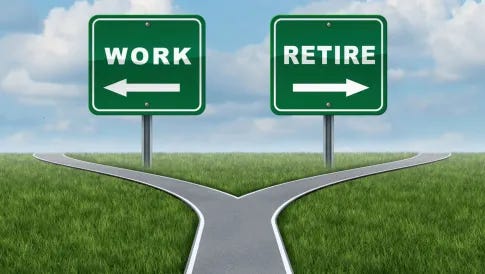
Okay, your turn. In the comments please tell us…
How old are you? Are you still working full-time? Or are you retired? Partially or fully? Are you having a hard time moving on from working? If so, is it because of a strong identification with your profession? Or is it something else—like finances, or other logistical matters? If you have retired, what now provides you with a sense of purpose and relevance? Are you involved in mentorship in your field? (If you’re commenting, please also do me the favor of hitting the heart button ❤️ for algorithmic purposes. Thank you!)
Big thanks to Dr. Samuel Masket, and to all of you—the most engaged, thoughtful, kind commenters I’ve ever encountered on the internet. And thank you, too, for all your encouragement and support. 🙏 💝 I couldn’t do this without you.
 | A guest post by
|
Being of service in some way is, I believe, one of the best ways to stay vibrant as we age.
My 82-year-old husband is like Sam. At the age of 4, he got lost while taking his 2-year-old sister on a nature hike. He had a satisfying career teaching and inspiring others to learn about nature. His college retired him in his early 70s, but together we wrote a well-received book about the woody plants of the area and donated the rights to the Natural History Institute. Parkinson's has slowed him down, but he still goes to "the field" a couple times a week and often finds people who are wondering.
I was also a lifelong educator, stopped teaching high school math at 60 because that job requires tremendous energy. Then for several years I adjunct taught astronomy and biology at two different colleges, did some grant-funded work in science education, and tutored homebound high school students in science and math. At 73, I decided to learn violin, found a luthier who took students, and made myself a beautiful instrument. At 80, I had lost my teeth and could no longer play my flute well enough but did not want to give up playing in a band, so I became a mallet player and put a marimba in my dining room. I am lucky to live in a town with college band and orchestra classes, but they're off for the summer, so I'm taking an online abstract painting course. Did I mention that my dad died at 100, and my 103-year-old mom lives with my sister? I feel I need to be prepared for another 20 years and hope to become a competent musician and artist. Thank you, Sari, for the opportunity to tell my story.