

Reclaiming My Roti
How a small win in the kitchen helped Viney Kirpal, now 76, re-establish her independence.



I wasn’t born with a disability. I acquired it in my 60s. That’s what made it harder to diagnose—and harder to live with.
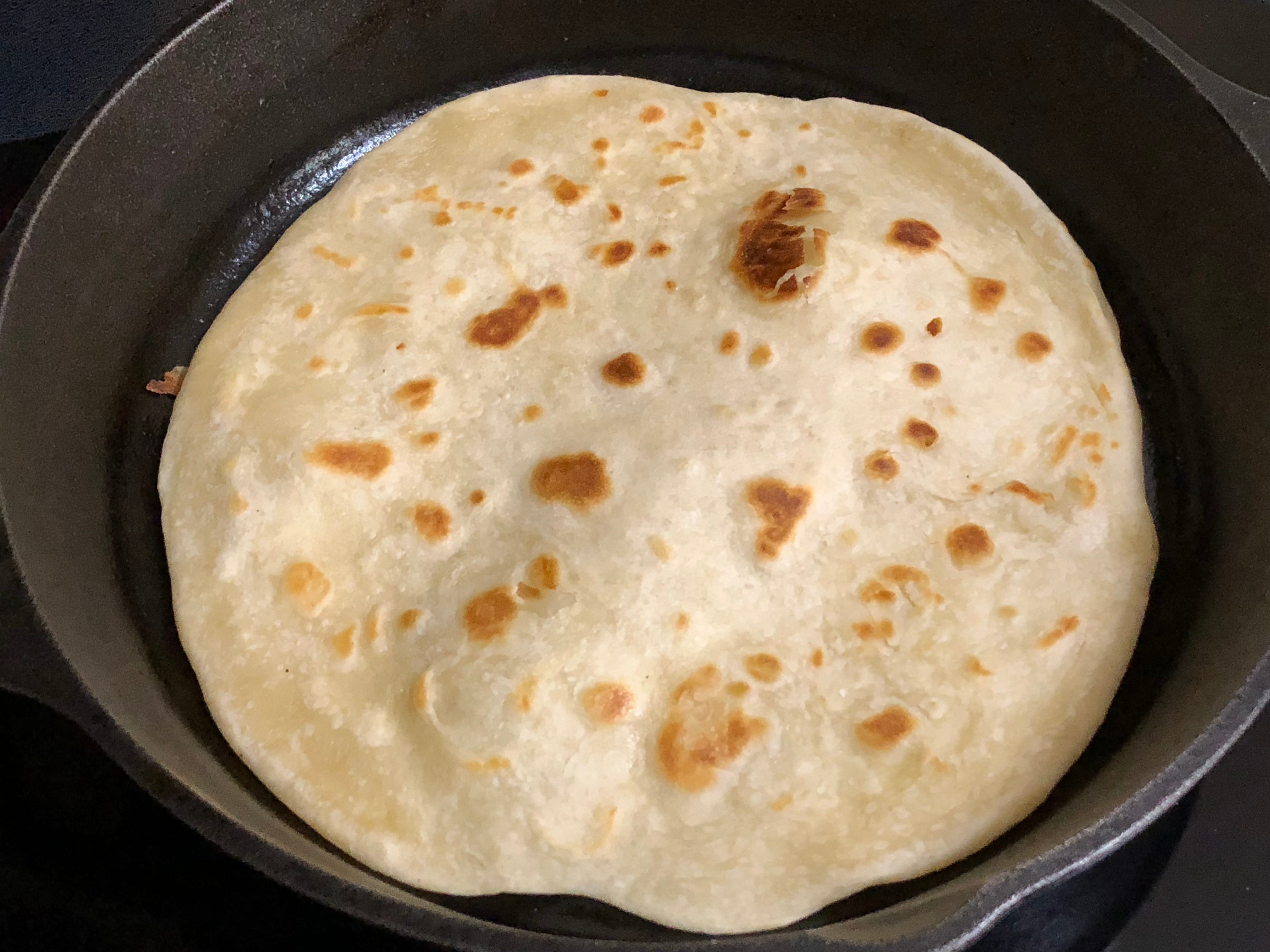
This May, I rolled a roti for the first time in 13 years. It puffed up, and I clapped with joy.
For 13 years, I had stopped entering the kitchen after my right shoulder gave way to a full tear in the supraspinatus muscle. As the strongest in the cluster of four muscles tore, my joint stopped taking the weight of my arm.
“I really enjoy your posts and your focus on the realities of aging in such a hopeful, life-affirming way.” - Julie Ansell, paid subscriber.
The first sign was so ordinary, it almost went unnoticed. One May morning in 2012, as sunlight spilled into my bedroom, I reached for my hairbrush. My elbow froze mid-air. A sharp, invisible jammer clamped down on my right arm. I tried again, puzzled, then anxious. My arm refused to rise.
I’ve always hated beginning my day with my hair unkempt. For years, I brushed and tied it neatly before stepping out of the bedroom. But that morning, my arm would not obey me.
When you’ve spent a lifetime using your arms without thought, the absence of that kind of mobility feels like an amputation of ease itself. The shock isn’t momentary—it renews with every small task.
Two days later, pain arrived—deep, persistent, like a knife twisting into the shoulder muscle. Physiotherapists came and went. Nothing changed. Finally, an MRI revealed the truth: a full tear in my right rotator cuff. I was 63.
When my rotator cuff tore, I couldn’t roll a roti. That loss—perhaps small to some—broke something in me. It wasn’t just about food. It was about pride, identity, agency, and joy.
When you’ve spent a lifetime using your arms without thought, the absence of that kind of mobility feels like an amputation of ease itself. The shock isn’t momentary—it renews with every small task. You reach for your teacup, but your hand won’t obey. You sit at the table, but can’t lift food to your mouth. You try to bolt the door, but your arm stops midway. Each attempt becomes a quiet humiliation, a reminder of how deeply the body shapes freedom. The loss seems small from the outside, but inside, it is immense—a grief measured not in moments, but in every second of helplessness.
For most people, rolling a roti—an Indian flatbread—is an everyday chore. For me, it was an act of love. It gave me pleasure to cook a tasty meal for my family and friends. I owned 40 cookbooks and delighted in trying out recipes and serving a variety of dishes. I cooked over a slow fire, listening to cumin seeds crackle in ghee, letting the aroma of roasted spices and warm aroma fill the house, adjusting the seasoning by intuition.
Cooking to music never wearied me; it delighted me. Each dish was my offering. It was a sacred act, an art form—something you performed with creative imagination, adding ingredients one by one until you instinctively knew it was just right.
Last May, thirteen years after that tear, at 76, I finally rolled a roti again. I flipped it expertly on the hot pan and watched it puff like in old times. My heart swelled. I clapped for myself. I took a picture of that small, imperfectly rolled but perfectly puffed bread. To others, it was just a roti. To me, it was movement. It was partial self-sufficiency. It was returning to something I had thought I’d lost forever.
***
I was healthy then—walking, jogging, traveling, living life fully. But invisible changes were happening beneath the surface.
In 2007, I learned I had breast cancer. The doctors removed my right breast. “You’re lucky,” they said. “The treatment worked.” But radiation and chemotherapy left behind their brutal signatures. They had damaged the left ventricle of my heart forever. Its pumping power fell from 65% to a mere 40%. My body grew weaker, more fragile.
The doctor ruled out surgery for the cuff tear. “No,” my oncologist said gently. “You’re too weak to undergo rehabilitation after another surgery.” I was told to manage.
When my rotator cuff tore, I couldn’t roll a roti. That loss—perhaps small to some—broke something in me. It wasn’t just about food. It was about pride, identity, agency, and joy.
Two months later, I had to be rushed to the emergency room with heart failure. My “ejection fraction” was 16%. (Normal is 50% to 70%.) I didn’t know what that meant then. I only knew I could no longer climb stairs. I needed help to bathe. The kitchen I once loved now felt like a war field laid with mines.
I left my job as a corporate trainer. My right shoulder was immobile; my breath was short; my world was shrinking.
When my heart stabilized a little, I relearned how to use my right hand. I propped it up with pillows, practiced moving it bit by bit. Every small note I wrote felt like climbing a mountain. Writing wasn’t just communication—it was defiance.
When I could, I returned to my non-profit work, guiding my team to help students prepare for competitive exams. I could no longer stand for hours, but I could still plan, think, guide. That mattered.
Still, my heart was failing. My arm lay forgotten. Modern medicine had saved me—but also betrayed me, refusing to look beyond the surface of its own side effects.
Then came 2018: my heart transplant. A miracle, yes—but my arm remained frozen in its old pain.
A year later, I tried again. Manipulation therapy improved mobility slightly, and I cried with relief. Then, just when I could lift my hand again, my left rotator cuff tore.
COVID-19 arrived. Hospitals closed. I lived with relentless pain. I couldn’t sleep on either side. Lifting a cup of tea required effort. Pulling a blanket at night needed help.
In late 2023, I fell in my home. My body lacked upper-body stability from both torn shoulders. A casual turn mid-conversation ended with a scary thud—the sound of bone meeting floor, breath knocked out, pain raged like fire. I had hurt my tailbone.
I fractured my wrist and a vertebra. But worse, I fractured my confidence. For the first time, I feared my home. I feared being alone. I feared being erased. That was the lowest point in my life—but also the beginning of change.
Desperation gave me courage. I found a physiotherapist and a chiropractor who treated me with gentleness and resolve. Slowly, I stood up again—literally and metaphorically.
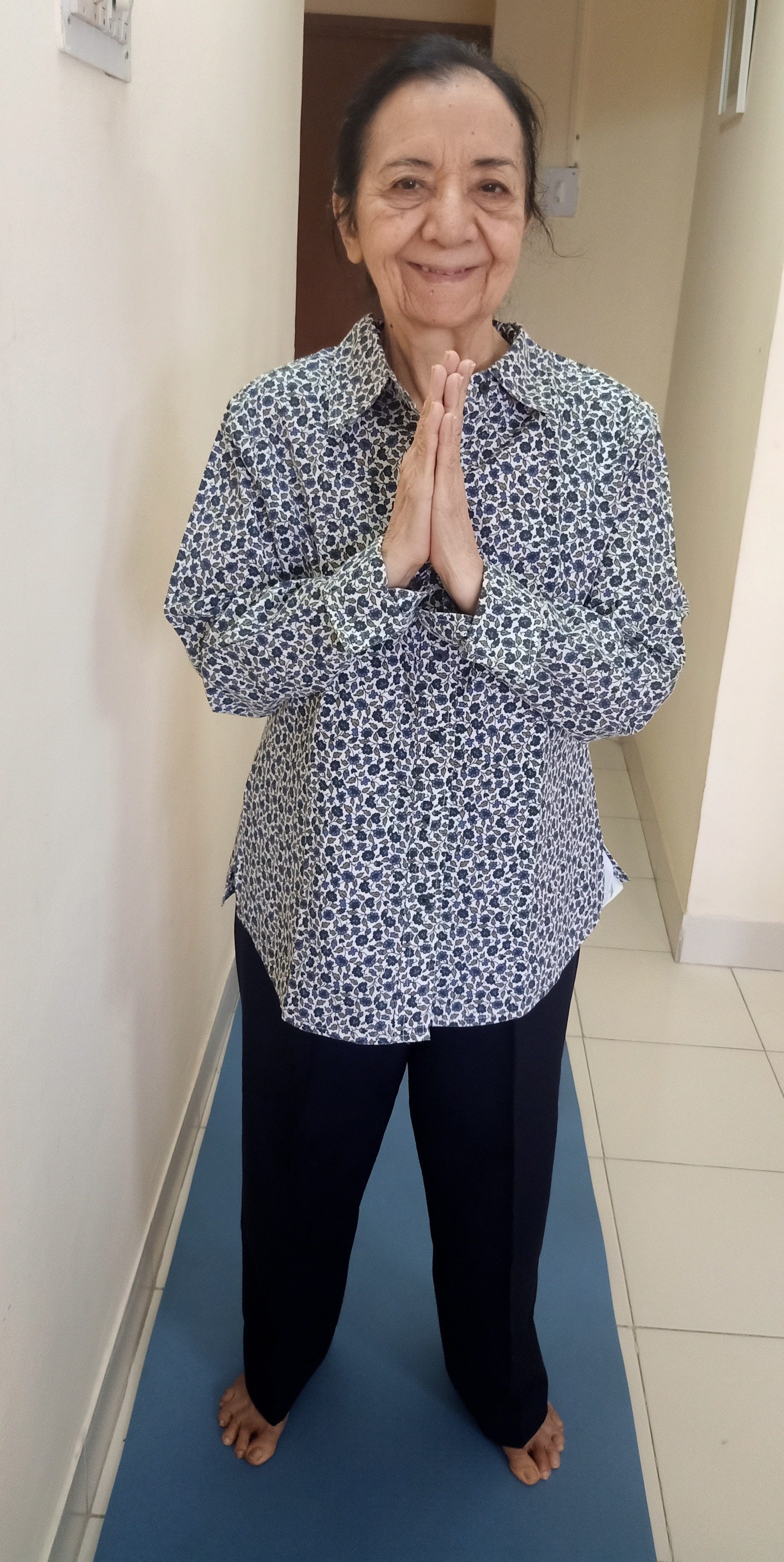
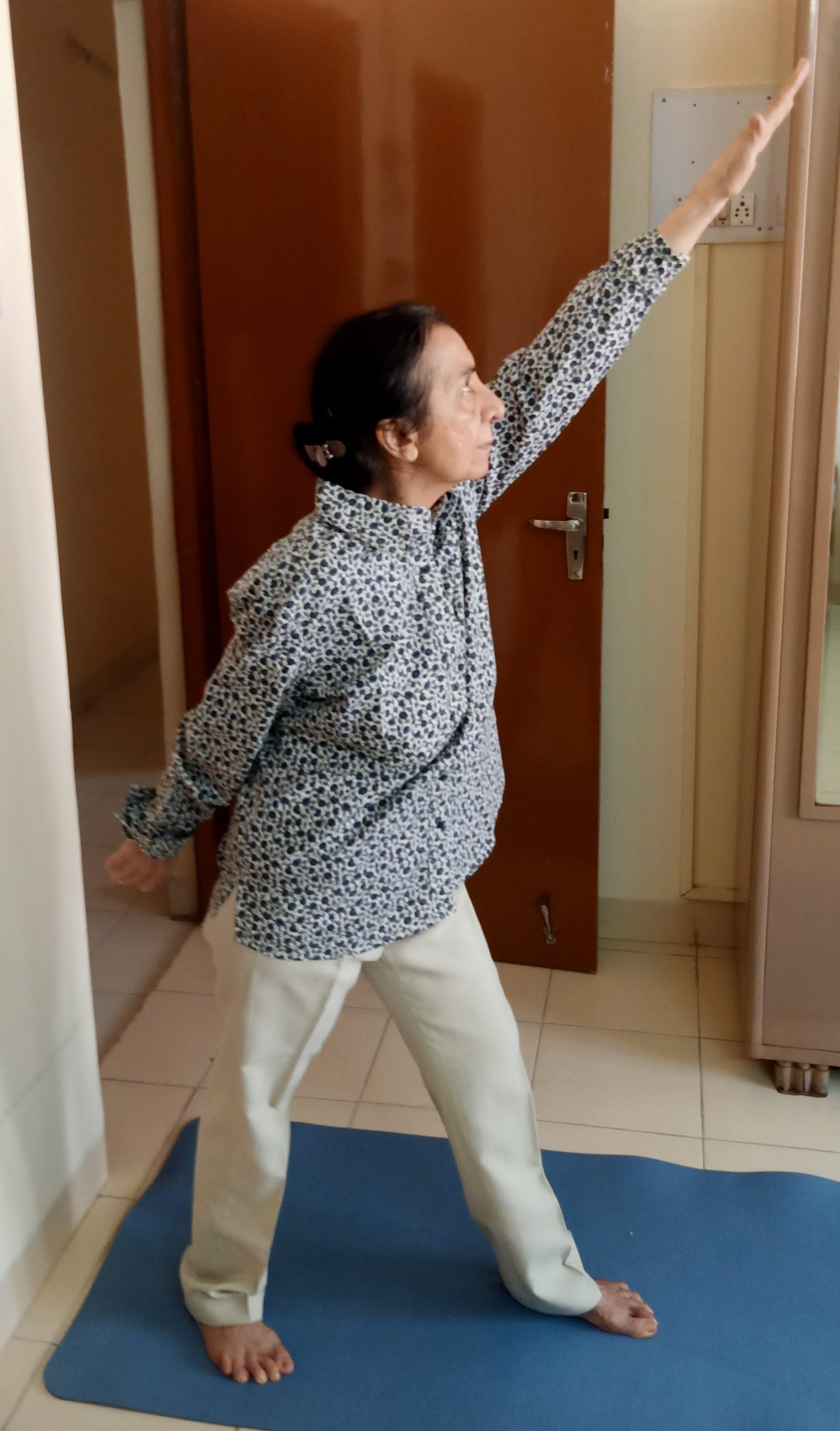
I also joined an online yoga class led by a young engineer who teaches older women—mothers and grandmothers—how to rebuild strength and balance. I didn’t expect joy. But joy came quietly, in the rhythm of daily practice.
My trainer often tells us, “Do as much as you can. Yoga is about continuity, not performance.” His words are a balm. I believe him.
I also joined an online yoga class led by a young engineer who teaches older women—mothers and grandmothers—how to rebuild strength and balance. I didn’t expect joy. But joy came quietly, in the rhythm of daily practice.
I still can’t raise my arms fully or comb my hair skillfully. But I can do gentle squats. I can balance on one foot with support. I can stretch. I can get up from a chair on my own. I can bathe on my own and take the towel off the towel stand. These may sound small—but they are everything.
The hallmark of my success? Rolling a roti.
This is not a small win. Small successful actions feel like triumphs.
Both my shoulders are permanently torn. They will never be whole. The pain remains. But I am not just shoulders. I am breath. I am effort. I am persistence. I am a woman who shows up.
My osteopath has asked me to set a functional goal for the next year. Mine is simple: to do as many everyday tasks as I can that define my independence.
Writing is part of that independence. It reminds me I am not just a body marked by mastectomy scars, torn muscles, and a donor heart—but a woman with a voice. Writing helps me assert identity beyond illness.
People call me strong. I don’t feel strong. I feel stubborn. Defiant. Angry. Grateful.
My body has been broken many times. But it has rebuilt itself slowly, painfully, powerfully. Yoga gives me structure. My osteopath has given me an aim, a direction. Writing gives me freedom.
This is not a story of a cure. It is not a story of going back. It is a story of reclamation.
My shoulders may never move as they once did. But my spirit moves forward every day, millimeter by millimeter. And that, to me, is a new definition of wholeness.
Healing isn’t about returning. Healing is about becoming.
Previously Viney Kirpal wrote “The Art of Healing” for Oldster.
 | A guest post by
|
Thank you Sallie
Omg, love this beautiful piece it reminds that it’s not what one carries but how one carries it that makes all the difference. You go sister 💕 keep rolling