




Imagine a crater 50 feet wide and 15 feet deep cracking open under your feet. Where would you be? Who would you be? Imagine something of similar scale cracking open in your head. This happened to me in 2006 when I was hit by a drunk with a truck.
My brain broke.
Words jammed in my ears if I heard them. Jammed in my throat if I tried to say them. Jammed and scrambled if I saw them. Words had been my job. My clients produced Oprah and Elmo and Martha and Elle, plus Vogue, The New Yorker, and Kermit the Frog, and I produced words for all of them.
Words took us on vacation, bought the car and powered it, dressed us up, took us out, paid tuition, planted trees. Then I couldn’t combine them, define them, align them, recall them, or take them to the bank. I was then 56, had planned to freelance for ten more years, and hadn’t planned on a drunk with a truck.
Imagine what it would be like to lose your best friend. Then try to imagine what it would be like to lose your best self. The first and second person who now overlapped as “me” had wholly different lives. The first person was a writer. The second person landed on a planet without a paragraph, I mean without a parachute, and was parked at a table in Brain Trauma with a bunch of other people who were pounding pegs in boards.
We were missing persons, missing the persons we used to be. Some of us were lawyers or teachers or street cleaners or Special Troops in conflict zones, which were once called wars. One guy made falafels. Some were parents. Some have parents. Some have toddlers. Some speak like toddlers. Or don’t speak. One guy was hit by a bus. One was hit by a bullet. Robin forgot the names of her kids. I couldn’t remember the names of my clients, or what I had ever done for them. I couldn’t remember my child’s first words or the scent of her hair.
Memory is what remains of everything we’ve ever seen or heard or learned or cared about. It is who we think we are. But it’s not what is in your head. It’s what you can find in your head. I took endless batteries of tests—not to measure what was lost, but to measure what remained. Sometimes the “bare minimum” was my maximum. I learned and forgot I’d been hit by a truck. I likely was told that a few hundred times.
I am a version of the person who wrote words before the truck. What would take the “first me” five minutes took “the new me” hours, so “we” learned to start preparing “me” long ahead of time.
Words took us on vacation, bought the car and powered it, dressed us up, took us out, paid tuition, planted trees. Then I couldn’t combine them, define them, align them, recall them, or take them to the bank. I was then 56, had planned to freelance for ten more years, and hadn’t planned on a drunk with a truck.
Someone in scrubs asked me to say the name of each thing I was shown in a series of pictures. A fish. A dish. A teapot. A turtle. Sometimes I could. Sometimes I couldn’t. The time it takes to convert a thought into sounds—then words—takes seconds for most people, but decades or longer for people like us. That’s why we have handlers, I mean therapists. I mean Specialists in Crisp Compassion.
Our home in New York was sold to pay the bills. I was shipped nine hours south to an outpatient clinic not as good as the one up north, where every few hours or centuries, someone asked if I knew where I was. Brain damage destroys your sense of time and place, and delivers an endlessly flexible setting, which can take anything anywhere at more or less any time. Someone else in scrubs asked if I might feel depressed.
Some writers suggest writing at a “little distance from yourself, standing beside yourself.” I was “beside myself” a lot. I was asked questions like: Can you smile for me? Can you stick out your tongue? Can you add 2+2? I had been expecting the first me to return so I could walk down the stairs and walk up the stairs and do what I’d always done to support my family.
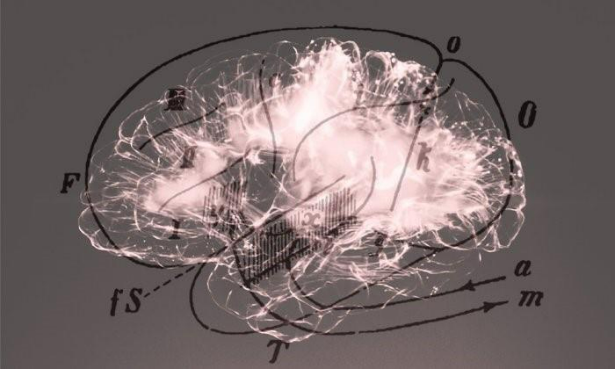
While dementia takes years to destroy who you were, a traumatic brain injury (TBI) can wreak the same damage in seconds. They say the first three months are the worst. But at the end of six months, I was still waiting for three months to end. That’s when someone else in scrubs asked if I had felt suicidal. To which I may have replied, “Not yet.”
One report said: “On examination, [I] generated 11 animals/minute and 6 “F” words per minute with frequent perseverations.” Fig, fog, flag, flog, frog, fast, frost, frosting, fact, fast, did I already say that, foot…f**k. I would hang onto a sound, like, let’s say, “ef” as in ef, ef, ef, ef, ef, ef, ef and not know what I meant to say.
I had cognitive fluctuations, which I sometimes said minus the “l.” As in, f-uctuations. This meant I ranged from pretty smart to smart as a stone. Also from uninhibited, which is bad, to uninhabited, which was worse. On the other hand, I got better at speaking in reverse, which meant I could count four numbers backwards and sometimes say four words backwards, too, both of which were required on cognitive tests.
I was also hearing voices, or rather, hearing what I recalled of the alphabet playing in my head. On endless rotation, as in “elemeno pea” or “elemeno pee.” Which brings me to another problem. Once I could manage to find the bathroom, I couldn’t manage to find my way back. Short-term memories drained away like water through a sieve, and long-term memories did the same.
In my first life, I was a heavy thinker. I did the same assignments as men (who weren’t also mommies to their kids)—while getting bills paid, meals made, homework done, baths taken, stories read, prayers said. I put dishes in the dishwasher and remembered to take them out. In this life, I was asked to recall a sequence of two things, moments after seeing it. I couldn’t. Then a “sequence” of one. I couldn’t. My starting point was shot to hell, my events were shot to hell, my timeline was shot to hell.
There were other losses, too, like the people I “left” and the ones who left me. My child was gone, my mom was gone, my friends up north were gone, our home was gone. Add to that list my income and my job. Make that “former job.” I also lost “the ability to judge and control distance, speed, and power of motor acts.” That is called dysmetria and causes you to slam into walls. One doctor said I was impaired and could not be repaired. Someone else asked if I’d considered suicide.
I started recalling more—albeit random—things. Like a model of the solar system, as constructed by a few “creatives” at a bar in Manhattan. The sun was a lemon. The Earth was an olive moving around the lemon, used as a visual aid by someone trying to explain why it gets dark earlier on the east coast than it does in LA. Mars would have been a cherry, but somebody ate it first.
I am a version of the person who wrote words before the truck. What would take the “first me” five minutes took “the new me” hours, so “we” learned to start preparing “me” long ahead of time.
To tell this story in a straightforward, linear style would fail to capture the absurd, recursive way in which I attempt to put pieces together—with painstaking care—then lose them, then put them together again. In my first life, the world seemed to arrange itself. Then it seemed to derange itself. An entire unlimited democracy of things that stopped making sense.
There were other issues, so I created a Four-Step Program.
The first step is to know where you are.
The second step is to know who you are.
The third step is to know why you’re here.
As you may have noticed, the Four-Step Program had three steps.
For most of year one, I didn’t remember how to do things or what anything was for. By the end of year one, I knew what some things were for. That’s when I was told to stop coming because things were “as good as they would get.” Evidently, you get better for a while and then you don’t. Unless you have massive private funds or massive insurance, and can then stay as long as you like.
I became a member of the largest single minority in the world: disabled people. Some people say I don’t look head-injured. Some people say I don’t sound head-injured. I know they’re being nice, and I want to be nice, too, so I don’t ask them how head-injured people look. What they see is in their head. But they don’t see what’s in ours. While some people think I’m way more screwed up than I am, others think I’m way less screwed up than I am. To riff on Descartes, they think, therefore I am. They see what they believe.
There was a philosopher named Nothing Doing. That is not true. I forget his name. He recommended doing nothing. Sometimes I took his advice. But then I started to write a book. I have to make the book “handicapped accessible.” No, that’s not it. I have to make writing the book handicapped-accessible so I can write it.
In year three, one doctor saw my scans and said if I could write a book, I would have achieved the impossible. I decided to do just that—by redefining the word “impossible” to simply mean something I had not done yet. But then I lost my agents. I had started getting old, and kept on doing it and no one was seeking old/un-brand-name writers. Or as one agent said, no one was seeking “brain-damaged” books.
Nineteen years post-truck, I can have one conversation every two or three days, then wilt or be fried to a crisp. Every three months, I walk past the Evoked Potential Lab in Neurology and wonder what that means. In my first life, I gave everything I had. In this life, I give everything I have left.
Check out all of Judith Hannah Weiss’s essays for Oldster Magazine. And check out her newsletter, Dispatch From Bewilderness.
 | A guest post by
|
Gosh if this is the way you write now I can't imagine how it was. It's so beautifully written, I was riveted.
Thank you for sharing. Wishing you all good things.
Dear Tony,
I love your comment. Thank you so much.
All my best,
J