

Is "Columbo" Oldster-Coded?
Deborah Shapiro on obsessively watching Peter Falk's iconic ten-season series, being partronized by someone younger for the first time, and the lasting appeal of the actor's style.


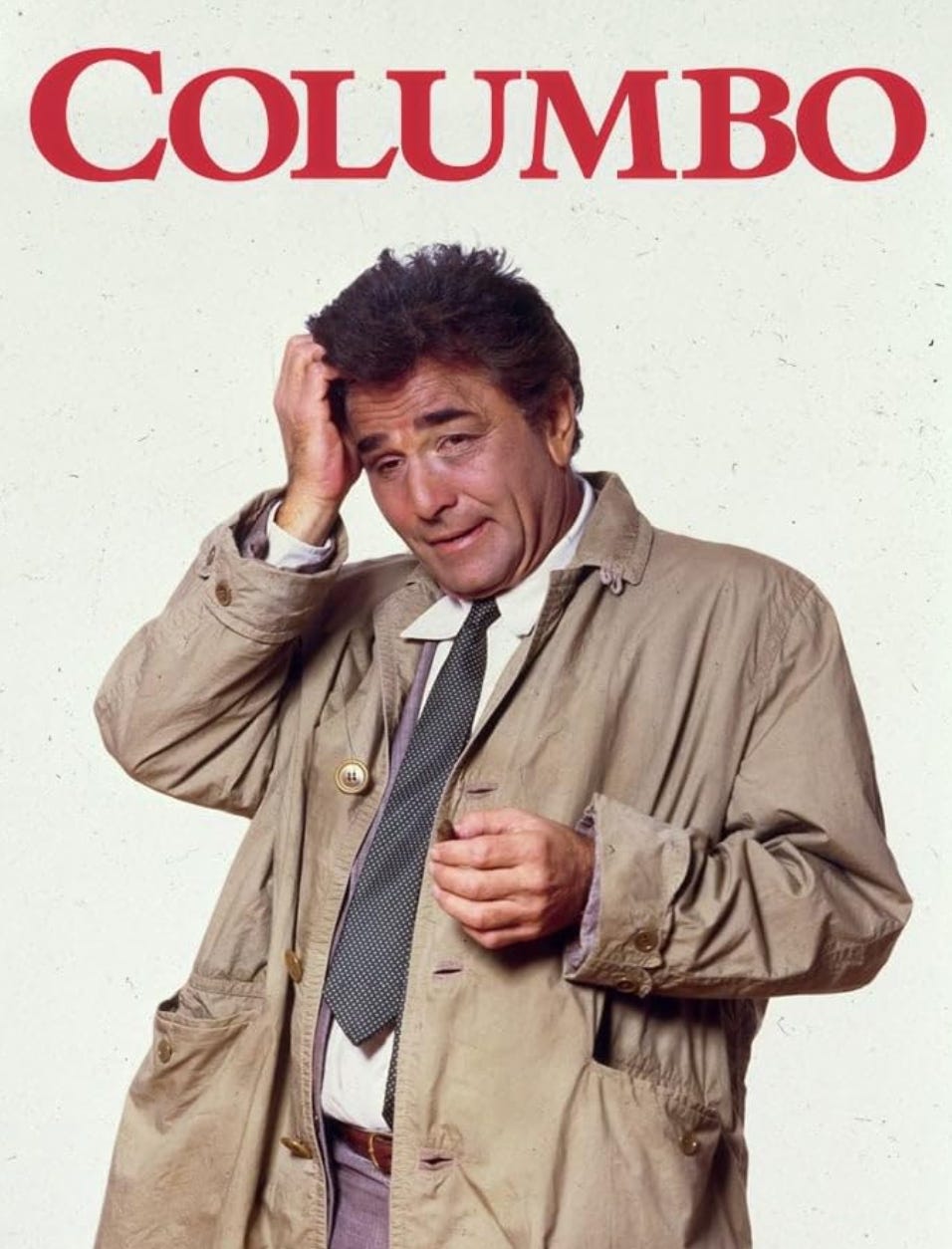
My latest book, Watching the Detective, has to do with a recent time in my life when all I wanted to watch was the classic TV series Columbo. Why, out of the endless options available, was this my go-to? It had to do with comfort, sure, and the show’s sensibility, its slower pacing, its tangents. And of course, Peter Falk. But it was something more than that. And trying to figure out what it was became an investigation, of sorts. My search revealed to me that the movement of time and the process of aging – existing through and over the course of time—were central to what was going on here. The appeal of watching Columbo lay not so much in nostalgia but in the way the past relates to the present, the correspondences, the overlaps, the interdependency—on both a cultural and a personal level.
I came into the world in the 70s, when the original run of the series was airing. The character of Columbo, whether I was totally aware of him, was always there. Unchanging and yet… changing as my perspective shifted. (Talking about Watching the Detective, a friend who is my age, said: “I think one mark of getting older is that you start to understand how weirdly hot Peter Falk was” – shifting perspectives!) Watching Columbo led me want to re-watch all the John Cassavetes movies I’d first seen in my 20s, including those starring his close friend Falk: Husbands and A Woman Under the Influence. You see new things decades later, of course. The marks of getting older are all here, but so too are the indelible impressions of our younger selves.
Here’s an excerpt from the book - Deborah Shapiro
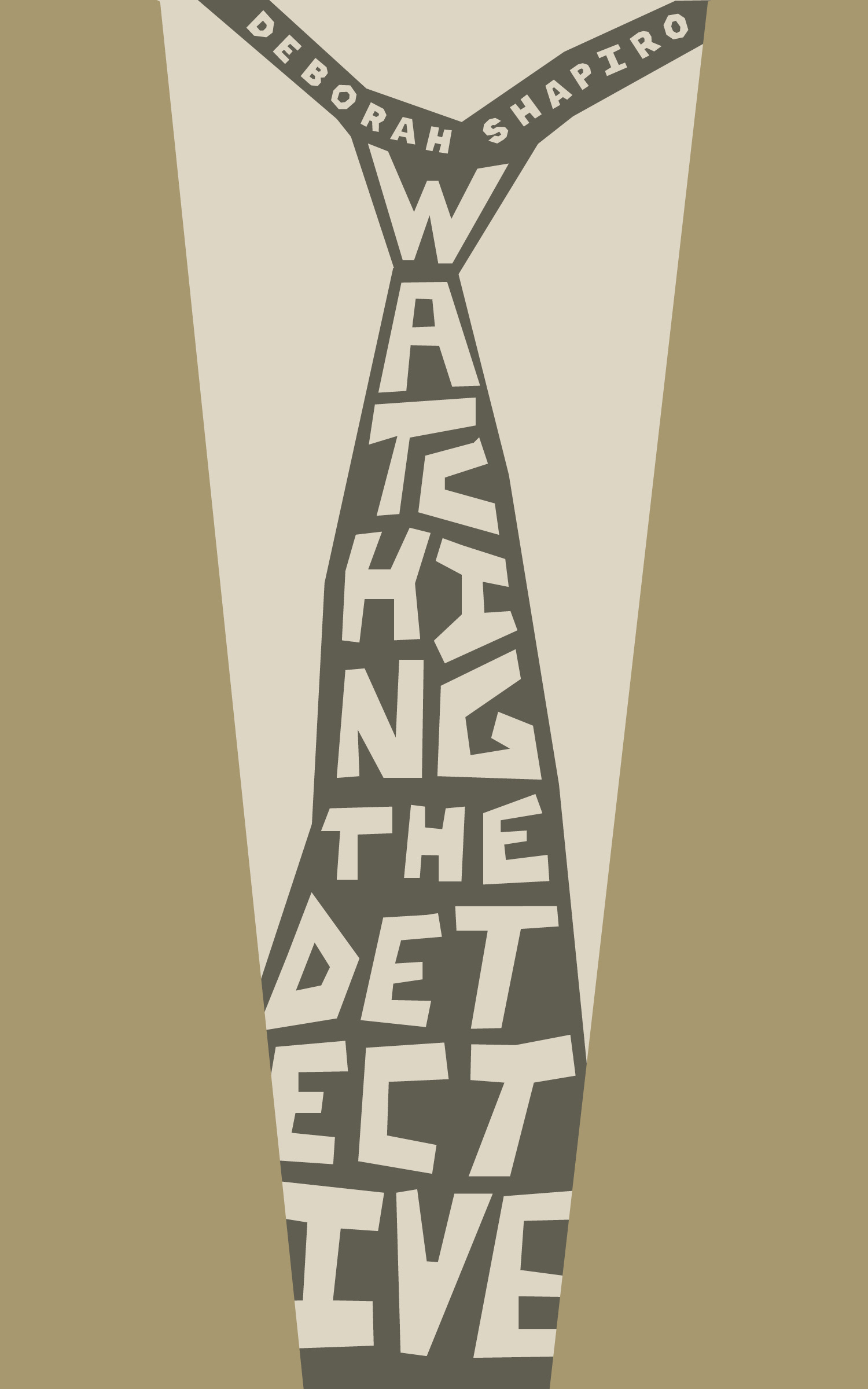
I watch Cassavetes’ Opening Night yet again, which stars Gena Rowlands as Myrtle Gordon, a beloved actress preparing to open a show called The Second Woman on Broadway. We encounter her first backstage, her warm blonde hair set and softly curled above her shoulders, wide face, pliant mouth, shadowed eyes, a cigarette resting between her lips, painted nails, glamorous and tough. Better to say toughened. She appears to have lived a bit, seen some things, a world-weariness has set in. When a young fan gets killed by a car while trying to meet Myrtle after a rehearsal, it sends the star spiraling.
She says when she was 18, she could do anything—her “emotions were so close to the surface”—but she’s now finding it harder to “stay in touch.” She refuses to state her age when asked, as though uttering it aloud would make it a fact, make it real. (Rowlands would have been around 46 or 47 when she filmed this.) She drinks heavily, she has visions of, hauntings by, the dead teenager, antagonizes the 65-year-old female playwright, worries about her looks (though in her oversize sunglasses—a defensive shield?—she has never appeared cooler), meets with Spiritualists.
Gena Rowland’s character in Opening Night refuses to state her age when asked, as though uttering it aloud would make it a fact, make it real. (Rowlands would have been around 46 or 47 when she filmed this.) She drinks heavily, she has visions of, hauntings by, the dead teenager, antagonizes the 65-year-old female playwright, worries about her looks…
She doesn’t have a husband, doesn’t have children—she tells us acting is all she’s got. And she can’t seem to play this part. She goes off-script, in both literal and figurative ways. She is late for the opening and when she finally turns up, she is fall-down drunk. Is it a spoiler to describe the ending? I won’t. I will just say that Peter Falk has a small, uncredited cameo as a tuxedoed theatergoer, smoking a cigarette in the lobby (everybody smokes) and embracing Myrtle onstage after the curtain call. And I will add that this movie is very much about aging.
There’s an echo of All About Eve (1950), in the dynamic between an older star and an aspiring, grasping young one, even if the younger one in Opening Night is a hallucination. In All About Eve, Bette Davis is Margo Channing, a Broadway diva who has recently turned 40. Anne Baxter is Eve Harrington, an obsessed young fan who becomes Channing’s assistant and proceeds to scheme her way to fame at Channing’s expense. Twenty-three years later, Anne Baxter would appear in the Columbo episode “Requiem for a Falling Star” (1973), playing—you guessed it—a “has-been movie queen” as her blackmailer/murder target puts it. The circularity in which we all—but especially actors, it seems—find ourselves.
My Opening Night rescreen happened right after experiencing, for the very first time in my life, the feeling of being patronized as an “old person.” So, this is what it’s like! I’m at the local food co-op and I sense that the cashier, with their perfect complexion (a name tag offers they/them pronouns), their undeniable youth, is treating me kindly because I register not so much as elderly or infirm but clearly no longer young and therefore not totally with it. “Hello!” with real eye contact and a smile. “Did you find everything okay??” Perhaps I’ll say the wrong thing, perhaps I won’t know how to work the credit card reader—it’s all right, they’ll be patient with me, forgiving. But look: I successfully bag my items all by myself! In the reusable cloth bags I have brought from home because I care about the planet, about the future, about the world the young will inherit and inhabit. “Have a great afternoon!” they say. “You, too!” I practically exude. I leave the store and don’t immediately understand what this sensation is. On my walk home, I begin to grasp it, and as I unload the groceries, I ask my husband, “Is this what being out in public is going to be like from now on?”
A 30-something Italian friend tells me a dubbed version of Columbo is still huge in Italy . . . among people over 60. Was Columbo always a show for older people, depending on how you define “older”? A friend, who is about seven years younger than me, who grew up in a multigenerational home in the Midwest, tells me she was “a Columbo kid because I was raised with old folks.” Another younger friend, whose father was in the Army and whose family moved around a lot—to bases in Massachusetts, Alaska, Illinois, and Washington state—was introduced to Columbo by his grandparents, who’d recorded the show on their VCR. They had just about every episode on tape, he tells me. For consecutive summers, from the age of 9 to 15, he and his sister would visit them on the South Shore of Massachusetts and watch. None of the tapes were labeled, by the way. An education, of sorts. And some of his favorite memories.
My Opening Night rescreen happened right after experiencing, for the very first time in my life, the feeling of being patronized as an “old person.” So, this is what it’s like! I’m at the local food co-op and I sense that the cashier, with their perfect complexion (a name tag offers they/them pronouns), their undeniable youth, is treating me kindly because I register not so much as elderly or infirm but clearly no longer young and therefore not totally with it. “Hello!” with real eye contact and a smile. “Did you find everything okay??”
It was never exclusively a show for older people. In 1972, introducing Falk as a guest on The Tonight Show, Johnny Carson noted that Columbo was the most popular character on television, particularly among high school and college students. But when Columbo was revived in the late ’80s, there seemed to be an effort to appeal to younger viewers whose tastes and expectations had changed. Musically, this meant a score heavy on synthesizers and saxophones, evidently. The production values from this era of the show haven’t aged especially well, perhaps because they were already behind their time and not exactly of it. What still works is Columbo’s unchanging suit and raincoat. This is what remains instantly recognizable. Timeless.
A question of legibility surfaces: Has the fact that we can watch or listen to almost anything from any time at any time with minimal effort changed the way we understand what we are watching and listening to? For the better? We know that what we are taking in is an artifact of another time yet it’s right there in front of us. We didn’t have to go digging for it; we didn’t unearth anything. There is a continuum, a kind of ongoingness, and this provides a context we didn’t have before. It is, to an extent, like the opposite of a time capsule. There is continual discovery or rediscovery, but there is no burial.
When Columbo first aired, most Americans only had a handful of TV channels to choose from: the three major broadcast networks, public television, and local UHF stations. Cable networks, airing original programming, really started growing in the mid to late ’70s. There were only so many options. This is not to bemoan the death of monoculture, just to note that Columbo existed within it and would likely never have permeated our mindscape otherwise.
…
I think about the fact that Falk originally used a raincoat from his own closet to outfit Columbo. “The raincoat worked 76 episodes for almost 27 years, but in the late ’90s we became concerned,” wrote Falk in his memoir. “It started to look fragile. I did what I could. Each evening, I put out a saucer of milk for it.” In “Now You See Him” (1976), Columbo sports a new coat, darker brown, with piping on the collar and pockets, a birthday present from his wife, or so he says. A “fine-looking raincoat” says a fellow officer. “Seems a little stiff to me,” says Columbo, whose discomfort becomes too much for him. “I gotta take off this coat—I can’t think in this coat!” He tries to lose the coat for the rest of the episode. He tells his dog, Dog, “I’m gonna leave this coat in the car. If someone tries to lift it, you look the other way.” In the end, he’s back in his old favorite. But why always a raincoat, in sunny LA? William Levinson and Richard Link, the show’s creators, imagined a finale, that never came to pass, in which the raincoat is at the dry cleaner’s for the duration of the episode; when the case is closed, Columbo walks outside and it’s raining—freeze-frame on the lieutenant with his expressive hands in the air. The beat-up, brown leather high-top shoes Columbo wore throughout the initial run of the show also belonged to Falk. The raincoat, the shoes, the suit—“a symphony of brown,” Falk said on Inside the Actors Studio in 1999, “with one concession to color, that drab green tie.”
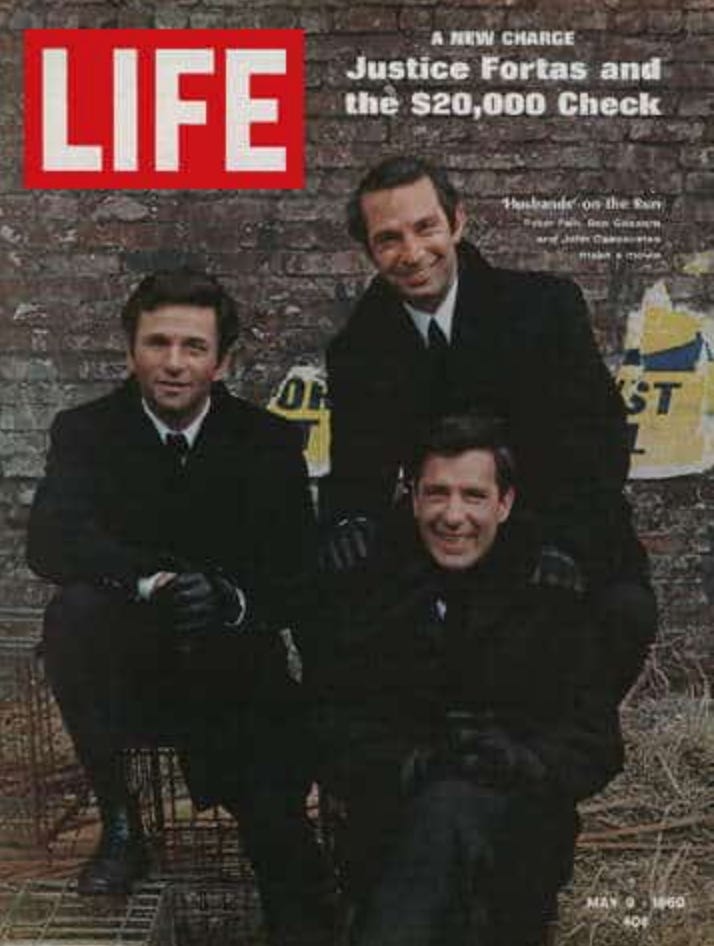
I think about Ben Gazzara detailing in his memoir how Falk wore a navy blue coat to John Cassavetes’ funeral in 1989. The same coat he’d “worn in the opening scene of Husbands, so many years before.” It would have been about 20 years. Gazzara notes that Husbands “opened with John, Peter, and me going to the funeral of our best friend—and here it was, the real thing.”
Was Columbo always a show for older people, depending on how you define “older”? A friend, who is about seven years younger than me, who grew up in a multigenerational home in the Midwest, tells me she was “a Columbo kid because I was raised with old folks.” Another younger friend, whose father was in the Army and whose family moved around a lot—to bases in Massachusetts, Alaska, Illinois, and Washington state—was introduced to Columbo by his grandparents, who’d recorded the show on their VCR. They had just about every episode on tape, he tells me.
I think about my friend Juan, who casually watched perpetual Columbo reruns as a child in South America and, years later, wound up buying a raincoat similar to—“same cut, same collar”—the lieutenant’s, almost out of some unthinking, deep-seated urge. Only eventually, he tells me, did he “delight” in the realization “that I was wearing Columbo’s coat.” A decade on: “I still have it, still love it. It has definitely grown more rumpled.” The sartorial pull of the early Columbo episodes is strong, he adds, noting the peacock aesthetic of the villains, in particular. How the show offers “a kind of amazing breadth of men’s fashion high points in the ’70s: bold but elegant patterns, lots of carefully styled and coordinated suits.”
I think about the fact that my dad has held on to so many articles of clothing from the past, which he offers now to me and my sister, my husband, and my brother-in-law. My son has inherited a couple of flannel shirts. He has sent us a pair of leather gloves which look just like the kind many a murderer has used on Columbo to leave no fingerprints. A wool sport coat he bought on a trip to Scotland when he was a young man is too moth-eaten to salvage. (He can’t dispose of it himself; he can only give it to us to get rid of while he’s not looking—recycle it, repurpose it, he doesn’t care so long as he doesn’t have to know. “Do with it as you wish.”) But he passed along a pair of brown leather penny loafers to my husband—in good shape, though to preserve them, my father had applied a few layers of Shoe Goo, an adhesive and sealant, to the soles. My husband took the Goo’d shoes to a cobbler, had them resoled, and, with a sense of accomplishment, says he’ll have them forever. And, as I write this, I’m wearing a well-kept Fair Isle sweater that once belonged to my father, from the Scotland-travel era. It’s big on me and perfect for a day when the wind blows the leaves along the sidewalk and the sky gets dark before dinnertime.
 | A guest post by
|
Ohhh... SO many thoughts on this, as my mentor and my girls’ amazing godmother, Jacqueline Saint Ann, spent YEARS on set as Falk’s costume designer and dresser. They were inseparable. At home, we even got to skulk around the house in his original trench coat. It made us all want to be sleuths. 😂
I cannot WAIT to read Deborah's book! Like everyone else, I watched Columbo as a kid. I was also a dedicated Rockford Files girl. But my parents loved Peter Falk because he grew up in CT, near where we lived. When I moved to NYC after college, and when my parents came in for my birthday, which is Christmas Day, we always went to Shun Lee Palace. One year, as we were leaving, Falk and his wife were arriving and my parents stopped him to talk about their old stomping grounds. He was delightful. And, I swear, was wearing that old raincoat.