

How Has Getting Older Affected Your Sense of Yourself, or Your Identity?
What do you say we all answer Oldster Questionnaire question #8? A Friday open thread...

Readers,
In the past several months I’ve been interviewed a lot about Oldster, and also about my own experience of getting older. Sometimes the interviewers have turned my own questions (from The Oldster Magazine Questionnaire) back on me. I already took the questionnaire myself nearly five years ago, but it’s been interesting to consider my thoughts and feelings from a new vantage point, now that I’ve entered my 60s.
One of the questions that came up in a recent conversation is the eighth one in the questionnaire:
How has getting older affected your sense of yourself, or your identity?
I realized that something has recently shifted for me on that front. Maybe it has to do with my work now being recognized in a more serious way, but suddenly I’ve gained a new level of confidence in myself.
It’s not just about my work. It also has to do with who I am in the worlds I travel through—family, friends, community (locally and more broadly), my profession. I like who I show up as, now that I’m older and more seasoned at living life.
I also value myself and my time more, which makes it so I’m less likely to waste it on people and endeavors I’m not really interested in, or don’t serve me well.
This new perspective allows me to self-advocate and stand up for myself in ways I never used to know how to, or have the chutzpah for. And it helps me to find my boundaries and limits in situations where, in the past, I might have allowed myself to be drawn in directions that were not good for me. I’ve learned to count to ten before offering a knee-jerk, people-pleaser’s “yes” when the more truthful and self-supportive answer might be “no.”
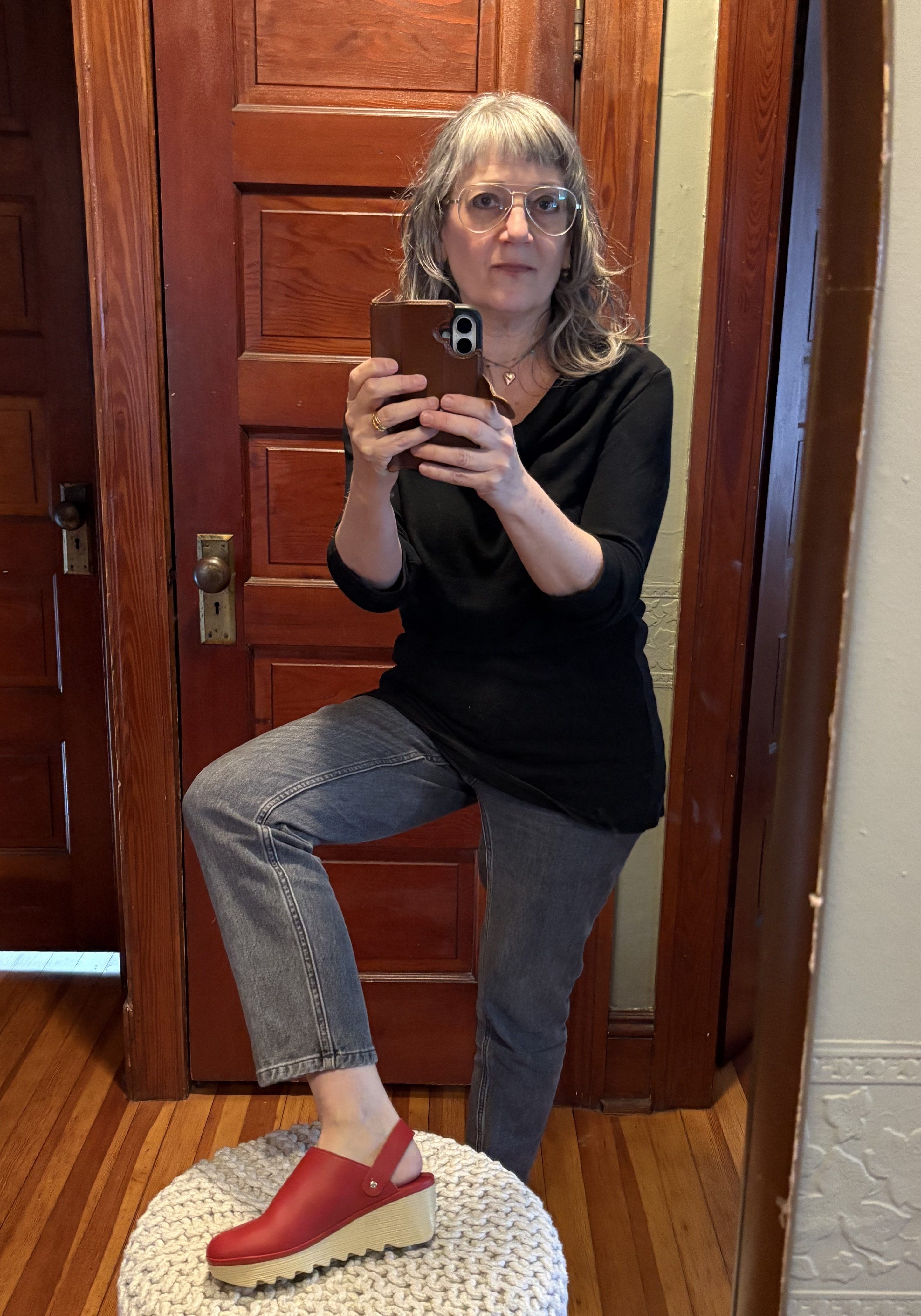
This shift also extends to my appearance. I’ve accepted the effects of aging on how I look, in a way I really hadn’t before. Not only that, I think I might actually prefer how I look now—gray hair and wrinkles and all. My physical form feels to me like a favorite pair of well-worn blue jeans.
What’s more, I’ve sort of settled into the identity of A Somewhat Older Person—a more experienced colleague/mentor/big sister to Millennials and Gen Z-ers. Yes, to some extent I still feel like a kid internally—I suppose I always will—but there’s also this new role that I gladly play when its called for, and which I feel comfortable in.
***
I’m always curious about other people’s experiences of getting older, so I figured I’d toss this question out to all of you for a Friday Open Thread. In the comments please tell us…
How old are you? How has getting older affected your sense of yourself, or your identity? Was there a particular age at which your self-concept shifted? Maybe more than one? What do you suspect influenced those shifts? Do you like who you’ve become as you’ve gotten older? Are there aspects of your identity as an older person that you don’t like? Ones you don’t? Answer as many or as few of these questions as you’d like! (If you’re commenting, please also do me the favor of hitting the heart button ❤️ for algorithmic purposes. Thank you.)
I really love these open threads because they help me feel less alone in my experience of aging. I also enjoy getting to know more about all of you.
Thanks for chiming in. And for reading and supporting my work at Oldster. I really appreciate it. 🙏 💝
Today is my 60th birthday, I just rolled out of bed and made coffee, and this will be a stream-of-consciousness free-writing exercise. Bear with me, if you will.
It feels as though I crossed a sort of border upon waking this morning. Not because I'm 60, but because, coincidentally, someone I love of the same age received a dire cancer diagnosis last week. As I observe this milestone for that dear person and myself, I'm forced to confront mortality in a new way, by witnessing the suffering of someone very close.
I was a soldier for 23 years. I participated in two Middle Eastern combat operations--fewer than many service members, but sufficient for the purpose of working in the presence of people trying to kill one another and living with the concept of violent death striking without warning. When I returned, physically intact, I was as relieved as one might imagine, but also surprised. I'd had a couple of close calls, and I lost a couple of friends.
Like so many returning from war, I wondered, "Why did I make it, when Brian and Sid didn't?"
I realized that whatever was going to kill me, it wouldn't be war. That sense of a new "lease on life" led me to reevaluate everything. I left my stagnant first marriage. I went to graduate school and instead of becoming a "tie guy" (a retired soldier who trades the uniform for a shirt and tie to work for the Defense Department) I focused on writing and editing to keep the lights on.
When love struck like a bolt from the clear sky a few years later, I remarried. And as my partner and I age together, each after previous 20-year marriages, my identity as a warrior has receded far behind and seems foreign to me, like a life read about in a novel. Those memories are fresh, but they no longer define my identity.
My sense of myself is defined these days by love, family, and challenging myself to be kind, make a difference in my community, create something beautiful whenever possible, and stay healthy. I speak and stand for democracy, and against the corrupt authoritarianism we're now forced to endure in America.
I'm still running a few miles every other day around Winston-Salem, North Carolina. My wife and I take our bikes out to Salem Lake to ride the trails. We hike in the mountains and visit the ocean. We wear our well-worn skins comfortably.
As I grieve for the struggle my loved one with cancer faces, my sense of my own identity is evolving into willing acceptance of a new kind of service to those around me. How much time to I have? Will I get sick too, or live to a truly ripe old age? The uncertainty isn't so different from that of living in a combat zone, only perhaps less...immediate.
So, as an older person, I have a duty to stay as strong and healthy as possible, for as long as I can, to be here for our now-grown children making their way in an exceedingly difficult world. I'm not what I once was physically, but I can still stand in protest to cruelty and corruption. I can loudly advocate for the democracy I served for so many years. And if it comes to it, I remember how to resist oppression in more direct ways. I can advise, I can teach, and I'm still strong enough to act.
So, I suppose my current sense of myself, or my identity, is that I have much to contribute.
I spend time learning, writing, cultivating a garden, loving family and friends, and trying to maintain a certain level of self-discipline going forward.
Miyamoto Musashi, a renowned Japanese swordsman, strategist, artist, and writer, famous for his undefeated record in 62 duels and for founding the Niten Ichi-ryū style of swordsmanship, wrote in THE BOOK OF FIVE RINGS, that one should
"Be prepared to die every day."
Back in my paratrooper days, that meant having my affairs in order at all times and adhering to a certain mindset. At age 60, it means never missing an opportunity to say, "I love you." It means forcing myself to be more generous, accepting back pain to help a neighbor with heavy lifting, and simply being present for those I care about. It means being prepared to LIVE every day.
Dear Ms. Botton: Thanks for Oldster. You're doing great work.
My new group identification at age 80 is “old”. I don't mind the tag, but I do mind how it is defined. “Old” seems to mean that a vintage individual is fairly useless, not especially with it, and always moaning about something. A lot of people are apparently unfamiliar with the newer “old” models, the growing number of mature folks who are alert, aware, able, and competent. As a group we need better PR, and the generations following us need to update their LLMs to reflect the new realities of aging.